
Overview
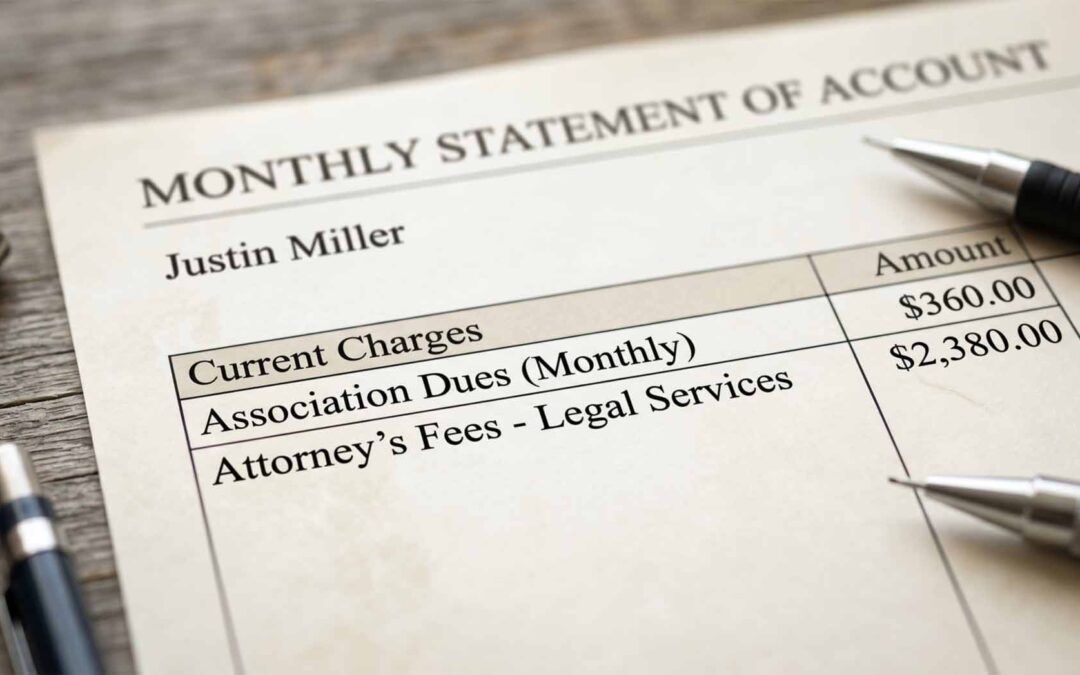
When a California homeowner opens an HOA account statement and finds that the HOA has charged its legal fees to that account, the threshold question is whether the HOA had any authority to put them there. After all, it should go without saying that an HOA can’t impose whatever charges it likes. On the contrary, an HOA may only post a charge against an individual account only when a statute or the governing documents grant that power, and a legal fee that rests on neither isn’t a debt the homeowner owes.
The confusion driving most of these disputes is the gap between charging legal fees and recovering them. An HOA recovers its attorney’s fees by prevailing in litigation and persuading a court or arbitrator to award them. It can’t manufacture that same outcome on its own by adding a line item to a homeowner’s ledger. So an HOA that bills its lawyer’s time to a homeowner’s account before any court has weighed in is usually reaching for a result the law makes available only to the winner of a lawsuit.
That being said, there are a few narrow paths that can make such charges legitimate, and homeowners should know them so they can tell a lawful charge from an abusive one. The governing documents sometimes authorize an HOA to pass certain legal costs directly through to an owner, though that authority is narrower and more constrained than bad HOAs often claim. Separately, when an HOA collects a genuinely delinquent assessment, the Davis-Stirling Act lets it add the reasonable cost of collection, including attorneys’ fees, without first going to court. Outside those situations, the consultation fees, enforcement fees, and legal-review charges that bad HOAs frequently drop onto account statements are simply illegal.
This Fact Sheet explains when an HOA may lawfully charge legal fees to a homeowner’s statement or account, when it may not, the difference between fees an HOA collects in a true delinquency and fees it can only recover by winning in court, the procedural limits that apply even when an HOA claims a disciplinary basis for a charge, and the steps a homeowner should take after an unauthorized legal fee appears on their statement.
Key Points
Whether an HOA can charge its legal fees to a homeowner’s account depends entirely on authority. The Davis-Stirling Act and an HOA’s governing documents define the narrow circumstances in which a legal charge can stand, and everything outside those circumstances fails. The points below sort legal charges into the categories that decide their legitimacy, the fees an HOA can only recover by winning in court, the collection costs it may add to a genuinely past-due account, and the disciplinary charges hemmed in by strict procedural rules. They also explain how to recognize the charges that have no legal footing at all, and what a homeowner should do if such illegal charges land on a statement.
- HOAs need affirmative legal authority before they can post any charge for legal fees to a homeowner’s account. HOAs hold only the powers that California law and their governing documents grant them, so every charge they impose has to trace back to one of those sources. At the center of this principal is the American Rule, under which each side pays its own legal fees unless a statute or an enforceable contract provision shifts that burden. HOAs that can’t point to a statute or a governing-document provision authorizing a legal charge have no basis to impose it, and the homeowner owes nothing on it. This is why the first response to any legal fee on a statement is to ask which specific authority the HOA claims supports it.
- Legal fees tied to a dispute shift only when a homeowner or an HOA wins in court, never by the HOA’s own decision. In an action to enforce the governing documents, Civil Code 5975 awards reasonable attorneys’ fees to the prevailing party, but that award comes from a judge or an arbitrator after someone wins, not from an HOA writing the fees onto a ledger. HOA boards cannot charge homeowners to consult the association’s attorney about a dispute with that owner, send a demand letter, or have counsel prepare for a hearing. The fee-shifting statutes that govern who pays whom after an HOA lawsuit are their own subject, and they carry very different risk depending on which such fee-shifting statute applies. [For a full breakdown of which statutes let homeowners recover their fees, and how much risk to the homeowner each one carries, read my Fact Sheet “When Can You Recover Attorney Fees from Your California HOA? Key Laws Explained.”]
- A CC&R provision that authorizes enforcement fees doesn’t let an HOA bill those fees to an account at will, and it cuts both ways. Some CC&Rs contain a clause allowing the HOA to recover the attorneys’ fees it incurs enforcing the governing documents, and HOAs lean on that language to justify charging an owner for a demand letter or a disciplinary matter. That clause matters less than HOAs claim, for three reasons. California courts treat CC&Rs as contracts, so a fee provision in them is a litigation recovery mechanism, which means the fees get fixed by a court for the party that prevails in an enforcement action, not self-declared by the HOA and posted to a ledger before anyone has won anything. Civil Code 1717 then makes that provision reciprocal as a matter of law even when the CC&Rs are written to favor only the HOA, so a homeowner who disputes the charge and prevails can turn the HOA’s own fee clause around and recover their own attorneys’ fees. And the provision still can’t reach a charge imposed before any violation has been found, nor can it convert a disciplinary penalty into a lienable assessment, because Civil Code 5855 and Civil Code 5725 continue to apply regardless of what the CC&Rs say. A board-adopted rule purporting to authorize fee charges is weaker still, because the board can’t grant itself through its rules a recovery power the recorded CC&Rs and the Davis-Stirling Act don’t provide.
- A hearing and an adverse finding still don’t let the HOA charge you its attorneys’ fees. Bad HOAs assume that if they hold a Civil Code 5855 hearing and rules against a homeowner, the attorney’s time for the demand letter (if any) and attending the hearing becomes a chargeable cost on the homeowner’s statement of account. It doesn’t. A disciplinary hearing produces discipline, meaning a monetary penalty for the violation if the CC&Rs authorize fines and the board followed the Civil Code 5855 process. It doesn’t produce an attorneys’ fees award. A CC&R fee clause is a contract provision that, under Civil Code 1717, gets enforced by a court fixing fees for the prevailing party in an action on the contract, and the board can’t sit as both the prevailing party and the judge who awards the fees. Civil Code 5725 drives the same point home, because even a valid disciplinary penalty can’t be treated as a lienable assessment, so the attorney’s time can’t ride along inside the penalty either. The board can fine you for the violation. It can’t convert its lawyer’s bill into part of that discipline.
- The clearest route that lets HOAs add legal costs to an account without going to court is the collection of a genuinely delinquent assessment. Civil Code 5650 makes a past-due assessment a debt of the owner and allows HOAs to recover the reasonable costs of collecting it, including reasonable attorneys’ fees. This authority, however, is narrow. It applies only to the collection of an actual delinquency, the fees have to be reasonable and genuinely tied to the collection efforts, and Civil Code 5600 bars HOAs from imposing any charge that exceeds the amount necessary to cover the actual cost it’s meant to defray. Thus, an HOA facing a past-due assessment may add the attorneys’ fees incurred in their collection efforts, but an HOA that “creatively” attempts to brand a dispute over a fine or an architectural issue as a collection, and then adds on legal fees, may not.
- The disciplinary label HOAs reach for doesn’t authorize charging legal fees. Bad HOAs routinely recast their legal fees as an enforcement or disciplinary charge, but discipline never converts an HOA’s own attorneys’ fees into a permissible penalty. In other words, calling a legal charge “disciplinary” gives it no footing it wouldn’t otherwise have. The disciplinary process is hemmed in tightly by the statutes governing the process. Civil Code 5855 requires HOAs to give a member at least 10 days’ written notice before a meeting to consider discipline or a monetary charge, to let the member attend and respond, and to allow the member a chance to cure. Under Civil Code 5725, any fines imposed on a homeowner after properly following the Davis-Stirling Act’s due process requirements cannot be treated as anything other than a fine. This is intended to prevent bad HOAs from relabeling fines as assessments, which when unpaid, can lead to liens and non-judicial foreclosures.
- A homeowner who spots an unauthorized legal fee on their statement of account should immediately challenge the charge in writing. An improper charge rarely disappears on its own, and staying silent can let it grow with late fees and interest, so a homeowner should move deliberately through the steps below to challenge the charge while protecting every right along the way.
- Demand the legal authority and an itemized basis in writing. A homeowner should send a written request asking the HOA to identify the exact statute or governing-document provision that authorizes the charge, along with an itemized invoice (even if partially redacted to preserve privilege) showing that the HOA’s lawyer performed the work and how much time the lawyer billed. HOAs that can’t or won’t produce that authority have effectively conceded the charge has no footing.
- Pay a disputed assessment under protest, and treat a disputed fine differently. When the charge is a regular or special assessment, a homeowner should pay it no matter what. Always pay assessments, no matter how illegal they may be. Then protest. You can always get your money back. A disputed fine, on the other hand, sits differently, because Civil Code 5725 bars HOAs from treating a disciplinary penalty as an assessment. So a homeowner should pay under protest whenever the HOA is treating the disputed amount as a lienable assessment, can stand firmer on a fine the HOA has properly kept separate, and in both cases should dispute the charge in writing rather than let it stand. [If you haven’t read my Fact Sheet, “Can You Stop Paying Disputed HOA Dues in California?,” I urge you to do so.]
- Use the dispute resolution procedures the Davis-Stirling Act allows (or requires). A homeowner can request internal dispute resolution (IDR) under Civil Code 5910, and I recommend doing so if the homeowner believes that the HOA may act reasonably. Otherwise, IDR is a waste of time. In those cases where Civil Code 5930 requires ADR (i.e., in the context of the Davis-Stirling Act, this means mediation), homeowners should demand ADR. Even if the case doesn’t settle at mediation, at the very least, a homeowner will have a good idea of what legal position the HOA will take if the homeowner files a lawsuit. [To learn more about when ADR is required under Civil Code 5930, read my Fact Sheet “California HOA Mediation: When ADR Is Mandatory Under Civil Code 5930.”]
- If applicable, sue in small claims court to recover the charge. Civil Code 5658 lets a homeowner who paid under protest bring the dispute to small claims court, where the individual limit is currently $12,500, no attorney is required, and the homeowner can show the judge that no court awarded the fees and no provision authorized the charge on the homeowner’s HOA account. [Keep in mind that cases filed in small claims court also exempt from Civil Code 5930’s ADR requirement.]
- Homeowners facing legal charges on their HOA statement of account should call the HOA attorneys at MBK Chapman. A surprise legal fee on a homeowner’s account often signals a broader problem, a bad HOA that is willing to violate the law to apply pressure or exert authority over a homeowner needs to be dealt with swiftly and firmly. The HOA attorneys at MBK Chapman are widely considered the most experienced and well-trained homeowner-side HOA attorneys in California, and they have deep knowledge about what the Davis-Stirling Act requires before HOAs can charge or recover a single dollar in attorneys’ fees.
An HOA’s authority to charge legal fees begins and ends with the Davis-Stirling Act and the governing documents. Unfortunately, this hasn’t stopped bad HOAs from ignoring the law and attempting to foist legal fees on unsuspecting homeowners. The dividing line is straightforward, however, and once a homeowner understands the law’s limitations, it becomes easy to spot illegal attempts to charge legal fees.
FAQs
Can my HOA charge me for its attorneys' fees without going to court?
Only in narrow circumstances. California follows the American Rule, so an HOA needs a statute or a governing-document provision authorizing the charge before it can post your legal fees to your individual homeowner’s account. The main statutory route is a genuinely delinquent assessment, where Civil Code 5650 lets the HOA add the reasonable costs of collection, including reasonable attorneys’ fees. Outside that, an HOA can’t bill you for its lawyer’s time just because it consulted counsel about your dispute, sent you a demand letter, or held a hearing.
My HOA added its legal fees to my homeowner account after a dispute. Is that legal?
Almost never. Legal fees tied to a dispute shift only when someone wins a lawsuit and a court or arbitrator awards them under Civil Code 5975 (or another fee-shifting provision of the Davis-Stirling Act). An HOA can’t reach that result on its own by adding a line item to your ledger before any case has been filed or decided. So when an HOA bills you for its attorneys’ fees over an enforcement disagreement, an architectural denial, or a rule fight, with no court ruling behind it, they’re wrong, and you should fight the charge immediately.
Can my HOA charge me legal fees as part of disciplining me for a violation?
No. Calling a legal charge “disciplinary” or “enforcement” gives it no footing it wouldn’t otherwise have, because discipline never converts an HOA’s own attorneys’ fees into a permissible penalty. The disciplinary process is also tightly limited.
What should I do if my HOA charges me legal fees I don't think I owe?
Ask in writing for the exact statute or governing-document provision that authorizes the charge, along with an itemized invoice from the attorney (even if redacted). If the charge is part of a regular or special assessment, pay it under protest under Civil Code 5658 to stop late fees, interest, and lien exposure while you dispute it, since an unpaid assessment can lead to foreclosure. A standalone fine doesn’t carry that same pressure From there, you can try IDR under Civil Code 5910 or sue in small claims court, where the individual limit is currently $12,500. If the fees are over that amount, you may need to offer ADR under Civil Code 5930 before you can sue.

About Michael Kushner
Michael Kushner is a California attorney with over 30 years of experience representing homeowners in disputes with their HOAs. He is widely regarded as California’s leading homeowner-side HOA attorney, and has built one of the state’s most prominent law practices dedicated to holding HOAs accountable under the Davis-Stirling Act and California law.
In addition to his law firm’s work, Michael is a recognized lecturer, author, and the host of the hit HOA HELL podcast, where he provides homeowners living in HOA-governed communities with clear, practical strategies for dealing with bad HOAs. He’s also the author of the best-selling book, HOA HELL | California Homeowners’ Definitive Guide to Beating Bad HOAs, which has become a go-to resource for both homeowners seeking real-world solutions to their HOA disputes, as well as those good HOA board members who are interested in doing a good job.
About MBK Chapman Fact Sheets
Homeowners searching for answers online will often come across articles that appear authoritative, but are actually written as search-engine marketing content rather than by an experienced HOA lawyer. These pieces tend to prioritize keyword density over clarity, accuracy, or legal context, which often leaves homeowners more confused than informed.
At MBK Chapman, our Fact Sheets are part of our HOA Law Library and are written by Michael Kushner, an HOA lawyer with decades of hands-on experience representing California homeowners. In fact, Michael Kushner is the HOA lawyer who pioneered the systems and strategies used by some of California’s most successful homeowner-side HOA law firms.
Each Fact Sheet is deliberately concise, statute-based, and designed as a quick-reference guide to help homeowners understand key HOA laws and enforcement rules at a glance.
AND DON’T FORGET TO TUNE INTO MY PODCAST, HOA HELL
YOU CAN ALSO ORDER MY GROUNDBREAKING BOOK
HOA HELL | California Homeowners’ Definitive Guide to Beating Bad HOAs
Amazon | Barnes & Noble
