
Overview
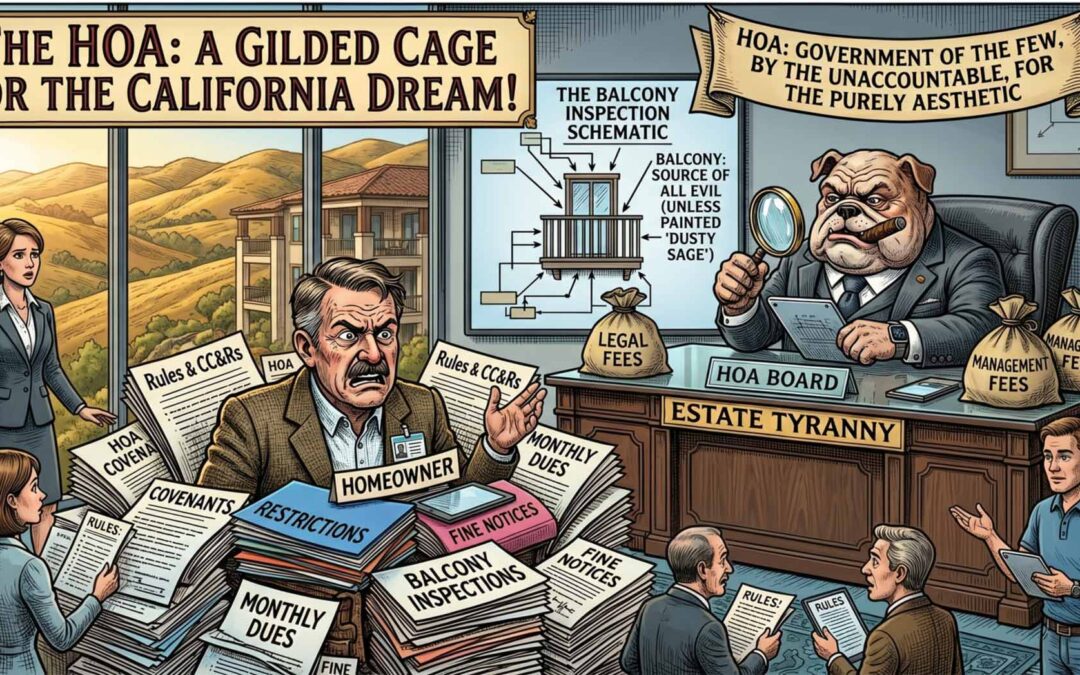
Based on the volume of comments I’ve received from our Reddit account and listeners to my podcast, HOA HELL, who bluntly write things like “Fuck HOAs,” “You’re stupid to buy into an HOA,” “Who would ever live in an HOA community,” and “HOAs should be banned,” I have a feeling that a lot of Californians share the same sentiment. To be sure, behind most of those comments sits a real grievance, a fine that felt arbitrary, an abuse HOA director, a bad HOA board that ignored a repair request for months, a special assessment that landed without warning, or a rule the HOA enforced against one owner and quietly waived for another.
Not everything frustrated homeowners tell each other carries equal weight. Some of the advice homeowners trade in those threads is sound, like the warning to read the governing documents and disclosures before closing escrow, which spares buyers from inheriting problems they never saw. Other claims are defeatist myths, like the blanket assertion that suing an HOA guarantees the homeowner pays for it in the end, a warning that ignores the fee-shifting the Davis-Stirling Act and most governing documents build in.
Frustration with a bad HOA is rational, and a homeowner who feels it has usually earned it. What follows the frustration does the lasting damage. Many homeowners conclude that fighting a bad HOA is pointless, that the HOA holds every card, and that the safer move is to absorb the treatment and stay quiet. That resignation has a name, learned helplessness, and bad HOAs want it and count on it, because a homeowner who believes resistance is futile stops resisting, and the misconduct continues unchecked. The Davis-Stirling Act, when understood and used property, tells a different story, handing homeowners far more leverage than the venting on YouTube, Reddit, or Google and in comment threads suggests.
This Fact Sheet explains why so much of the anger directed at California HOAs is justified, which of the common warnings homeowners repeat actually protect them, which widely shared beliefs are myths that serve the HOA rather than the homeowner, and how the Davis-Stirling Act equips homeowners to push back when a bad HOA needs a beating.
Key Points
The anger aimed at California HOAs splits into two very different categories, and telling them apart decides whether a homeowner stays stuck or gets results. Some of that anger tracks genuine misconduct the Davis-Stirling Act forbids. Some of it hardens into folk wisdom that sounds protective but quietly keeps homeowners from using the rights they already hold. The points below separate the legitimate grievances from the myths, expose the beliefs that serve bad HOAs at the homeowner’s expense, and show where the law hands homeowners real leverage against a bad HOA board that counts on them not knowing any better.
- The fury aimed at bad HOAs reflects real misconduct, not oversensitivity. When homeowners flood Reddit, Google, and podcast comment sections with their contempt for HOAs, they’re usually reacting to conduct the Davis-Stirling Act prohibits outright. Civil Code 4775, for example, obligates HOAs to maintain, repair, and replace the common areas, so an HOA that ignores a leaking roof or a crumbling stairway for months isn’t exercising discretion, it’s neglecting a statutory duty. Civil Code 5850 and Civil Code 5855 forbid HOAs from imposing fines without a published penalty schedule and without first giving the owner notice and a hearing, so the “arbitrary fine” homeowners rage about is frequently an unlawful one. Civil Code 5605 bars HOAs from levying large assessment increases or special assessments without a membership vote, which means the surprise five-figure bill that blindsides an owner often broke the very law meant to prevent it. The contempt tends to track actual legal violations, not hurt feelings.
- A commonly repeated comment advising homeowners to read their disclosures before escrow closes, is the one worth taking seriously. Among the warnings homeowners frequently trade online, the instruction to read the governing documents and disclosures before closing escrow is sound, and it carries statutory teeth. Civil Code 4525 requires the seller to deliver a defined package of disclosures before the sale closes, including the CC&Rs, the bylaws, the operating rules, the budget, the reserve study, the assessment and fee schedule, the recent board meeting minutes, and any notice of pending litigation or anticipated special assessment. A buyer who reads that package closely can spot an underfunded reserve, a looming assessment, a litigation cloud, or a pattern of dysfunction before signing rather than inheriting it afterward. The homeowners warning others to read the disclosures learned this lesson the hard way, and they’re right to pass it on.
- The claim that anyone who buys into an HOA is a fool overstates a real point until it curdles into a myth. The insults aimed at HOA buyers, that they’re stupid, that they’re dumb, that no sane person would live in an HOA community, bury a legitimate warning under a false conclusion. The legitimate warning is that HOA living comes with binding obligations and real financial risk, so buyers have to investigate before they commit. The false conclusion is that HOA membership is inherently a trap to avoid at all costs, which ignores that a large and growing share of California’s housing stock sits inside common interest developments, leaving many buyers no realistic alternative. A bad HOA that breaks the rules causes the damage, not the decision to buy into a common interest development in the first place, and the Davis-Stirling Act arms the owner of even the worst HOA with tools the insult never mentions.
- The belief that suing an HOA always backfires on the homeowner is the most damaging myth of all, and the Davis-Stirling Act routinely disproves it. The warning that a homeowner who sues will “pay for it in the long run” circulates so widely that owners swallow abuse rather than test it. The Davis-Stirling Act tells a different story. Civil Code 5975 makes the governing documents enforceable as equitable servitudes and awards reasonable attorneys’ fees and costs to the prevailing party in an action to enforce them, so a homeowner who wins an enforcement action can shift the legal bill onto the HOA instead of absorbing it. Civil Code 5235 does the same in records disputes, letting a prevailing homeowner recover costs and fees plus a penalty of up to $500 for each separate failure to produce records. [If you’d like to read more about the different fee-shifting provisions available in the Davis-Stirling Act, read my Fact Sheet “When Can You Recover Attorney Fees from Your California HOA? Key Laws Explained.”]
- The resignation that sets in after the anger is exactly what bad HOAs want and count on. Once a homeowner accepts the myths, that buying into an HOA was foolish, that fighting a bad HOA is pointless, that the HOA holds every card, the anger curdles into surrender. That surrender has a name, learned helplessness, and bad HOAs depend on it. Bad HOAs depend on learned helplessness from their members because a homeowner who believes resistance is futile stops sending demand letters, stops attending meetings, stops challenging illegal fines, and stops requesting records. Every owner who goes quiet lets the misconduct continue and emboldens the next illegal act and abusive altercation. A bad HOA board would rather face a hundred resigned owners than one who knows the Davis-Stirling Act, because the resigned owner costs it nothing while the informed owner can cost the board members an election or even a lawsuit.
- A homeowner who wants out of that trap should convert frustration into a documented, statute-based record. Anger by itself changes nothing, but anger channeled through the procedures of the Davis-Stirling Act forces a bad HOA to respond in a predictable way. The steps below turn a venting homeowner into one a bad HOA can’t safely ignore.
- Put every complaint and request in writing, and keep proof. A homeowner should stop raising issues verbally in hallways and parking lots and start submitting written requests, complaints, and records demands, keeping a dated copy of each. A paper trail converts a he-said-she-said grievance into evidence, and it starts the clock on the strict response deadlines the Davis-Stirling Act imposes on HOAs.
- Use the dispute resolution procedures the law guarantees. Civil Code 5900 requires HOAs to offer a fair internal dispute resolution process, and Civil Code 5930 requires the parties in certain types of enforcement actions to attempt alternative dispute resolution before filing. At the very least, engaging in IDR helps the homeowner understand the arguments the HOA intends on relying upon.
- Demand the records. Civil Code 5200 entitles members to inspect and copy a wide variety of associations records, and a targeted records request frequently surfaces the budget shortfall, the legal bill, or the board decision driving the conduct the homeowner is fighting. [I wrote an entire series of Fact Sheets about the power of Civil Code 5200. If you’re interested in exercising your rights under that statute, you should read them. Start with this one: “Can I See My California HOA’s Records? A Homeowner’s Guide to Civil Code 5200.” You can find links to the others in that document.]
- Organize other owners and use the election process. A single frustrated owner is easy to dismiss, but an organized bloc of owners is not, and the Davis-Stirling Act protects the tools that bloc needs. Civil Code 5105 requires HOAs to run elections under fair procedures, Civil Code 5145 lets a member sue to challenge an election that broke the rules, and a recall or a competing slate of directors can replace a board that refuses to follow the law. Homeowners who pair a documented record with organized pressure change outcomes no individual complaint ever could. [You can find valuable information about using the recall process by reading my Fact Sheet, “HOA Recall Election in California: Step-by-Step Guide for Homeowners.”]
The contempt so many California homeowners feel toward their HOA is earned, but contempt by itself protects no one. The homeowners who escape the worst of HOA living aren’t the ones who vent the loudest. They’re the ones who learn to tell a legitimate warning from a self-defeating myth, then put the Davis-Stirling Act to work. A bad HOA’s power rests almost entirely on owners who never test it, which is why the informed homeowner is the one a bad HOA fears, and using the law against a bad HOA is the part that changes anything.
FAQs
Is there good reason for a lot of homeowners to hate their HOAs?
Yes, there are a lot of really bad HOAs out there. Homeowners who despise their HOA are typically reacting to conduct the Davis-Stirling Act already prohibits, like an HOA that arbitrarily refuses to let them make improvements to their home in violation of Civil Code 4775, ignores its duty to maintain the common areas under Civil Code 4775, imposes fines without the notice and hearing Civil Code 5850 requires, or levies a large special assessment without the membership vote Civil Code 5605 demands. Such behavior is understandably enraging.
If I sue my HOA, will I just end up paying for it in the long run?
Not necessarily, and treating that as a certainty is the myth that keeps homeowners passive. The Davis-Stirling Act awards reasonable attorneys’ fees and costs to the prevailing party in an action to enforce the governing documents under Civil Code 5975. That, and the numerous other fee-shifting statutes peppered throughout the Davis-Stirling Act go a long way toward shifting power and leverage back to the knowledgeable homeowner.
Is it stupid to buy a home in an HOA community?
Not if you like the home and the neighborhood, though buyers do need to investigate before they commit. Civil Code 4525 requires the seller to deliver a disclosure package before escrow closes, including the CC&Rs, the bylaws, the operating rules, the budget, the reserve study, the assessment schedule, recent meeting minutes, and any notice of pending litigation or a coming special assessment. A buyer who reads that package carefully can spot an underfunded reserve or a dysfunctional board before signing. A bad HOA that breaks the rules causes the harm, not the decision to buy into an HOA.
What's the best way to fight back against a bad HOA?
Stop raising issues verbally and start building a documented, statute-based record. Put every complaint and request in writing and keep dated copies, invoke the dispute resolution procedures the HOA must offer under Civil Code 5900 and the alternative dispute resolution Civil Code 5930 requires before certain enforcement lawsuits, and demand the association records Civil Code 5200 entitles you to inspect. Organizing other owners and using the election/recall provisions in Civil Code 5105 multiplies that pressure, because a bad HOA can dismiss one frustrated owner far more easily than an informed, organized bloc.

About Michael Kushner
Michael Kushner is a California attorney with over 30 years of experience representing homeowners in disputes with their HOAs. He is widely regarded as California’s leading homeowner-side HOA attorney, and has built one of the state’s most prominent law practices dedicated to holding HOAs accountable under the Davis-Stirling Act and California law.
In addition to his law firm’s work, Michael is a recognized lecturer, author, and the host of the hit HOA HELL podcast, where he provides homeowners living in HOA-governed communities with clear, practical strategies for dealing with bad HOAs. He’s also the author of the best-selling book, HOA HELL | California Homeowners’ Definitive Guide to Beating Bad HOAs, which has become a go-to resource for both homeowners seeking real-world solutions to their HOA disputes, as well as those good HOA board members who are interested in doing a good job.
About MBK Chapman Fact Sheets
Homeowners searching for answers online will often come across articles that appear authoritative, but are actually written as search-engine marketing content rather than by an experienced HOA lawyer. These pieces tend to prioritize keyword density over clarity, accuracy, or legal context, which often leaves homeowners more confused than informed.
At MBK Chapman, our Fact Sheets are part of our HOA Law Library and are written by Michael Kushner, an HOA lawyer with decades of hands-on experience representing California homeowners. In fact, Michael Kushner is the HOA lawyer who pioneered the systems and strategies used by some of California’s most successful homeowner-side HOA law firms.
Each Fact Sheet is deliberately concise, statute-based, and designed as a quick-reference guide to help homeowners understand key HOA laws and enforcement rules at a glance.
AND DON’T FORGET TO TUNE INTO MY PODCAST, HOA HELL
YOU CAN ALSO ORDER MY GROUNDBREAKING BOOK
HOA HELL | California Homeowners’ Definitive Guide to Beating Bad HOAs
Amazon | Barnes & Noble
