
Overview
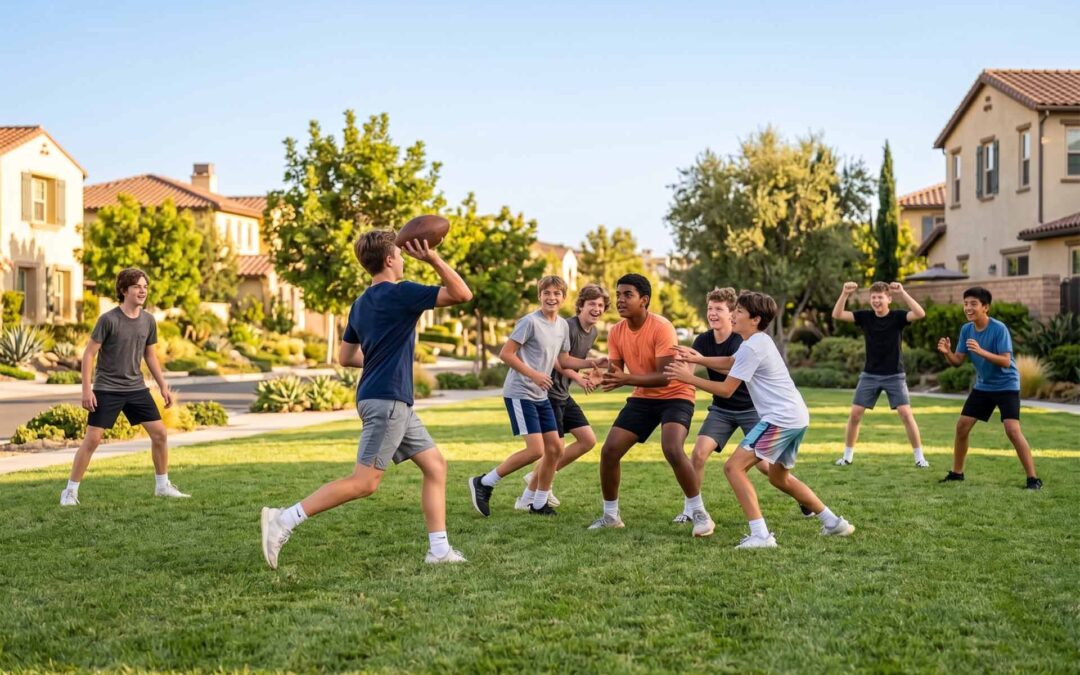
Bad HOA boards across California routinely tell parents that their kids can’t play on the common area grass, can’t ride their bicycles anywhere in the common area, or tell residents that they can’t gather a group for recreation in the community park. Many homeowners wrongly assume their HOAs have that power. The truth, however, is that HOAs typically do not have that power. Members and their guests hold the right to use the common area for ordinary recreation, and your HOA needs a real, objectively reasonable basis to restrict that use.
It all comes down to a distinction that bad HOA boards work hard to blur, i.e., the difference between casual play and organized play. Casual, unorganized recreation sits at the protected end of the spectrum. Kids riding bikes, a pickup basketball game, a parent tossing a baseball with their child, or a few friends practicing yoga on the grass all qualify as the ordinary use the common area exists to serve. Organized play is where an HOA sometimes gains legitimate footing, but not for the reasons most HOA board members might assume. Neither money nor headcount, standing alone, decides the question.
What drives the line is a handful of practical factors. The intended purpose of the specific common area matters most because banning soccer on a designated turf field is far harder to justify as remotely reasonable than restricting it on an ornamental entry lawn. Whether the activity monopolizes shared space so that other residents are frozen out matters too, as does the real-world impact of noise, parking overflow, turf damage, and safety. Commercial use sits in its own category because a paid instructor or trainer running sessions on the common area triggers a separate and stronger restriction that has nothing to do with whether the activity counts as “play.” Through all of it, one distinction controls your leverage. An HOA can regulate use through reservations, group-size limits, or set hours far more easily than it can ban ordinary recreation outright.
This Fact Sheet explains when your California HOA can and can’t restrict play in the common areas, where casual play ends and organized play begins, why an outright ban on your kids playing is something that no HOA will be able to defend, and how the reasonableness standard built into the Davis-Stirling Act constrains what your HOA board may do. It walks through concrete examples on both sides of the line and lays out the practical steps you should take when your board crosses it, including the extra steps available to parents whose kids are the ones being singled out. [Those extra steps exist because a rule aimed at children does more than touch on typical restrictions on common area use. It triggers familial status protections under federal and state fair housing law, and those protections hand parents some of the strongest leverage available against a bad HOA board.]
Key Points
California HOAs hold genuine authority over their respective common areas, but that authority runs out long before most bad HOAs admit. Play is one of the areas where bad boards overreach the most, partly because they assume that owning and maintaining the common area lets them dictate exactly how residents enjoy it. The points below map the full terrain, from the baseline right you and your kids start with, through the narrow situations where an HOA gains real footing, to the extra protections that attach the moment a rule actually targets children.
- Your kids, your guests, and you have a baseline right to use the common area for ordinary recreation, and your HOA needs an objectively reasonable basis to take that away. Under Civil Code 4500, the common area belongs to all owners together, and the right to use it for ordinary purposes, including everyday recreation, comes with that shared ownership. That means your starting position isn’t that play is forbidden until the HOA allows it. It’s the reverse. Play and recreation are permitted unless your HOA can point to a legitimate, reasonable basis to restrict those uses. The burden sits on your HOA board to justify a restriction, not on you to justify letting your kids play outside. Any conversation with your HOA should begin from that baseline because it controls who has to prove what.
- Civil Code 4350 requires every common area restriction to be reasonable. An HOA can’t make a rule enforceable just by adopting it and announcing it. Under Civil Code 4350, an operating rule is valid only if it’s reasonable, which means it must connect rationally to a legitimate HOA purpose, can’t be arbitrary, and has to apply evenhandedly across the community. A rule that restricts how residents play in the common area, especially when it comes to children, has to clear that same bar. When the burden a rule imposes on normal residential life outweighs whatever benefit the HOA claims, the rule fails the reasonableness test and your HOA can’t enforce it no matter how confidently the board cites its own authority. [You can read more on HOA rulemaking powers by reading my Fact Sheet, “HOA Rules in California: Legal Authority and Rulemaking Limits.”]
- Your HOA can regulate how you use the common area far more easily than it can ban you from using it at all. This distinction controls your leverage in almost every dispute. An HOA can adopt reasonable, evenhanded rules that channel use, like requiring reservations for the field, capping group sizes, setting hours, or asking larger gatherings to sign up in advance, and those kinds of rules usually survive because they manage common area use without eliminating it. An outright ban on ordinary recreation is a different animal, and it almost always fails the reasonableness standard contained in Civil Code 4350 because it destroys the underlying right instead of organizing it.
- Casual, unorganized play sits at the protected end of the spectrum. Kids riding bikes, a pickup basketball game, a parent throwing a baseball with their child, a few friends doing yoga on the grass, kids running around and inventing games, all of this is the common area doing exactly what it exists to do. None of it monopolizes shared space, none of it carries a commercial element, and none of it imposes the kind of impact that gives an HOA a legitimate reason to step in. A rule that sweeps in this ordinary recreation collapses under Civil Code 4350 because the burden of shutting down everyday residential life dwarfs any benefit your HOA could realistically claim. This is the category bad HOAs most often try to regulate, and it’s the category they’re least equipped to defend. [You might enjoy watching a 90-second short from my podcast, HOA HELL, titled “Can Your HOA Ban Yoga or Stretching in Your Front Yard? The Law on HOA Aesthetic Overreach,” where I discussed how some bad HOAs even try controlling “play” behavior on a resident’s private property.”]
- Where casual play ends and organized play begins comes down to a handful of practical factors. Bad HOAs choose to rely on the wrong test. They assume that paying someone, or having a lot of people, automatically converts protected recreation into something they can ban. It doesn’t. A large group can be perfectly fine and a small one can cross the line, depending on the factors below. Three things actually move an activity from the protected end toward the restrictable end, and an HOA needs at least one of them before it has any real footing.
- The intended purpose of the specific common area is a critical factor. A space designed and built for a given activity is one your HOA can’t easily keep you from using for that activity. Soccer on a designated turf field is the field performing its function, so banning it is close to indefensible. That same soccer game on the manicured ornamental lawn at the community entrance is a different question because that space was arguably never meant to absorb it. Neither the activity nor the number of participants changes, but the reasonableness of restricting it shifts entirely based on what the area was built for.
- Your HOA can typically defend its rulemaking authority when an activity monopolizes common areas by freezing out other residents. The legitimate worry isn’t that you’re using the common area. It’s that your use ties up a part of the common area so completely that other residents can’t use it at all. A team that occupies the community’s only field every Tuesday and Thursday from 5:00 p.m. to 6:30 p.m. effectively locks everyone else out of that field during those hours, and equal access to shared space is something your HOA can reasonably protect. Occasional or rotating use monopolizes nothing, so frequency by itself, without that lockout effect, gives your HOA very little to stand on. The flip side is also true—declining to let others join your activity does not necessarily constitute monopolizing the common area. Declining to let an outsider join a private activity, like a yoga group that doesn’t want a stranger dropping in, or kids who don’t want an unknown adult or older kids to join their game, doesn’t equate to tying up shared space.
- The real-world impact of the activity also factors strongly into the reasonableness of the rule. Tangible, demonstrable impacts are what give an HOA legitimate room to regulate, and the bigger and more disruptive the impact, the more footing your HOA gains. A recurring activity that floods the streets with spectator parking, tears up the turf, or generates genuine noise or safety concerns or complaints hands your board real, articulable basis to set restrictive rules. A few kids playing on the grass generates none of that. Your HOA has to identify a concrete impact, not a hypothetical one, because a theoretical worry about wear or disturbance won’t satisfy the reasonableness standard contained in Civil Code 4350.
- A genuine, evidence-based safety concern can give your HOA real footing, but a vague or invented one can’t. California law lets an HOA regulate the common area to protect health and safety, so a concern backed by something concrete, like an actual hazard tied to a specific activity in a specific spot, can support a reasonable restriction. The catch is that your HOA has to identify a real and articulable danger, not gesture at a theoretical one. “Someone could get hurt” describes every activity ever invented, so an HOA that can’t point to anything more specific than that hasn’t justified anything. Safety is the excuse bad HOAs reach for most often precisely because it sounds unanswerable, but under the Civil Code 4350 reasonableness standard it has to rest on credible evidence and the restriction has to actually fit the risk. So, a rule regarding adult supervision of children under a certain age while using the pool could easily pass the reasonableness test, while a rule requiring all minors to be supervised at all times, regardless of the nature of the activity, wouldn’t.
- Your HOA’s insurance and liability concerns are legitimate, but they justify managing an activity, not banning ordinary play. Bad HOAs often invoke insurance, telling residents that the carrier “won’t allow” a given activity or that the HOA’s liability exposure forces its hand. Sometimes there’s a real underwriting concern, especially with organized contact sports, large recurring events, or activities that draw crowds and outside participants. But a legitimate insurance concern almost always points toward reasonable management, like requiring a reservation, capping group size, or asking an organized league to carry its own coverage, rather than toward an outright ban on everyday recreation. An HOA that claims insurance forces it to prohibit your kids from riding bikes or kicking a ball on any common areas as opposed to, say, certain portions of the common area, has almost certainly stretched a real concept past its breaking point.
- Paying an instructor or trainer changes everything because commercial use is a separate and stronger basis for restriction. Practicing yoga with some friends on the grass is protected recreation, but the moment you pay an instructor to run that same session in the same spot, the activity becomes commercial use of the common area. Most CC&Rs prohibit running a business or commercial activity on common property, so the paid version trips that wire on its own terms. HOAs never have to win the argument over whether group yoga counts as organized play because it can regulate the commerce instead of the activity. That’s why a paid boot camp, a fee-based fitness class with outside clients, or a personal trainer monetizing the greenbelt can be barred while the unpaid version of the identical activity stays protected. The HOA in such a case is regulating the business, not the exercise.
- No HOA in California can defend an outright ban on your kids playing in the common area. A flat rule that children can’t play in the common area, that kids must be supervised by an adult at all times with no relation to the nature or safety-related concerns of the activity, or that target children on bikes and skateboards, or the use of balls or toys, fail on two independent grounds at once. It collapses under the Civil Code 4350 reasonableness standard because it shuts down normal residential life for no benefit that comes close to justifying it. It also operates as a restriction aimed squarely at families with children, which crosses directly into territory involving both federal and state family discrimination laws. Even when bad HOAs attempt to dress such rules up as “safety” measures they routinely fail because a restriction that functionally tells families their kids can’t be kids in the community where they live is one no HOA will be able to defend.
- A rule that targets families with children triggers familial status protections that hand parents some of the strongest leverage available against a bad HOA. When a play restriction targets children, whether it says so on its face or whether your HOA enforces a neutral-sounding rule only against families with kids, it migrates into territory controlled by federal and state fair housing laws. Familial status is a protected category, and those protections give parents tools that go well beyond the reasonableness analysis, including the ability to bring the full weight of fair housing enforcement to bear on a bad HOA. This is why selective enforcement matters so much. An HOA that lets adults gather freely while citing only the families with children has handed those parents a discrimination claim on top of everything else. [For a breakdown of how these protections work and how to use them, read my Fact Sheet “HOA Discrimination in California: Fair Housing Act (FHA) and FEHA Protections.”]
- Here’s what you can do if your HOA board tries to shut down play in the common area. Get the restriction in writing and ask your HOA to identify the exact rule or CC&R provision it’s relying on and the specific reason it’s enforcing it. This is aimed at forcing the HOA to commit to a written justification, and its refusal often reveals it has none. Save every notice, email, and letter, and photograph or log comparable activities the HOA lets slide, since selective enforcement against your family is powerful proof of both unreasonableness and discrimination. Put your objection on the record at a board meeting and ask that it go in the minutes, and consider invoking your HOA’s internal dispute resolution process to force the board to engage. Building this record early gives you leverage to resolve the dispute and positions you to win if your HOA refuses to back down.
- If your HOA is restricting play in the common area without a legitimate, reasonable basis, call the HOA attorneys at MBK Chapman. If your HOA attempts to ban your kids from playing in any of the common areas, shuts down an ordinary gathering, or enforces a neutral rule only against families with children, don’t accept it just because the board insists it has authority. The HOA attorneys at MBK Chapman are known statewide for their deep knowledge and experience in homeowner-side HOA law, and they’re experts in forcing HOAs to comply with the laws related to rulemaking authority. If your HOA is using the common area as an excuse to push your family around, contact us and we’ll set your HOA straight.
California HOAs have the authority to manage the common area, but managing it and locking you or your kids out of it are two very different things. Casual recreation starts out protected, and your HOA has to earn its way to a restriction through the specific purpose of the space, genuine monopolization, or real and measurable impact, not through vague preferences. Paid, commercial activity stands on its own footing, and the difference between a rule that channels use and one that bans it will usually decide who prevails. When a restriction reaches your children, the reasonableness standard and fair housing law work together to give your family the strongest hand at the table. Knowing where each of these lines sits turns a board’s confident “you can’t do that” into a question you’re fully equipped to challenge.
FAQs
Can my California HOA stop my kids from playing in the common area?
No, not as a blanket rule. The common area belongs to all owners under Civil Code 4500, so your kids start with the right to use it for ordinary recreation, and your HOA needs a legitimate, reasonable basis under Civil Code 4350 to restrict that. A flat ban on children playing, or a rule that singles out bikes, balls, skateboards, and toys, fails the reasonableness standard and also operates as a restriction aimed at families with children, which pushes it into federal and state fair housing discrimination territory that no HOA is allowed to enter.
What's the difference between casual play and organized play in a California HOA?
Casual play is everyday recreation like kids riding bikes, a pickup basketball game, or a few friends doing yoga on the grass, and it sits at the protected end of the spectrum because it doesn’t tie up shared space, carry a commercial element, or impose real impact on the common area. Organized play only gives your HOA footing when one of a few specific factors is present, namely the activity doesn’t match what that piece of common area was built for, it monopolizes a shared space and locks other residents out, or it generates concrete impact like spectator parking, turf damage, or genuine safety concerns. Neither paying someone nor the size of the group decides the question by itself.
Can my HOA ban an activity just because it claims a safety or insurance concern?
Not unless the concern is real and supported by evidence. An HOA can regulate the common area to protect health and safety, but any such rule still has to satisfy the reasonableness standard required by Civil Code 4350, which means the board has to point to a concrete, articulable risk, not a generic worry that “someone could get hurt,” which describes every activity ever invented. The same goes for insurance, where a legitimate underwriting concern almost always justifies managing an activity through reservations or group limits rather than banning ordinary play outright, so a board that can’t produce specific policy language is using “liability” as a label, not a reason.
Does paying an instructor change whether my HOA can restrict an activity?
Yes, because money shifts the activity onto a separate and stronger track. Practicing yoga with friends on the grass is protected recreation, but paying an instructor to run that same session turns it into commercial use of the common area, and most CC&Rs separately prohibit running a business or commercial activity on common property. That lets your HOA regulate the commerce instead of the activity, which is why a paid boot camp or a fee-based class with outside clients can be barred while the identical unpaid version enjoys significantly more protection.

About Michael Kushner
Michael Kushner is a California attorney with over 30 years of experience representing homeowners in disputes with their HOAs. He is widely regarded as California’s leading homeowner-side HOA attorney, and has built one of the state’s most prominent law practices dedicated to holding HOAs accountable under the Davis-Stirling Act and California law.
In addition to his law firm’s work, Michael is a recognized lecturer, author, and the host of the hit HOA HELL podcast, where he provides homeowners living in HOA-governed communities with clear, practical strategies for dealing with bad HOAs. He’s also the author of the best-selling book, HOA HELL | California Homeowners’ Definitive Guide to Beating Bad HOAs, which has become a go-to resource for both homeowners seeking real-world solutions to their HOA disputes, as well as those good HOA board members who are interested in doing a good job.
About MBK Chapman Fact Sheets
Homeowners searching for answers online will often come across articles that appear authoritative, but are actually written as search-engine marketing content rather than by an experienced HOA lawyer. These pieces tend to prioritize keyword density over clarity, accuracy, or legal context, which often leaves homeowners more confused than informed.
At MBK Chapman, our Fact Sheets are part of our HOA Law Library and are written by Michael Kushner, an HOA lawyer with decades of hands-on experience representing California homeowners. In fact, Michael Kushner is the HOA lawyer who pioneered the systems and strategies used by some of California’s most successful homeowner-side HOA law firms.
Each Fact Sheet is deliberately concise, statute-based, and designed as a quick-reference guide to help homeowners understand key HOA laws and enforcement rules at a glance.
AND DON’T FORGET TO TUNE INTO MY PODCAST, HOA HELL
YOU CAN ALSO ORDER MY GROUNDBREAKING BOOK
HOA HELL | California Homeowners’ Definitive Guide to Beating Bad HOAs
Amazon | Barnes & Noble
