
Overview
Most homeowners understand that their HOA operates under governing documents, but few realize these documents exist within a strict legal hierarchy that determines which provisions control when conflicts arise. This distinction matters because HOA boards often rely on provisions in rules, architectural guidelines, or election rules that lack the legal force the HOA board claims. When a board attempts to enforce a lower-level rule that contradicts a higher-ranking document, that rule becomes unenforceable.
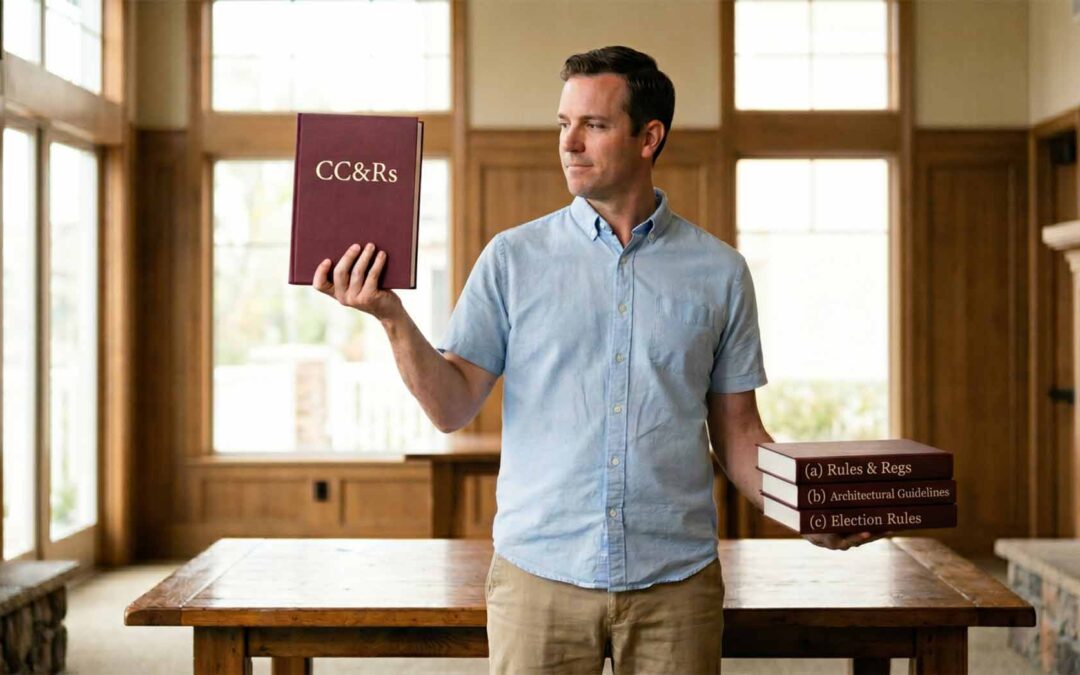
Civil Code 4205 provides the definitive ranking for every California HOA. If a governing document conflicts with federal, state, or local law, the law always controls. Within the documents themselves, the recorded CC&Rs trump the Articles of Incorporation, the Bylaws, and all other operating rules. Architectural guidelines and election rules sit at the same bottom level as standard rules and cannot override or alter rights expressly granted in the CC&Rs.
Bad HOAs frequently attempt end-runs around this hierarchy by using rules to create restrictions the CC&Rs do not authorize, avoid the membership vote required for a formal amendment, or weaken rights protected by the Davis-Stirling Act or other controlling laws. Understanding this framework allows homeowners to spot illegal board actions and challenge enforcement efforts that lack a valid legal footing.
This Fact Sheet explains how to evaluate HOA rules against the broader hierarchy of governing documents to help determine what actually controls. It identifies the common tactics bad HOA boards use to bypass Civil Code 4205 and provides the tools necessary to challenge those abuses. By utilizing the statutory protections of the Davis-Stirling Act, homeowners can successfully force their HOAs to abandon unauthorized or conflicting restrictions. [If this topic interests you, check out my Fact Sheet, “How Are CC&Rs, Bylaws, Rules, and Architectural Guidelines Different From Each Other?”]
Key Points
Civil Code 4205 establishes a strict hierarchy that determines which HOA authorities control when conflicts arise. That hierarchy prevents HOA boards from treating every rule, guideline, policy, or board practice as equally enforceable. Once homeowners understand which authorities sit higher in the hierarchy, they can quickly identify when an HOA board attempts to enforce restrictions that conflict with controlling law or higher-ranking governing documents.
- Federal, state, and local law control over every HOA governing document. Civil Code 4205 makes clear that governing documents must yield to controlling law. HOAs cannot enforce CC&R provisions, Bylaws, operating rules, architectural guidelines, election rules, or enforcement policies that conflict with federal, state, or local statutes and ordinances. This limitation matters because bad HOAs often behave as though their governing documents allow them to ignore legal protections that apply outside the HOA context. They don’t.
- The CC&Rs sit at the top of the HOA’s governing document hierarchy. Under both Civil Code 4205 and Civil Code 4350(c), after controlling law, the recorded declaration, commonly called the CC&Rs, outranks the HOA’s remaining governing documents. The CC&Rs typically establish the community’s core property rights, use restrictions, maintenance obligations, and enforcement powers. If an HOA rule, architectural guideline, election rule, or policy conflicts with the CC&Rs, the CC&Rs control. HOA boards cannot use lower-ranking documents to rewrite recorded covenants without obtaining the formal membership approval required to amend the CC&Rs themselves. [If you’d like to read about which provisions of the CC&Rs you must read, and which you can safely ignore, read my article “CC&Rs Explained: The Only Parts You Need to Read.”]
- The Articles of Incorporation and Bylaws rank above operating rules. Civil Code 4205 and Civil Code 4350(c) place the Articles of Incorporation above the Bylaws and places both above an HOA’s operating rules (sometimes referred to as Rules & Regulations). While the Articles usually address narrower corporate issues, and thus are rarely ever relevant, the hierarchy still matters because HOA boards sometimes rely on operating rules or policies that conflict with rights or procedures established in the Bylaws. When that happens, the lower-ranking provision becomes unenforceable regardless of how long the HOA has followed that particular practice.
- Operating rules occupy the lowest level of the governing document hierarchy. Operating rules exist to fill gaps, clarify procedures, and regulate issues the CC&Rs address only generally or do not address at all. When validly adopted, rules allow HOAs to regulate the practical day-to-day operation of the community without formally amending the CC&Rs every time a new operational issue arises. For example, if the CC&Rs broadly authorize the HOA to regulate parking, architectural submissions, pool usage, clubhouse reservations, or election procedures, the HOA may adopt operating rules explaining how those systems will function in practice. The HOA board may not, however, use operating rules to create restrictions untethered to any authority in the governing documents or to impose rules that directly conflict with higher-ranking documents, like the CC&Rs.
- California law imposes strict limitations on how HOA boards create and enforce operating rules. Under Civil Code 4350, an HOA board may only adopt operating rules if the CC&Rs, Articles of Incorporation, or Bylaws grant the board rulemaking authority in the first place. Because this authority exists in the vast majority of California HOAs, Civil Code 4350 also requires every operating rule to be reasonable, meaning the rule must relate rationally to a legitimate HOA purpose, remain consistent with the governing documents and controlling law, and apply uniformly rather than arbitrarily. Civil Code 4360 further requires HOA boards to follow a mandatory statutory process before operating rules become enforceable. Except in limited emergency situations, the HOA must first provide general notice of the proposed rule change and give homeowners at least 28 days to comment. Then, at the open board meeting where the HOA votes on the proposed rule, the board must provide homeowners the right to speak before the board votes on whether to institute the new rule. If the HOA board approves the rule, the HOA must provide notice of the newly adopted rule to the membership within 15 days. [If you’d like to learn more about an HOA’s rulemaking powers and limitations, read my Fact Sheet “HOA Rules in California: Legal Authority and Rulemaking Limits.”]
- Architectural guidelines, election rules, fine schedules, parking policies, and similar board-adopted materials. Provided that these other governing documents were created in compliance with the requirements described above, they operate at the same level as the rules (i.e., they have the same legal “weight”). In other words, regardless of the titles an HOA might give these various other documents, they function at the same level as operating rules and sit at the bottom of the governing document hierarchy.
- HOA boards cannot use rules as an end run around a higher governing document. This is one of the most common rule-related abuses homeowners encounter. Instead of amending the CC&Rs through the required membership approval process, bad HOA boards often attempt to impose major new restrictions through operating rules or architectural guidelines despite the fact that the proposed rule conflicts directly with a provision of the CC&Rs. For example, an HOA board may try to prohibit uses the CC&Rs permit or shift maintenance obligations the CC&Rs place on the HOA. [You should ready my Fact Sheet, “When Are HOA Rules Illegal in California?,” if you want to learn more about determining whether any of your HOA’s rules are illegal.”]
- If your HOA attempts to enforce restrictions that conflict with higher-ranking authorities, call the HOA attorneys at MBK Chapman. HOA disputes involving HOA rules and the limits of the board’s rulemaking powers often turn on whether the HOA board is relying on a lower-ranking authority that conflicts with the CC&Rs, the Bylaws, or controlling law. The HOA attorneys at MBK Chapman know how to identify when HOA boards attempt to enforce rules, architectural guidelines, election rules, or board policies that exceed the authority the governing documents or California law permit. If your HOA board attempts to enforce unauthorized or conflicting restrictions, call us at MBK Chapman.
HOA governing documents do not all carry equal legal weight. The hierarchy determines which authorities control when conflicts arise and prevents HOA boards from using lower-ranking documents to contradict higher-ranking ones. Once homeowners understand where rules, architectural guidelines, election rules, Bylaws, and the CC&Rs sit within that structure, they can identify when an HOA restriction conflicts with controlling law or exceeds the authority the governing documents provide.
FAQs
What is the hierarchy of HOA governing documents in California?
Both Civil Code 4205 and Civil Code 4350(c) establish a clear order of priority for the governing documents of all California HOAs. Federal, state, and local laws sit at the top of this hierarchy and always control over any conflicting provision of an HOA’s governing documents. Among the governing documents themselves, the recorded CC&Rs hold the highest authority, followed by the Articles of Incorporation, the Bylaws, and finally the operating rules (as well as architectural rules, election rules, etc.).
Can an HOA rule override the CC&Rs?
No. Civil Code 4205 and Civil Code 4350(c) state that operating rules are only valid if they do not conflict with the CC&Rs or other higher-ranking governing documents. If a rule attempts to contradict a right or obligation expressly granted in the CC&Rs, that rule is unenforceable. HOA boards cannot use rulemaking as a shortcut to bypass the formal membership vote required to amend the CC&Rs.
What happens if an HOA governing document conflicts with California law?
The law always wins. Civil Code 4205 dictates that if a governing document conflicts with the Davis-Stirling Act or any other state, federal, or local statute, the law controls. Even if a board follows proper procedures to adopt a rule, it remains illegal and unenforceable if it violates statutory protections, such as those regarding solar panels, drought-resistant landscaping, or EV chargers (to name just a few).
Are architectural guidelines and election rules on the same level as standard rules?
Yes. In the legal hierarchy, architectural guidelines, election rules, and similar board-adopted policies sit at the same bottom level as operating rules.

About Michael Kushner
Michael Kushner is a California attorney with over 30 years of experience representing homeowners in disputes with their HOAs. He is widely regarded as California’s leading homeowner-side HOA attorney, and has built one of the state’s most prominent law practices dedicated to holding HOAs accountable under the Davis-Stirling Act and California law.
In addition to his law firm’s work, Michael is a recognized lecturer, author, and the host of the hit HOA HELL podcast, where he provides homeowners living in HOA-governed communities with clear, practical strategies for dealing with bad HOAs. He’s also the author of the best-selling book, HOA HELL | California Homeowners’ Definitive Guide to Beating Bad HOAs, which has become a go-to resource for both homeowners seeking real-world solutions to their HOA disputes, as well as those good HOA board members who are interested in doing a good job.
About MBK Chapman Fact Sheets
Homeowners searching for answers online will often come across articles that appear authoritative, but are actually written as search-engine marketing content rather than by an experienced HOA lawyer. These pieces tend to prioritize keyword density over clarity, accuracy, or legal context, which often leaves homeowners more confused than informed.
At MBK Chapman, our Fact Sheets are part of our HOA Law Library and are written by Michael Kushner, an HOA lawyer with decades of hands-on experience representing California homeowners. In fact, Michael Kushner is the HOA lawyer who pioneered the systems and strategies used by some of California’s most successful homeowner-side HOA law firms.
Each Fact Sheet is deliberately concise, statute-based, and designed as a quick-reference guide to help homeowners understand key HOA laws and enforcement rules at a glance.
AND DON’T FORGET TO TUNE INTO MY PODCAST, HOA HELL
YOU CAN ALSO ORDER MY GROUNDBREAKING BOOK
HOA HELL | California Homeowners’ Definitive Guide to Beating Bad HOAs
Amazon | Barnes & Noble
