
Overview
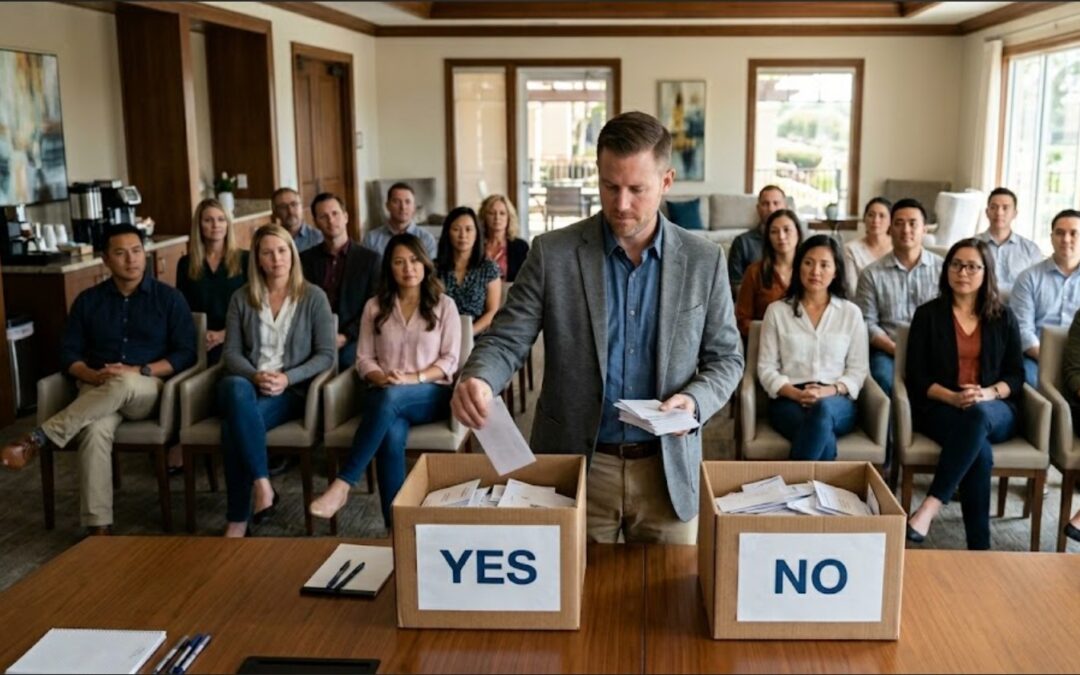
Without exception, every California HOA election must have an independent inspector of elections. The inspector receives the ballots, verifies member eligibility, tabulates the votes, and announces the results. When that person lacks genuine independence, the election lacks genuine integrity. Yet a surprising number of California HOA boards appoint inspectors who are currently under contract with the HOA for compensable services, including the HOA’s own management company, or who are related to a board member or director candidate. Those arrangements not only violate the Davis-Stirling Act, but they also provide homeowners with the necessary grounds to challenge the results under Civil Code 5145. [While Civil Code 5110 requires HOAs to select either one or three inspectors of election, for simplicity’s sake, this Fact Sheet will only refer to the inspector in the singular.]
Civil Code 5110 does not leave the definition of “independent” to HOA’s discretion. The statute defines it precisely. An inspector of elections must be a third party who is not a director, not a candidate for director, not related to a director or candidate for director, and not a person or business entity currently employed or under contract with the HOA for any compensable services other than serving as inspector. That last requirement disqualifies the HOA’s management company, its legal counsel, its landscaper, and any other vendor the HOA currently pays for services. The statute identifies qualifying examples, including a volunteer poll worker with the county registrar of voters, a licensed California accountant, or a notary public. An inspector may be a member of the HOA, but the other disqualifiers still apply in full.
The inspector’s responsibilities go well beyond opening envelopes and counting votes. Under Civil Code 5110, the inspector must determine the number of members entitled to vote and the voting power of each, authenticate proxies, hear and resolve all challenges to the right to vote, and perform every act necessary to conduct a fair election. The inspector owes duties to the entire membership, not to the board that appointed them. When an HOA board appoints an inspector who defers to management, lacks the training to perform these functions, or sits in a disqualifying relationship under Civil Code 5110, the HOA board compromises the integrity of the entire election regardless of how the vote ultimately turns out.
Electronic voting raises the stakes further. When an HOA adopts electronic secret balloting under Civil Code 5105, the inspector takes on a set of technical responsibilities that go well beyond anything the paper ballot system required. The inspector must ensure that the electronic voting system accurately authenticates each voter’s identity, protects ballot secrecy, issues a receipt to every voter, and permanently separates identifying information from each ballot. The inspector must also give every member enrolled in electronic voting a method to confirm their device can communicate with the voting system at least 30 days before the voting deadline. A management company or untrained volunteer is not equipped to meet those obligations, and an HOA that uses one anyway does so at serious legal risk.
This Fact Sheet explains exactly what Civil Code 5110 requires of an inspector of elections, what disqualifies a person from serving, what the inspector must do before and during an election, and what tools Civil Code 5145 gives a homeowner when an HOA cuts corners on inspector independence.
Key Points
Civil Code 5110 is not only one of the most important provisions in the Davis-Stirling Act, also one that a lot of HOAs routinely violate. The statute governs who may serve as inspector of elections, what that person must do, and what standard of conduct applies throughout the entire election process. HOA boards that treat the inspector role as an administrative afterthought, appointing whoever is convenient or inexpensive rather than someone who’s actually qualified, create elections that homeowners can challenge and courts will void. Understanding what Civil Code 5110 actually requires puts homeowners in a position to spot violations before, during, and after an election.
- Every California HOA election must have either one or three inspectors of elections. Civil Code 5110 requires the HOA to select an independent third party or parties to serve as inspector, and the number must be either one or three. Two inspectors are not permitted. HOA boards typically select the inspector, but that selection authority does not give the board discretion over who qualifies. Civil Code 5105 sets out the methods by which an inspector may be selected, including appointment by the board, election by the members, or any other method the election rules specify. Regardless of how the inspector is selected, the independence requirements of Civil Code 5110 apply in full.
- Civil Code 5110 defines inspector independence precisely. An inspector of elections must be an independent third party who is not a director, not a candidate for director, not related to a director or to a candidate for director, and not a person or business entity currently employed or under contract with the HOA for any compensable services other than serving as inspector. The statute identifies qualifying examples, including a volunteer poll worker with the county registrar of voters, a licensee of the California Board of Accountancy, and a notary public. An inspector may be a member of the HOA, but membership alone does not satisfy the independence requirement. All of the disqualifiers still apply to members, meaning a member who sits on the board, is running for director, is related to a director or candidate, or is under contract with the HOA for any compensable services cannot serve as inspector regardless of their membership status.
- The HOA’s management company cannot serve as inspector of elections. This is one of the most common violations in California HOA elections, and it is one of the clearest. A management company (including the individual managers employed by the management company) is under contract with the HOA for compensable services. Civil Code 5110 expressly disqualifies any person or business entity currently employed or under contract with the HOA for compensable services other than the inspector role itself. That disqualification covers the management company, its employees, and any subdivision of the management company. It also covers the HOA’s legal counsel, its accountant if retained under an existing contract, its landscaper, its maintenance vendor, and every other person or business the HOA currently pays for services. None of those parties qualify, and an HOA board that appoints any of them as inspector has violated Civil Code 5110 before the first ballot is ever distributed. [If you’d like to learn more about how to spot and deal with bad HOA managers, check out my article “How to Deal with a Bad HOA Management Company in California: Your Legal Rights and Options.”]
- Civil Code 5110 assigns the inspector a specific and demanding list of responsibilities that must be performed impartially, in good faith, and expeditiously. The inspector is not a passive vote counter. Civil Code 5110 gives the inspector broad, affirmative authority over the entire election process, and that authority runs in favor of the entire membership, not in favor of the board, management, or any particular director or candidate. An inspector who defers to anyone else on any of the following responsibilities has abdicated a core statutory duty.
- The inspector must determine the number of memberships entitled to vote and the voting power of each. This sounds straightforward, but it is not always simple. Most California HOAs operate on a one-vote-per-separate-interest basis, meaning each home or unit gets one vote regardless of how many people are on title. But some HOAs assign different voting power to different unit types, lot sizes, or property classifications based on formulas buried in the CC&Rs or bylaws. Before a single ballot goes out, the inspector must work through the governing documents, cross-reference them against the current membership roster, and independently determine both who is entitled to vote and how much voting power each membership carries. That calculation belongs to the inspector alone, and an error at this stage can skew every result that follows.
- The inspector must determine the authenticity, validity, and effect of any proxies. A proxy is a written authorization that allows one person to act on another person’s behalf. In the HOA election context, a proxy allows a member who cannot attend a meeting or participate in a vote to designate someone else to vote in their place. For example, if an owner is traveling and cannot cast a ballot during the voting period, that owner might sign a proxy authorizing another person to vote on their behalf. Under the Davis-Stirling Act, that authorized person must be another member of the HOA, not just any adult the owner trusts. A proxy given to a non-member is invalid. The inspector must review every proxy submitted, confirm that it is signed by a qualifying member, confirm that the person designated to vote is also a qualifying member, and determine what effect the proxy has on the vote. Proxy disputes arise more often than most homeowners expect, and when they do, the inspector, not the board and not management, resolves them.
- The inspector must hear and determine all challenges to the right to vote. Not every person who submits a ballot or shows up claiming the right to vote actually qualifies as a member under the Davis-Stirling Act. Civil Code 4160 ties HOA membership directly to ownership of a separate interest in the development as reflected in the recorded chain of title. That means the inspector must be prepared to resolve real-world disputes that arise from less obvious ownership situations. Consider a few examples. An owner sells their home but the sale closes after ballots have already been distributed. The prior owner no longer qualifies as a member, and the inspector must disqualify that ballot. Or consider a trust that holds title to a property. The trustees of that trust are the legal owners under California law because unlike a corporation or LLC, a trust is not a separate legal entity capable of holding property in its own name. If the trustees attempt to name their adult child who lives at the property as a “trust representative” with authority to vote or serve on the board, the inspector must reject that designation. If someone is not on recorded title, that person does not qualify as an owner under Civil Code 4160, and therefore has no voting rights under Civil Code 5105 regardless of what the trustees have authorized in writing or the board has permitted. These are not hypothetical edge cases. They arise regularly in California HOA elections, and the inspector’s responsibility to resolve them independently and correctly is one of the most important functions Civil Code 5110 assigns. [If you’re interested, I wrote a detailed Fact Sheet about who qualifies as an “owner” for HOA purposes titled, “Who Counts as an Owner for California HOA Voting and Board Rights?”]
- The inspector must count and tabulate all votes and determine the final results of the election. In plain terms, this means the inspector physically receives every ballot, opens and processes each one according to the procedures required by the Davis-Stirling Act, adds up the votes cast for each candidate or on each measure, and announces the outcome. In a paper ballot election, that process involves the familiar double-envelope system, where each member seals their ballot inside a small inner envelope, places that envelope inside a larger outer envelope bearing their name, address, and signature, and mails or delivers it to the inspector. The inspector first verifies the outer envelope to confirm the voter’s identity and eligibility, then separates it from the inner envelope to preserve ballot secrecy before opening and counting the votes inside at the open meeting scheduled for that purpose. In an electronic election, the inspector oversees the internet-based voting system that performs those functions digitally, but the inspector remains responsible for verifying the integrity of every step. Determining when the polls close is also the inspector’s call, consistent with the governing documents and the election rules. No board member and no manager has any role in that process, and an inspector who allows either to participate in counting, reviewing, or announcing results before the inspector has independently completed the tabulation has compromised the integrity of the entire election.
- When an HOA adopts electronic voting under Civil Code 5105, the inspector’s responsibilities expand significantly beyond anything the paper ballot system required. The inspector must ensure that the internet-based voting system authenticates each voter’s identity, protects the secrecy and integrity of every ballot, issues a confirmation receipt to every member who votes electronically, and permanently separates all identifying information from each ballot, making it impossible to connect any vote to any specific member. The system must also store all ballots and keep them accessible for recount and review. On top of those system requirements, the inspector must give every member enrolled in electronic voting a method to confirm, at least 30 days before the voting deadline, that their device can successfully communicate with the voting system. These are not aspirational standards. They are hard statutory requirements under Civil Code 5110, and a management company or untrained volunteer appointed as inspector is not equipped to fulfill any of them. An HOA that makes that appointment anyway creates serious and documentable legal exposure from the moment the first electronic ballot goes out. [If you’d like to learn all about California’s electronic HOA election law, read my Fact Sheet “Can My California HOA Switch to Electronic Voting?”]
- When an HOA appoints an unqualified inspector, every aspect of the election that inspector touches is vulnerable to challenge. An unqualified inspector is not a technicality that courts overlook. It is a statutory violation that runs through the entire election, from ballot distribution to tabulation to the announcement of results, and Civil Code 5145 gives homeowners meaningful tools to act on it.
- Civil Code 5145 gives a homeowner one year from the announcement of election results to bring a civil action for a violation of the Davis-Stirling Act’s election provisions. If a homeowner proves a violation by a preponderance of the evidence, a court must void the election results unless the HOA can prove that its noncompliance did not affect the outcome. That is a meaningful burden for an HOA to carry, particularly when the margin of victory is narrow or when the inspector’s violations infected the entire election rather than a single procedural step. The HOA cannot simply argue that its intentions were good or that it substantially followed the correct process. It must affirmatively prove that the specific violation had zero effect on the outcome, and if it cannot make that showing, the court must void the results.
- A homeowner who prevails under Civil Code 5145 is entitled to attorneys’ fees and up to $500 per violation. The same is not true for the HOA if it prevails because the HOA is only entitled to its fees upon prevailing if the court finds that the homeowner’s lawsuit was frivolous. That fee-shifting provision significantly changes the leverage dynamic when a homeowner challenges an election. A homeowner who retains HOA attorneys to pursue the challenge can recover those fees upon prevailing, and the HOA faces real financial exposure if it defends a losing position. Civil Code 5145 also allows a homeowner to bring the challenge in small claims court if the amount in controversy falls within the jurisdictional limit, and even a homeowner who simply consults with an attorney before filing a small claims action can recover those consultation fees upon prevailing, a protection that exists in almost no other provision of California law.
- If an election in your HOA was run by an inspector who did not meet the requirements of Civil Code 5110, call the HOA attorneys at MBK Chapman. An unqualified inspector is not a technicality. It is a statutory violation that goes to the heart of election integrity, and it is exactly the kind of issue that MBK Chapman’s HOA attorneys have the experience and the statutory command to pursue. Whether the violation involves the HOA’s management company serving as inspector, a board member’s relative overseeing the count, a vendor under contract with the HOA tabulating the results, or an inspector who is simply unqualified, MBK Chapman can evaluate the record, identify the violation, and help a homeowner decide whether and how to challenge the results.
Civil Code 5110 exists because HOA elections matter. Directors control assessments, enforcement, reserves, and every other aspect of community governance. An inspector who lacks genuine independence undermines the democratic process that the Davis-Stirling Act was designed to protect. HOA boards that cut corners on inspector qualifications do not just create legal risk for themselves. They deprive every member of the HOA of a fair election, and California law gives those members the tools to fight back.
FAQs
Can my HOA select our manager as the inspector of elections?
No. A management company is under contract with the HOA for compensable services, and Civil Code 5110 expressly disqualifies any person or business entity currently employed or under contract with the HOA for compensable services other than serving as inspector. That disqualification covers the management company itself, its individual employees, and any subdivision of the management company. It makes no difference how long the management company has served the HOA, how familiar it is with the membership roster, or how convenient the arrangement might be. The disqualification is absolute.
Can a member of my HOA serve as inspector of elections?
Yes, but with important limitations. Civil Code 5110 permits a member of the HOA to serve as inspector, but all of the statutory disqualifiers still apply. A member who is currently a director, currently a candidate for director, related to a director or candidate for director, or currently under contract with the HOA for any compensable services (other than serving as an inspector) cannot serve as inspector regardless of their membership status. A rank-and-file member with no board role, no candidacy, no family connection to anyone on the board or running for the board, and no existing contract with the HOA for paid services would qualify, assuming they are willing and able to perform the inspector’s full range of statutory responsibilities impartially and in good faith.
What happens if my HOA appoints an unqualified inspector of elections?
Every aspect of the election that inspector touched becomes vulnerable to a legal challenge under Civil Code 5145. A homeowner has one year from the announcement of election results to bring a civil action. If the homeowner proves a violation by a preponderance of the evidence, a court must void the election results unless the HOA can prove its noncompliance did not affect the outcome. That is a significant burden for an HOA to carry, particularly when the inspector’s disqualification ran through the entire election rather than a single isolated step. A homeowner who prevails is entitled to attorneys’ fees and up to $500 per violation, and the HOA cannot recover its own costs unless the court finds that the homeowner’s lawsuit was frivolous.
Does my California HOA still need an inspector of elections if it switches to electronic voting?
Yes, and the inspector’s responsibilities actually increase significantly when an HOA adopts electronic voting. Under Civil Code 5110, the inspector must ensure that the internet-based voting system authenticates each voter’s identity, protects ballot secrecy, issues a confirmation receipt to every voter, and permanently separates all identifying information from each ballot. The inspector must also give every member enrolled in electronic voting a method to confirm their device can communicate with the voting system at least 30 days before the voting deadline. None of those obligations disappear simply because the ballots are digital rather than paper. If anything, electronic voting demands a more technically capable and genuinely independent inspector, not a less qualified one.

About Michael Kushner
Michael Kushner is a California attorney with over 30 years of experience representing homeowners in disputes with their HOAs. He is widely regarded as California’s leading homeowner-side HOA attorney, and has built one of the state’s most prominent law practices dedicated to holding HOAs accountable under the Davis-Stirling Act and California law.
In addition to his law firm’s work, Michael is a recognized lecturer, author, and the host of the hit HOA HELL podcast, where he provides homeowners living in HOA-governed communities with clear, practical strategies for dealing with bad HOAs. He’s also the author of the best-selling book, HOA HELL | California Homeowners’ Definitive Guide to Beating Bad HOAs, which has become a go-to resource for both homeowners seeking real-world solutions to their HOA disputes, as well as those good HOA board members who are interested in doing a good job.
About MBK Chapman Fact Sheets
Homeowners searching for answers online will often come across articles that appear authoritative, but are actually written as search-engine marketing content rather than by an experienced HOA lawyer. These pieces tend to prioritize keyword density over clarity, accuracy, or legal context, which often leaves homeowners more confused than informed.
At MBK Chapman, our Fact Sheets are part of our HOA Law Library and are written by Michael Kushner, an HOA lawyer with decades of hands-on experience representing California homeowners. In fact, Michael Kushner is the HOA lawyer who pioneered the systems and strategies used by some of California’s most successful homeowner-side HOA law firms.
Each Fact Sheet is deliberately concise, statute-based, and designed as a quick-reference guide to help homeowners understand key HOA laws and enforcement rules at a glance.
AND DON’T FORGET TO TUNE INTO MY PODCAST, HOA HELL
YOU CAN ALSO ORDER MY GROUNDBREAKING BOOK
HOA HELL | California Homeowners’ Definitive Guide to Beating Bad HOAs
Amazon | Barnes & Noble
