
Overview
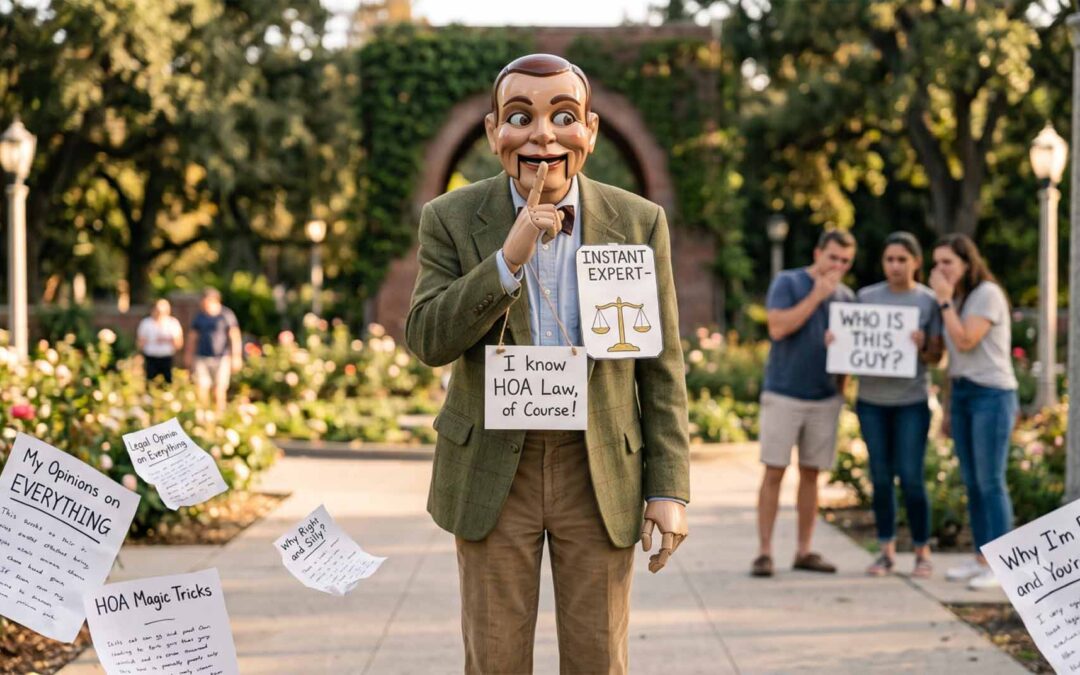
Homeowners frustrated with their HOAs increasingly take their complaints online. Unfortunately, a steady stream of really ignorant and really bad advice has told many to shut up or pay the price. The latest example comes from an article that sought the opinion of a purported real estate law expert, the managing partner of a well-known South Orange County law firm. In that article, this “expert” warned homeowners that a critical social media post aimed at the board or individual HOA directors could create a situation where an HOA could use a homeowner’s online criticism of the board against them for breaching their CC&Rs’ non-disparagement provision. According to this attorney’s biography, he’s an expert in “multiple areas of complex litigation, including…real estate…,” who probably bills north of $1,000 an hour.
He’s also flat wrong. And not in some subtle, reasonable-minds-differ way. He’s wrong about the most basic protection California homeowners have when they speak out against their HOAs. And the fact that a high-priced partner at a well-known firm said it out loud, in print, tells you that a fancy title and a four-figure hourly rate means nothing when the lawyer behind them doesn’t understand the nuances of HOA law in California under the Davis-Stirling Act. This attorney plainly doesn’t.
That’s not a cheap shot. It’s the whole point. Homeowners read advice like his, assume a big-firm lawyer must know what he’s talking about, and go quiet exactly when they should be organizing their neighbors and speaking up. That’s the real damage. Terrible (and wrong) advice from someone who sounds authoritative does more to protect bad HOAs than any non-disparagement clause ever could because it makes homeowners censor themselves for free.
Here’s what this “powerhouse” attorney got dead wrong. The Legislature recognized the problem with non-disparagement provisions, and about four years ago decided to shut HOAs trying to enforce those provisions down cold. The results of their crackdown landed in Civil Code 4515, which explicitly protects homeowners’ right to use social media and other online forums to criticize their HOAs and directors, even when that criticism is harsh, abrasive, or aimed at specific directors. The statute also voids any provisions of an HOA’s CC&Rs, bylaws, or rules that tries to prohibit such “disparagement.” So a non-disparagement clause that threatens fines for a critical post doesn’t expose the homeowner to anything. It exposes the HOA, which can end up paying penalties and the homeowner’s attorneys’ fees for trying to enforce a clause California law explicitly gutted.
I can only guess that this high profile attorney blurred two very different things in rendering his opinion to the reporter: disparagement and defamation. Disparaging statements include true, accurate, well-founded criticisms, as well as lies. Defamation involves only lies, as truth is an absolute defense to all defamation claims. Truthful and factual disparagement is not only completely legal, it’s a fundamental tool in a homeowner’s arsenal against a bad HOA. Real threats, harassment, and defamation stay illegal no matter who commits them.
In this Fact Sheet, you’ll learn why non-disparagement provisions found in an HOA’s governing documents are void and unenforceable, where protected criticism ends and genuinely illegal speech begins, and how an HOA that tries to fine you can wind up paying your attorneys’ fees instead. And finally, you’ll learn why it’s so important to avoid so-called expert attorneys who lack substantial HOA-related expertise when you’re facing an HOA-related dispute no matter how big a law firm they come from.
[If you’d like to learn all about Civil Code 4515 and how it protects homeowners who criticize their HOA boards online, read my Fact Sheet “Can Your California HOA Stop You From Criticizing the Board?”]
Key Points
Civil Code 4515 hands California homeowners a right their HOAs can’t write away, and that’s the right to criticize their HOAs and their directors online, harshly and by name, without facing any HOA discipline. That protection overrides every governing document an HOA has, which leaves the non-disparagement provisions HOAs point to when they threaten fines with no force at all. What follows covers the reach of that protection, the narrow band of speech that stays illegal no matter which HOA is involved, and the price HOAs pay when they try to enforce a provision the Legislature already voided. It also covers why the size of a law firm and the rate it charges reveal nothing about whether the lawyers inside it understand any of this.
- The Davis-Stirling Act explicitly protects homeowners’ right to criticize their HOAs and directors online, even harshly. Civil Code 4515 guarantees homeowners the right to use social media and other online forums to criticize their HOA’s directors about HOA-related topics, including HOA governance, elections, recalls, legislation, and any other issue of concern to their communities. The Legislature added that online protection through a 2022 amendment that took effect on January 1, 2023, and they did it precisely because HOAs like the ones this so-called real estate “expert” mentioned in the article were trying to police what residents posted about them on social media platforms like Facebook, Reddit, Instagram, and Nextdoor.
- Civil Code 4515 voids any provisions in an HOA’s CC&Rs, bylaws, or rules that tries to fine homeowners for criticizing HOA board members online. The very provisions that the purported expert attorney quoted in the article was talking about are void as a matter of law. Civil Code 4515, therefore, automatically renders completely unenforceable any non-disparagement provisions found in an HOA’s governing documents. It makes no difference whether the HOA buried the clause in the recorded CC&Rs or in a rule the HOA board passed on its own, because Civil Code 4515 overrides all of them. So the exact scenario the high-priced attorney warned about, a homeowner fined under a non-disparagement clause for a critical post, describes an HOA breaking the law, not a homeowner breaching the HOA’s governing documents. [You can read about the hierarchy of HOA governing documents in my Fact Sheet, “California HOA Governing Documents: What Controls?”]
- Civil Code 4515 protects criticism, but it’s not a license to say anything. While the statute shields peaceful, protected speech and organizing, it doesn’t reach conduct that’s independently illegal. Real threats, harassment, stalking, vandalism, and knowingly false statements of fact that damage a specific person are unlawful whether or not an HOA’s governing documents contain a non-disparagement provision, and Civil Code 4515 offers no cover for any of them. [In defense of the article’s author, who simply reported the opinion of the so-called expert attorney, she did acknowledge that it was “false statements” that opened homeowners up to defamation lawsuits.]
- Disparagement and defamation are different things, and confusing them causes a lot of damage. Disparagement means any statement, regardless of its truth or falsity, that criticizes or reflects poorly on someone, and it includes true, accurate, well-documented criticism. Defamation, on the other hand, is far narrower, because it requires a false statement of fact, and truth is a complete defense to any defamation claim. Homeowners who post truthful accounts or opinions of an HOA board’s (or individual director’s) conduct haven’t defamed anyone no matter how much the HOA dislikes it, and Civil Code 4515 protects those posts even though a non-disparagement provision purports to make such statements a punishable violation.
- California’s anti-SLAPP statute hands homeowners a weapon that can end an HOA’s lawsuit at the starting gate. Strategic Lawsuit(s) Against Public Participation are lawsuits filed to punish someone for exercising their free speech or petition rights and to drain their resources defending it. The Legislature answered with Code of Civil Procedure 425.16. That statute lets homeowners respond with a special motion to strike at the outset of the case, and the motion runs on two prongs. Homeowners first show the claim arises from their constitutionally protected activity, and the burden then shifts to the HOA to prove it’s likely to prevail on the merits. A granted motion can strike the offending claims or knock out the entire complaint, and courts must award prevailing homeowners their attorneys’ fees and costs, which run high because these motions are complex and labor-intensive. An HOA that sues its members over a critical post, whether it pleads defamation or reaches for its non-disparagement provision, files a claim that arises from their speech, and that alone puts an anti-SLAPP motion on the table for homeowners to utilize as a powerful tool from day one.
- HOAs that attempt to discipline homeowners under non-disparagement provisions will end up paying dearly for doing so. Civil Code 4515 lets homeowners sue to stop an HOA from enforcing a governing document-based non-disparagement provision, and it authorizes a civil penalty of up to $500 for each violation. And while it’s true that Civil Code 4515 itself doesn’t award attorneys’ fees to the prevailing party on its own, Civil Code 5975 does. That statute awards attorneys’ fees to the prevailing party in actions to enforce the governing documents, and that includes a homeowner not only defending a lawsuit filed by an HOA trying to enforce its non-disparagement provision, but also a homeowner filing a lawsuit against the HOA to have a court declare such a provision illegal and unenforceable. This is a far different, and immensely better, result than the purported expert interviewed in the article communicated.
- A big firm, a four-figure hourly rate, and expertise in real estate law reveal nothing about whether a lawyer has expertise in HOA law. The Davis-Stirling Act is a specialized and vast body of law, and plenty of accomplished real estate attorneys who handle general real estate or complex litigation lack sufficient expertise to competently represent clients enmeshed in disputes with their HOAs. The opinion that prompted this Fact Sheet came from exactly that kind of lawyer, a self-described expert in complex litigation and real estate who got the most basic point about HOA speech rights backwards in a national publication. I believe that the opinions expressed by this attorney did a good deal of damage to homeowners who have no reason to know that they just received very bad information. Homeowners who take this attorney’s statements at face value will never know that their most potent tool to hold their HOAs accountable was just taken away from them.
- If your HOA has disciplined you, or threatened to discipline you, because of online comments you made about the HOA or its directors, call the HOA attorneys at MBK Chapman. The HOA attorneys at MBK Chapman know that Civil Code 4515 protects your right to criticize your HOA and voids the non-disparagement provisions contained in some HOAs’ governing documents. If your HOA is using a non-disparagement clause to punish you for speaking out, contact us and we’ll make your HOA pay.
Contrary to what well-meaning, but ignorant, attorneys have said publicly, the rights of California homeowners to harshly criticize their HOAs and HOA directors online are powerfully protected by the Davis-Stirling Act. Civil Code 4515 strips the non-disparagement provisions that many HOAs rely on of any force, and it flips an attempted fine into the HOA’s liability rather than the homeowner’s. What matters isn’t how harsh the criticism gets, it’s whether the criticism is accurate. Disparagement is protected. False statements of fact aren’t. And homeowners who understand that distinction, and who bring their HOA disputes to expert homeowner-side HOA attorneys rather than to so-called real estate and complex litigation “experts” are best equipped to protect their rights. It’s unfortunate, therefore, that the opinions of attorneys who really don’t know what they’re talking about will likely lead thousands of homeowners astray, thus empowering bad HOAs to continue with their abuses unchecked.
FAQs
Can my California HOA fine me for truthfully criticizing it on social media?
No. Civil Code 4515 protects your right to use social media and other online forums to criticize your HOA and its directors about HOA governance, elections, recalls, legislation, and other issues affecting your community. It doesn’t matter how harsh or abrasive the criticism is, or whether it’s aimed at the HOA board as a whole, or at individual directors. The Legislature added that protection through a 2022 amendment effective January 1, 2023, precisely because HOAs were policing what residents posted on platforms like Facebook, Reddit, Instagram, and Nextdoor.
Are HOA non-disparagement clauses enforceable in California?
No. Civil Code 4515 voids any provision in an HOA’s CC&Rs, bylaws, or rules that tries to prohibit protected criticism, which renders non-disparagement provisions unenforceable as a matter of law. It makes no difference whether the clause sits in the recorded CC&Rs or in a rule the HOA board passed on its own, because Civil Code 4515 overrides all of them.
What's the difference between disparagement and defamation in an HOA dispute?
Disparagement covers any statement that criticizes or reflects poorly on someone, true or false. Defamation is far narrower, because it requires a false statement of fact, and truth is a complete defense to any defamation claim. That distinction is the whole ballgame, because truthful criticism of your HOA board is both protected by Civil Code 4515 and legally safe, while real threats, harassment, and knowingly false statements of fact stay illegal no matter who makes them.
What happens if my California HOA tries to enforce a non-disparagement clause against me?
It can cost the HOA dearly. Civil Code 4515 lets you sue to stop enforcement and authorizes a civil penalty of up to $500 per violation. Civil Code 4515 carries no fee provision of its own, but Civil Code 5975 awards attorneys’ fees to the prevailing party in an action to enforce the governing documents, which covers both defending an HOA’s enforcement suit and filing your own action to have the provision declared void. An HOA that sues you over a critical post also exposes itself to an anti-SLAPP motion under Code of Civil Procedure 425.16, which can have severe financial consequences for the HOA.

About Michael Kushner
Michael Kushner is a California attorney with over 30 years of experience representing homeowners in disputes with their HOAs. He is widely regarded as California’s leading homeowner-side HOA attorney, and has built one of the state’s most prominent law practices dedicated to holding HOAs accountable under the Davis-Stirling Act and California law.
In addition to his law firm’s work, Michael is a recognized lecturer, author, and the host of the hit HOA HELL podcast, where he provides homeowners living in HOA-governed communities with clear, practical strategies for dealing with bad HOAs. He’s also the author of the best-selling book, HOA HELL | California Homeowners’ Definitive Guide to Beating Bad HOAs, which has become a go-to resource for both homeowners seeking real-world solutions to their HOA disputes, as well as those good HOA board members who are interested in doing a good job.
About MBK Chapman Fact Sheets
Homeowners searching for answers online will often come across articles that appear authoritative, but are actually written as search-engine marketing content rather than by an experienced HOA lawyer. These pieces tend to prioritize keyword density over clarity, accuracy, or legal context, which often leaves homeowners more confused than informed.
At MBK Chapman, our Fact Sheets are part of our HOA Law Library and are written by Michael Kushner, an HOA lawyer with decades of hands-on experience representing California homeowners. In fact, Michael Kushner is the HOA lawyer who pioneered the systems and strategies used by some of California’s most successful homeowner-side HOA law firms.
Each Fact Sheet is deliberately concise, statute-based, and designed as a quick-reference guide to help homeowners understand key HOA laws and enforcement rules at a glance.
AND DON’T FORGET TO TUNE INTO MY PODCAST, HOA HELL
YOU CAN ALSO ORDER MY GROUNDBREAKING BOOK
HOA HELL | California Homeowners’ Definitive Guide to Beating Bad HOAs
Amazon | Barnes & Noble
