
Overview
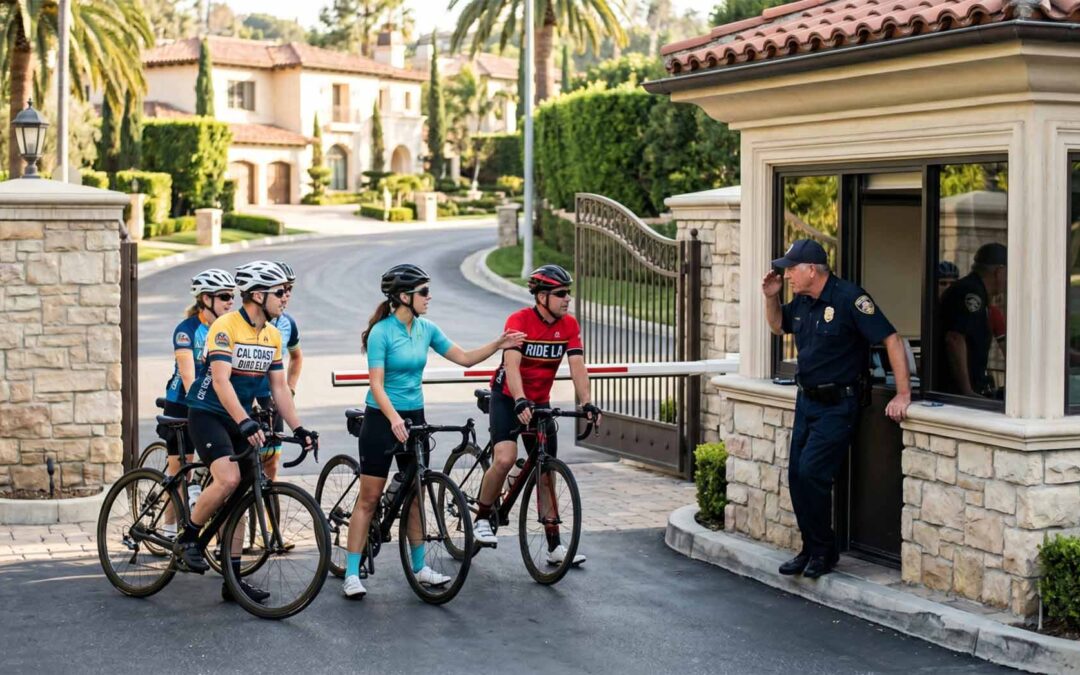
An AI-generated video of an HOA meeting over a public trail went viral this month. The meeting never happened. The problem it described, however, has been happening for decades. The video depicted Mulholland Estates, a private gated community in the hills above Sherman Oaks, blocking public access to Fossil Ridge Park, a 110-acre public park owned by the Santa Monica Mountains Conservancy, a California state agency. The video was fabricated. The blockage by the HOA was not.
For more than two decades, Mulholland Estates security guards turned away members of the public who attempted to access Fossil Ridge Park through the community’s private roads, the only practical route to the park. What made that conduct particularly striking was not just that it violated the public’s legal rights. It violated the HOA’s own CC&Rs, which had expressly established public easements over Westpark Road for the specific purpose of providing access to Fossil Ridge Park since the community’s CC&Rs were recorded in 1988. It took a formal 2011 memorandum from the Santa Monica Mountains Conservancy to the Mulholland Estates HOA to force the issue into the open and restore the public’s access rights.
The legal principle at the center of this story applies well beyond one celebrity-filled gated community in the Santa Monica Mountains. When a public easement exists over private property, whether created by a developer as a condition of project approval, recorded in an HOA’s CC&Rs, or otherwise established in the chain of title, no HOA has the legal authority to block it, restrict it, or make access so practically difficult that it functions as a de facto blockage. A public easement is a property right that runs with the land. The HOA does not own it, cannot revoke it, and cannot instruct its security personnel to ignore it.
This Fact Sheet uses the Mulholland Estates and Fossil Ridge Park situation as its entry point solely because the viral video made it the most searched example of this issue in California right now. The underlying legal principle, however, affects any California HOA whose community sits adjacent to, or provides the only practical access to, a public park, trail, or other public space burdened by a recorded easement.
Key Points
The Mulholland Estates and Fossil Ridge Park situation went viral because it struck a nerve. The idea of a wealthy gated community blocking public access to a public park feels wrong to most people, and it should, because it is wrong, both morally and legally. But AI generated the viral video that reignited the story this month. The meeting it depicted never happened. What did happen, over more than two decades at that exact community, is well-documented, legally significant, and directly relevant to any California homeowner who lives near a gated community that sits between the public and a public space.
- The viral video was fabricated, but the Fossil Ridge Park blockage was real and lasted more than two decades. The Santa Monica Mountains Conservancy, a California state agency, owns Fossil Ridge Park, a 110-acre public park in Sherman Oaks. The park sits adjacent to Mulholland Estates, a wealthy private gated community, and the only practical access to the park runs through the community’s private roads. Despite that, for decades, Mulholland Estates security guards turned away members of the public who attempted to reach the park. What made that conduct especially indefensible was that the Mulholland Estates CC&Rs, recorded in 1988, expressly established public easements over Westpark Road for the specific purpose of providing access to Fossil Ridge Park. The HOA didn’t just violate the public’s legal rights. It also violated its own governing documents. In March of 2011, the Santa Monica Mountains Conservancy issued a formal memorandum directly to the Mulholland Estates HOA to force the issue and restore public access. This occurred more than 20 years after the community’s CC&Rs first established that access.
- A public easement is a property right that no HOA can revoke, restrict, or ignore. An easement gives someone other than the property owner the legal right to use a portion of that property for a specific purpose. A public easement goes further: it gives the general public that right, and it runs with the land, meaning it survives changes in ownership, changes in HOA leadership, and changes in the community’s governing documents. Once someone records a public easement in the chain of title, it binds every subsequent owner and every HOA that governs the property. No board vote can eliminate it. No security guard can legally block it. No HOA rule or architectural guideline can restrict it. An HOA that attempts any of those things is not exercising its authority under the Davis-Stirling Act. It is acting entirely outside that authority. [If you’d like to take a deeper dive into how easements work, read my article “California Easements Explained.” You might also like my Fact Sheet, “What Can I Do If Someone Blocks My Easement?”]
- Public easements arise in several ways, and homeowners and the general public need to know how to identify them. The most common source is the developer’s original recorded CC&Rs, which sometimes include public access easements as a condition of government approval for the development. That is precisely what happened at Mulholland Estates (regarding Fossil Ridge Park), where the developer recorded the public easements in 1988 as part of the HOA’s founding documents. Public easements can also arise from separate recorded instruments, dedications that developers make on subdivision maps, conditions that local governments impose during the entitlement process, or agreements between developers and public agencies like the Santa Monica Mountains Conservancy. In every case, the easement appears somewhere in the public land records, and any title search of the affected property will reveal it. If a gated community, like Mulholland Estates, sits between the public and a park, trail, or other public space, the place to look for the public’s access rights is the recorded chain of title, not the HOA’s current rules or the preferences of its security personnel.
- California’s coastline produces some of the most contentious public easement disputes in the state, and HOAs are sometimes at the center of them. The California Coastal Act gives the California Coastal Commission broad authority to require public access easements as a condition of approving coastal development. That means many HOA communities built along the California coast have public access easements recorded against their property as a direct result of the development approval process, whether their current boards know it or not. Those easements typically run along the beach, over private roads, or through community property to give the public a path to the water. An HOA that blocks or restricts that access is not just defying the public. It is violating a condition that the Coastal Commission imposed as the price of the community’s existence, and the Coastal Commission has independent enforcement authority to compel compliance.
- An HOA that blocks a public easement exposes itself to significant legal consequences. Blocking a recorded public easement is not a gray area. A court can enforce it through injunctive relief, meaning a court order compelling the HOA to restore access. Depending on the circumstances, affected parties can also seek damages. Public agencies with jurisdiction over the easement can intervene directly, as the Santa Monica Mountains Conservancy did in 2011 when it sent its formal memorandum to the Mulholland Estates HOA demanding that it allow the public access to Fossil Ridge Park, which could only be facilitated by allowing the public to traverse through the community. Because the easement sits in the HOA’s own chain of title, an HOA board that directs security personnel to block access cannot credibly claim ignorance. Every board member carries a fiduciary duty to the membership and to the law, and directing staff to violate a recorded property right breaches that duty directly.
- If a gated community near you blocks access to a public park, trail, or other public space, start by identifying whether a recorded easement exists. Pull the recorded CC&Rs for the community and review them for any public access provisions. Check the subdivision map the developer recorded with the county. Search the county recorder’s records for any separately recorded easement instruments affecting the property. If a public easement exists and the HOA blocks it, that blockage is legally indefensible regardless of what the HOA’s current rules say, regardless of what instructions its security personnel have received, and regardless of how long the blockage has been in place. Duration does not legitimize an illegal obstruction of a recorded property right.
- If a California HOA is blocking your access to a public easement, call the HOA attorneys at MBK Chapman. Easement blockages by HOAs rank among the clearest examples of HOA overreach precisely because the violated right appears in black and white in the public land records. MBK Chapman’s HOA attorneys have the experience to identify recorded easements, document the blockage, and pursue the legal remedies that force compliance. The Mulholland Estates/Fossil Ridge Park situation took more than twenty years to resolve through informal pressure. With the right legal representation, homeowners and members of the public do not have to wait that long.
The Fossil Ridge Park story went viral because it felt outrageous. It was outrageous. But the more important takeaway is not that one celebrity-filled gated community blocked a public park for two decades. It is that the legal tools to stop that kind of conduct exist, they rest on recorded property rights that no HOA board can wish away, and homeowners and members of the public who understand those tools can use them. An HOA’s gates do not change what the law says about what lies on the other side of them.
FAQs
Was the viral video about Fossil Ridge Park real and Mulholland Estates?
No. AI generated the video, and the HOA meeting it depicted never happened. However, the underlying problem the video described was real. Mulholland Estates security guards blocked public access to Fossil Ridge Park for more than two decades, despite the fact that the community’s own CC&Rs, recorded in 1988, expressly established public easements to provide that access. The Santa Monica Mountains Conservancy had to issue a formal memorandum to the Mulholland Estates HOA in 2011 to force compliance. The video was fake. The blockage was not.
Can a California HOA legally block access to a public park or trail?
No. When a public easement exists over a private community’s roads or property, the HOA has no legal authority to block it, restrict it, or instruct its security personnel to turn people away. A public easement is a recorded property right that runs with the land and binds every subsequent owner and every HOA that governs the property. No board vote, no HOA rule, and no security guard instruction can legally override it. An HOA that blocks a public easement exposes itself to court-ordered injunctive relief, potential damages, and intervention by public agencies with jurisdiction over the easement.
How do I find out if a public easement runs through a California HOA community near me?
Start with the recorded CC&Rs for the community, which sometimes include public access easements that developers created as a condition of government approval for the development. Also check the subdivision map the developer recorded with the county and search the county recorder’s records for any separately recorded easement instruments affecting the property. Public easements always appear somewhere in the public land records, and a title search of the affected property will reveal them. If an easement exists and the HOA blocks it, that blockage is legally indefensible regardless of how long it has been in place.
What can I do if a California HOA is blocking access to a public easement?
A court can order the HOA to restore access through injunctive relief, and depending on the circumstances, affected parties may also seek damages. Public agencies with jurisdiction over the easement can intervene as well. The first step is confirming that a recorded easement exists by reviewing the community’s CC&Rs, subdivision map, and county recorder records. Once you establish that the easement exists and the HOA blocks it, you have a legally documented basis to demand compliance and pursue court enforcement if the HOA refuses.

About Michael Kushner
Michael Kushner is a California attorney with over 30 years of experience representing homeowners in disputes with their HOAs. He is widely regarded as California’s leading homeowner-side HOA attorney, and has built one of the state’s most prominent law practices dedicated to holding HOAs accountable under the Davis-Stirling Act and California law.
In addition to his law firm’s work, Michael is a recognized lecturer, author, and the host of the hit HOA HELL podcast, where he provides homeowners living in HOA-governed communities with clear, practical strategies for dealing with bad HOAs. He’s also the author of the best-selling book, HOA HELL | California Homeowners’ Definitive Guide to Beating Bad HOAs, which has become a go-to resource for both homeowners seeking real-world solutions to their HOA disputes, as well as those good HOA board members who are interested in doing a good job.
About MBK Chapman Fact Sheets
Homeowners searching for answers online will often come across articles that appear authoritative, but are actually written as search-engine marketing content rather than by an experienced HOA lawyer. These pieces tend to prioritize keyword density over clarity, accuracy, or legal context, which often leaves homeowners more confused than informed.
At MBK Chapman, our Fact Sheets are part of our HOA Law Library and are written by Michael Kushner, an HOA lawyer with decades of hands-on experience representing California homeowners. In fact, Michael Kushner is the HOA lawyer who pioneered the systems and strategies used by some of California’s most successful homeowner-side HOA law firms.
Each Fact Sheet is deliberately concise, statute-based, and designed as a quick-reference guide to help homeowners understand key HOA laws and enforcement rules at a glance.
AND DON’T FORGET TO TUNE INTO MY PODCAST, HOA HELL
YOU CAN ALSO ORDER MY GROUNDBREAKING BOOK
HOA HELL | California Homeowners’ Definitive Guide to Beating Bad HOAs
Amazon | Barnes & Noble
