
Overview
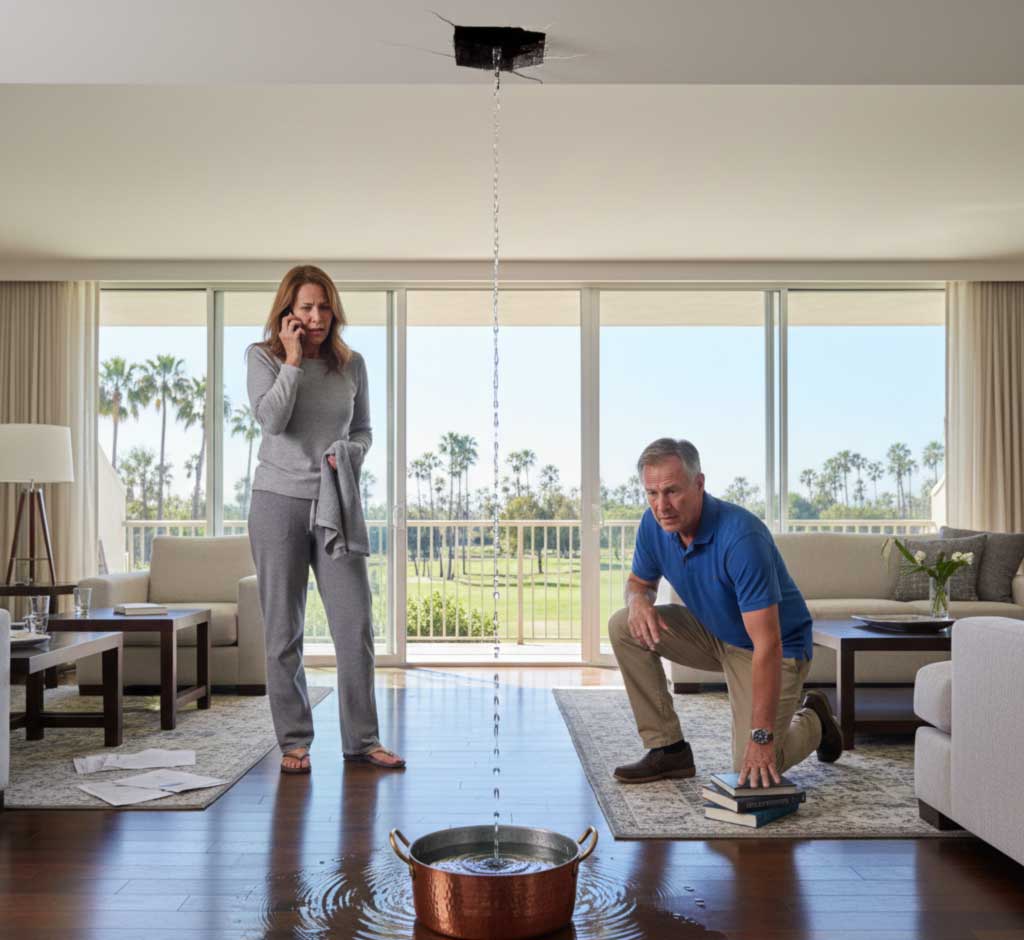
After a water intrusion, California HOA members are often given quick answers that obscure rather than resolve the real issues. In a lot of HOAs, the board or management responds by opening an insurance claim and promising that coverage questions will be sorted out later. In bad HOAs, however, the response is often very different (and more unacceptable). Bad HOAs often immediately disclaim responsibility altogether, assert that anything inside a homeowner’s unit is the homeowner’s problem, and instruct the homeowner to “go through their own insurance” without first analyzing where the water came from, what failed, or how the governing documents allocate responsibility.
Both responses bypass the same critical step. Neither approach, standing alone, answers the legal questions that actually control who pays. Insurance does not replace statutory duties, and a blanket denial does not eliminate them. Responsibility for water damage in an HOA turns on a variety of factors, including component classification, default statutory rules, variations in the CC&Rs, insurance structure, deductible allocation, and whether anyone failed to act reasonably before or after the water leak.
A significant part of the confusion comes from the fact that many homeowners in condominiums and townhomes do not realize that they typically carry a different type of homeowners insurance than owners of single-family homes. Nowadays, most lenders, as well as Fannie Mae and Freddie Mac, require owners of connected housing (e.g., condominiums, townhomes) to carry HO-6 policies, which are designed to work alongside an HOA’s master policy. Unfortunately, those two policies do not overlap cleanly, and gaps between them are often where disputes arise.
This Fact Sheet explains how HOA master policies and homeowner HO-6 policies typically interact after a water leak, why some HOAs attempt to disclaim responsibility before doing any analysis, how Civil Code 4775’s default rules and CC&R variations affect payment responsibility, how deductibles and interior losses are allocated, and why delay or denial frequently escalates routine water damage into a broader dispute.
For a quick-guide on who’s responsible when water invades your property, see my Fact Sheet, “HOA Water Damage: Who Is Responsible When Water Invades Your Unit?”
Key Points
Water damage payment disputes in HOAs are driven by statutory defaults, document-specific variations, insurance structure, and conduct after the loss. The following key points explain how these issues are analyzed in practice, and what homeowners can do if their HOAs play games following a water intrusion.
- Civil Code 4775 establishes default rules, but CC&Rs may modify them. Civil Code 4775 supplies the default allocation of maintenance, repair, and replacement responsibility when CC&Rs are silent. Under the default rule, the HOA is responsible for maintaining, repairing, and replacing the common area, while the homeowner is responsible for maintaining their separate interest. CC&Rs are permitted to modify these defaults, and some do, although most track the statute closely. Homeowners should not assume the default applies without reviewing their documents, because even modest deviations can materially change responsibility in a water damage claim.
- Exclusive use common areas are treated differently under the default statute. When CC&Rs do not say otherwise, Civil Code 4775 draws a critical distinction for exclusive use common areas. Maintenance responsibility typically rests with the homeowner, while repair and replacement responsibility remains with the HOA. This distinction is central in water intrusion cases involving balconies, patios, windows, doors, or exterior plumbing serving a single unit. Boards and managers frequently collapse maintenance and repair into a single concept, even though the statute treats them differently.
- Repair responsibility and payment responsibility are not the same thing. Civil Code 4775 addresses who must repair or replace a failed component. It does not automatically determine who pays for resulting interior damage. Payment responsibility is driven by insurance coverage, deductible allocation, and negligence analysis. An HOA can be obligated to repair a component while insurance or the homeowner initially bears interior losses (i.e., damage to their personal property).
- Bad HOAs improperly disclaim responsibility before performing any legal or factual analysis. In bad HOAs, the boards or managers often respond to water damage claims by asserting that anything inside the unit is the homeowner’s problem and directing the owner to their HO-6 policy. This approach skips the required analysis of component classification, CC&R variations, default statutory rules, and pre-loss or post-loss conduct. A disclaimer does not change the HOA’s statutory duties or insulate it from liability.
- Real property and personal property are treated differently for coverage and liability purposes. Real property generally consists of permanently attached components, such as walls, ceilings, flooring, built-in cabinets, plumbing fixtures, and other integrated elements. Personal property consists of movable items owned by the homeowner, such as furniture, electronics, clothing, rugs, and artwork. Master policies and HO-6 policies almost always treat these categories differently, which often surprises homeowners after a loss. As a general rule, if water intrusion occurs and causes damage to your personal property, even if the HOA is responsible for repairing the problem and restoring your real property (i.e., damage to the physical parts of your unit, such as built-ins, drywall, etc.), the HOA will generally not be responsible for repair or replacement of your personal property unless the HOA acted negligently prior to the water intrusion (e.g., by failing to maintain) or after (e.g., unreasonably delaying repairs, resulting in additional damage).
- The HOA’s master policy usually covers common areas and limited portions of the unit. Master policies typically insure common areas and may cover certain structural components inside units, depending on policy language. They generally do not cover personal property, and sometimes they don’t cover owner upgrades. Coverage is governed by the policy and governing documents, not by the visible location of the damage. That’s why it’s so critical for you to have adequate insurance of your own.
- HO-6 policies are designed to fill gaps left by the master policy, not replace it. HO-6 policies commonly cover interior finishes, personal property, loss of use, and sometimes portions of the master policy deductible. Coverage varies widely. Directing homeowners to their HO-6 policy without first determining whether the HOA bears responsibility for the underlying loss often shifts costs improperly.
- Deductibles are often the real battleground. Even when the master policy applies, deductibles can be substantial, and while CC&Rs frequently allocate deductible responsibility, when they are silent, default statutory rules and fault-based analysis often control unless the CC&Rs expressly allocate deductible responsibility differently.
- Negligence can expand liability beyond insurance coverage. If the HOA ignored known defects, deferred maintenance, or unreasonably delayed investigation or repairs after notice, it may be responsible for damages that exceed insurance coverage. Insurance involvement does not excuse statutory duties or shield the HOA from liability caused by unreasonable conduct.
- Relocation costs are presumptively the homeowner’s responsibility under Civil Code 4775(c). When drying, demolition, or water damage conditions make a unit unsafe to occupy, temporary relocation may be required. Civil Code 4775 provides a default rule that when an owner’s separate interest must be vacated so the HOA can repair, replace, or maintain areas the HOA is responsible for, the owner initially bears the cost of temporary relocation. Many homeowners and boards are unaware of this provision, which is why relocation disputes often come as a shock. This is, however, only the default rule. The CC&Rs may expressly allocate relocation costs differently. But even if they don’t, relocation costs may shift back to the HOA as damages if the homeowner can establish that the HOA’s negligence, unreasonable delay, or failure to maintain common area or exclusive use common area components caused or prolonged the uninhabitable condition.
- Delay often converts a routine claim into a broader dispute. Unreasonable delay in investigation, drying, or repairs frequently increases damage, raises health concerns, and creates liability that did not exist at the outset. Delay is one of the most common escalation points in HOA water damage cases.
- Homeowners must act promptly to preserve coverage and leverage. Failure to report water intrusion, mitigate damage, or involve insurance early can reduce coverage and complicate responsibility, even when the HOA ultimately bears fault.
- What to do if you experience a water intrusion event. If you experience a water intrusion event, you should immediately take the following steps:
- Early documentation and escalation matter. Provide your management company or board with detailed written notice. Supplement with video, photographs, or any other evidence you might have. Keep a detailed log (containing a timeline) as well. Request that the HOA immediately investigate the source of the water intrusion (unless that source is obvious, in which case, tell the board/management company what the source is) and initiate immediate repairs and/or remediation (including opening up drywall and installing blowers).
- Water intrusion requires immediate board action. Water intrusion typically requires prompt board action, particularly when ongoing moisture, structural exposure, or potential mold conditions are present. If you don’t get a response from someone on the board or management company within a day (at most), follow up in writing.
- Notify your insurer. You should notify your HO-6 carrier promptly without conceding responsibility. You should obtain the HOA’s master policy and review deductible allocation under the CC&Rs. You have a right to this information under Civil Code 5200. [For my detailed article on demanding documents using your Civil Code 5200 rights, see my article, “Forcing HOA Transparency: The Power of Civil Code § 5200 to Demand Records.”]
- You should insist on component classification. If you sense any disagreement regarding repair/damage responsibilities, demand that the HOA provide you with component classification (who’s responsible for what). If those responsibilities differ from what Civil Code 4775 says, then ask them to specify exactly where in the CC&Rs (and only in that document) such responsibilities are spelled out.
- You should insist on a reasonable repair timeline. Demand a timeline of repairs. If it’s not a reasonable timeline, say so in writing, and explain why you feel that way. Make sure to track delays and preserve evidence of worsening conditions.
- Call us at MBK Chapman if your HOA isn’t responding properly following a water intrusion. Water damage disputes in HOAs often escalate when the HOA improperly disclaims responsibility, insurance gaps appear, or repairs are delayed. If your HOA is denying responsibility, shifting costs improperly, or exposing you to unnecessary risk, call us at MBK CHAPMAN. We have extensive experience dealing with bad HOAs and water intrusion disputes involving improper cost shifting and delay.
Taken together, these points explain why homeowners in bad HOAs are so often misled after a water intrusion, pushed toward their own insurance without analysis, and left absorbing costs that may not legally be theirs. When boards disclaim responsibility, delay investigation, or oversimplify coverage, the issue is rarely “just insurance.” It is almost always a failure to apply the governing documents, Civil Code 4775’s default framework, and basic standards of reasonable conduct.
FAQs
Does the HOA’s insurance automatically cover water damage inside my unit?
No. Coverage depends on the master policy, the governing documents, and the nature of the damage. Interior damage is often addressed through the homeowner’s HO-6 policy unless the HOA’s negligence caused or worsened the loss.
If the leak came from a common area, doesn’t that mean the HOA pays for everything?
No. The HOA may be responsible for repairing the failed common area component under Civil Code 4775, but payment for interior damage depends on insurance coverage, deductible allocation, and negligence, not solely on the source of the leak.
Why does my HOA say it has no responsibility for damage inside my unit?
Bad HOAs improperly disclaim responsibility as a shortcut, directing homeowners to their insurance without analyzing component classification, CC&R language, or statutory defaults. A disclaimer does not eliminate statutory duties or potential liability.
What is the difference between real property and personal property in a water damage claim?
Real property includes permanently attached components such as walls, floors, ceilings, and built-ins. Personal property includes movable items such as furniture, electronics, and clothing. These categories are insured and reimbursed differently.
Who decides who pays the master policy deductible?
Deductible allocation is governed by the CC&Rs, and when they are silent, by default statutory rules and fault-based analysis under Civil Code 4775. Location of damage alone does not control.
What should I do if the HOA delays or refuses to investigate?
Document everything, follow up in writing, and escalate promptly. Then call us at MBK Chapman. Delay can increase damage and create liability beyond the original loss.

About Michael Kushner
Michael Kushner is a California attorney with over 30 years of experience representing homeowners in disputes with their HOAs. He is widely regarded as California’s leading homeowner-side HOA attorney, and has built one of the state’s most prominent law practices dedicated to holding HOAs accountable under the Davis-Stirling Act and California law.
In addition to his law firm’s work, Michael is a recognized lecturer, author, and the host of the hit HOA HELL podcast, where he provides homeowners living in HOA-governed communities with clear, practical strategies for dealing with bad HOAs. He’s also the author of the best-selling book, HOA HELL | California Homeowners’ Definitive Guide to Beating Bad HOAs, which has become a go-to resource for both homeowners seeking real-world solutions to their HOA disputes, as well as those good HOA board members who are interested in doing a good job.
About MBK Chapman Fact Sheets
Homeowners searching for answers online will often come across articles that appear authoritative, but are actually written as search-engine marketing content rather than by an experienced HOA lawyer. These pieces tend to prioritize keyword density over clarity, accuracy, or legal context, which often leaves homeowners more confused than informed.
At MBK Chapman, our Fact Sheets are part of our HOA Law Library and are written by Michael Kushner, an HOA lawyer with decades of hands-on experience representing California homeowners. In fact, Michael Kushner is the HOA lawyer who pioneered the systems and strategies used by some of California’s most successful homeowner-side HOA law firms.
Each Fact Sheet is deliberately concise, statute-based, and designed as a quick-reference guide to help homeowners understand key HOA laws and enforcement rules at a glance.
AND DON’T FORGET TO TUNE INTO MY PODCAST, HOA HELL
YOU CAN ALSO ORDER MY GROUNDBREAKING BOOK
HOA HELL | California Homeowners’ Definitive Guide to Beating Bad HOAs
Amazon | Barnes & Noble
