
Overview
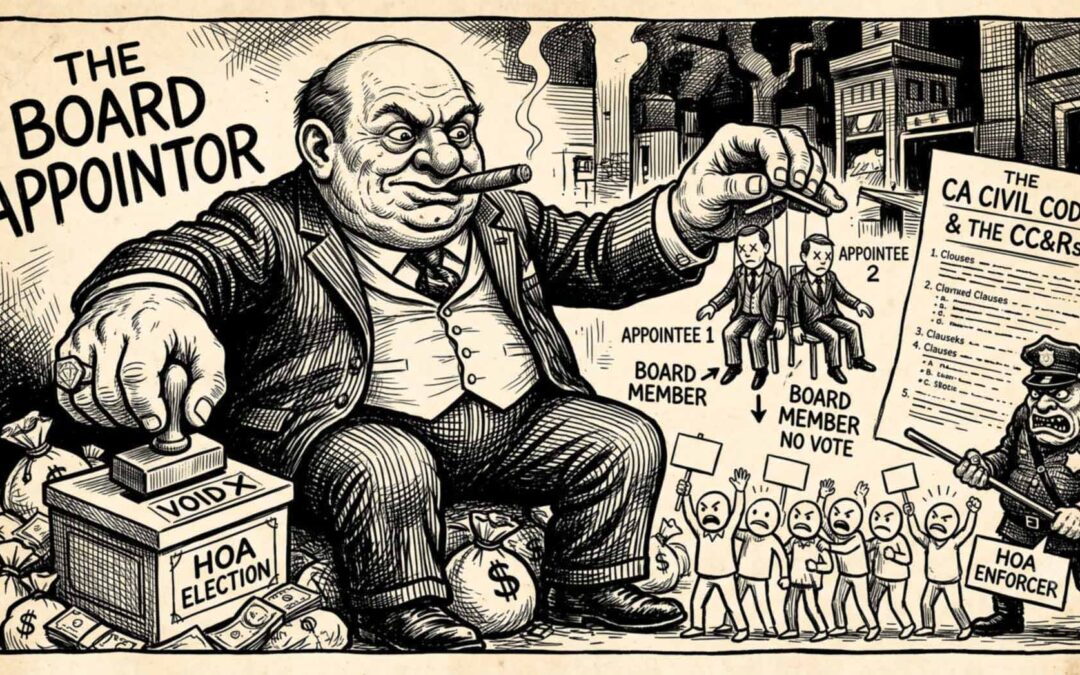
California law hands HOAs a quiet power that bad HOA boards have learned to weaponize. When a seat opens up, the board can usually fill it by appointment, with no vote of the members at all. That power exists for a sensible reason, which is to keep an HOA board functioning when a director resigns mid-term. Unfortunately, bad HOAs often exploit that power by letting elections fail and filling seats with hand-picked appointees.
The Davis-Stirling Act gives them the opening. When an HOA election draws too few voters to meet quorum, the law lets the HOA hold a second meeting at least 20 days later with the quorum lowered to 20%. That second meeting, however, is optional. A board that prefers the status quo isn’t required to call it. When no successors get elected, the sitting directors hold over and keep their seats until someone replaces them. So a bad HOA board can let an election collapse, decline to reconvene, fill any vacancy with an ally, and stay in control. Entrenchment through inaction is a deliberate strategy, not an accident. It happens enough to be a problem.
But homeowners aren’t stuck with that result. When an HOA is required to elect directors and fails to do so, a homeowner can petition the superior court to order the election. At that court-ordered election, the votes cast set the quorum by themselves, no matter how few members turn out and no matter what the bylaws or articles demand. That strips the board of its ability to hide behind low participation, and it gives homeowners a reliable way to force a binding election the board can’t stall or rig.
This Fact Sheet explains when a board may appoint a director instead of holding an election, how bad HOAs exploit the failed-quorum rules to entrench themselves, why a board can never override an actual vote count to install its own pick, and how homeowners can compel a real election through the courts. It also drives home the rule that decides every one of these disputes. Whenever an election is held and the votes are counted, the open seats go to the candidates with the most votes, never to a board’s chosen insider.
Key Points
The Davis-Stirling Act and the Corporations Code give HOA boards real authority to manage vacancies between elections, and a 2024 amendment to Civil Code 5115 added a tool meant to end the cycle of HOA elections that die for low voter turnout. That tool is voluntary, though, and a bad HOA board that wishes to remain in power following a stalled election will frequently refuse to use it. The points below discuss how HOAs can fill vacated seats on the board, what bad HOA boards do to keep power, and how homeowners can force a bad HOA to hold an election.
- The Board can usually fill a vacant seat by appointment. Unless the bylaws or articles state otherwise, Corporations Code 7224 empowers the HOA’s board to appoint a director to fill all but one type of director vacancy, and Corporations Code 7220 states that such an appointee will hold the vacated seat for the remainder of the predecessor’s unexpired term. When an HOA board refuses to fill a vacancy, Corporations Code 7224 allows the members to step in at any time and call a special election to fill the empty seat themselves.
- A seat left open by a director’s removal is the one vacancy an HOA board might not be able to fill on its own. Unless the HOA’s bylaws or articles explicitly provide otherwise, Corporations Code 7224 and 5034 require a member vote to fill a director’s seat left open by that director’s removal. For example, when the members vote out a director they believe has been mishandling reserve funds, absent explicit authority found in the bylaws or articles, the board can’t quietly install a replacement of its own choosing at the next board meeting.
- Civil Code 5115 lets homeowners salvage a low-turnout election with a 20% quorum. For years, HOAs with chronically low member participation in HOA elections couldn’t reach quorum to elect anyone, which left the same directors in their seats election after election. A 2024 amendment to Civil Code 5115, mirrored in Corporations Code 7512, now allows an HOA board to adjourn a failed election and reconvene it at least 20 days later with the quorum cut to 20% of the members. The Legislature built this amendment to push stalled elections across the finish line and break the grip of entrenched HOA boards.
- Bad HOA boards exploit the permissive language in Civil Code 5115 to keep the failure in place. Both Civil Code 5115 and Corporations Code 7512 say the HOA “may” reconvene at the reduced quorum, so the lower threshold the Legislature created to help homeowners never obligates the HOA board to do anything. A board that gains from the stalemate simply declines to call the second meeting. For example, an HOA board facing an organized slate of challengers can let the annual election fail for lack of quorum, then refuse to set the 20% reconvened meeting, knowing that no reconvened meeting means no new directors and no threat to the incumbents. The members did nothing wrong, turnout was the only problem, and the very provision meant to cure low turnout sits unused because the board won’t trigger it. [This is a genuine loophole. By making the reconvened meeting optional rather than mandatory, the Legislature handed a self-interested HOA board an easy way to neutralize the reform, and the fix would be a one-word change from “may” to “shall” once an election fails for lack of quorum. Until the Legislature closes it, homeowners can’t rely on the reconvened meeting alone and should be ready to move to the court remedy I discuss below.]
- Corporations Code 7220 keeps the sitting directors in place when an election produces no winner. Sitting directors hold office until their successors are elected and qualified, so a failed election removes no one. Bad HOA boards rely on this to hold power by electing not to set the lower quorum meeting permitted in Civil Code 5115. The result is a board that stays seated not because the members chose it, but because no valid election ever replaced it.
- An HOA’s board can never override a member vote to install its own pick. The appointment power reaches genuine vacancies and stops there. Once an election is held and the ballots are counted, the open seats go to the candidates with the most votes, and the board has no authority to set that result aside or substitute an insider. A bad board gains ground only when no valid election happens, which is why its entire strategy depends on preventing the count, not winning it. [If you’re interested in learning about how a proper election is supposed to run, read my Fact Sheet “California HOA Election Rules and Homeowner Rights.”]
- Corporations Code 7510 lets a single homeowner force the election in court. When an HOA fails to hold its required director election within the time the statute allows, any homeowner can petition the superior court to order the election. At that court-ordered election, Corporations Code 7510 makes the votes actually cast the quorum, regardless of how few members vote and regardless of any contrary quorum requirement contained in the bylaws or articles. [Because the reduced-quorum scheme in Civil Code 5115 is new, I couldn’t find any court decision applying the Corporations Code 7510 remedy to a board that games it by staging a quorum failure and then refusing to reconvene. The statutory logic, however, favors the homeowner. An HOA required to elect directors that deliberately leaves the election unfinished has failed to hold the meeting Corporations Code 7510 commands, and a court asked to order that election has every reason to grant the order and to treat the votes cast as the quorum.]
- Homeowners facing an entrenched HOA board should take action. A homeowner facing a stalled election should first demand in writing that the board call the 20% reconvened meeting that Civil Code 5115 authorizes, and organize enough neighbors to clear that threshold. If the board won’t reconvene, or refuses to seat the winners of an election that did happen, the homeowner should document the missed election, the refusal, and any appointments the board made in the meantime. Then, the homeowner should file an action in court to compel an election.
- If your HOA refuses to hold a board election or otherwise acts to contravene the will of the members, call the HOA attorneys at MBK Chapman. When a bad HOA board stalls elections, hides behind a failed quorum, or installs hand-picked appointees to keep control, the HOA attorneys at MBK Chapman can force a real election and return the open seats to the members. They’re among the most experienced and effective homeowner-side HOA attorneys in California, and they know how to use Corporations Code 7510 to compel a binding vote. If your HOA board is entrenching itself through a failed election, contact MBK Chapman today.
A board may fill genuine vacancies and may even decline to reconvene a failed election, but it cannot override a real vote count or seize a permanent hold on power the members never granted. Every legitimate election ends the same way, with the most votes taking the open seats. When a board tries to dodge that outcome by letting elections die, homeowners hold two levers that close the gap, the 20% reconvened meeting under Civil Code 5115 and a court order under Corporations Code 7510 that counts the votes cast no matter how few show up.
FAQs
Can a California HOA board appoint a director instead of holding an election?
Yes, for most vacancies. Unless the articles or bylaws provide otherwise, Corporations Code 7224 lets the board appoint someone to fill a vacancy, such as one created by a resignation, and Corporations Code 7220 keeps that appointee in the seat for the rest of the predecessor’s unexpired term. The board’s appointment power has limits, though. A seat left open by a director’s removal generally goes to the members, and if the board never fills a vacancy, the members can call a special election to fill it themselves.
What happens when an HOA election doesn’t reach quorum?
Nothing changes unless someone forces it to. The sitting directors hold over under Corporations Code 7220 and keep their seats until successors are elected and qualified, so a failed election removes no one. Civil Code 5115 lets the HOA reconvene the meeting at least 20 days later with the quorum cut to 20%, but that second meeting is optional. A board that benefits from the stalemate can decline to call it and let the failure stand. This could be fixed if the Legislature changed the word “may” to “shall,” but until that happens, homeowners will have to work to compel a bad HOA to use the lower-quorum requirement added to Civil Code 5115 in 2024.
Can my HOA board refuse to hold the lower-quorum meeting on purpose?
Yes, and that’s the loophole. Both Civil Code 5115 and Corporations Code 7512 say the HOA “may” reconvene at the reduced 20% quorum, which means no statute forces the board to do it. A board facing serious challengers can let the annual election fail for lack of quorum, then refuse to set the reconvened meeting, which keeps the incumbents in place and the challengers out. The provision meant to cure low turnout sits unused because the board won’t trigger it. The Legislature could close this loophole by changing the word “may” to “shall,” but until that happens, homeowners will have to work to compel a bad HOA to use the lower-quorum requirement added to Civil Code 5115 in 2024.
How can homeowners force their HOA to hold a real election?
By going to court. When an HOA fails to hold its required director election within the time the statute allows, a single member can petition the court under Corporations Code 7510 to order the election. At that court-ordered election, the votes actually cast set the quorum by themselves, no matter how few members vote and no matter what quorum the bylaws or articles require. That removes a bad HOA board’s ability to hide behind low turnout because participation can no longer block the result.

About Michael Kushner
Michael Kushner is a California attorney with over 30 years of experience representing homeowners in disputes with their HOAs. He is widely regarded as California’s leading homeowner-side HOA attorney, and has built one of the state’s most prominent law practices dedicated to holding HOAs accountable under the Davis-Stirling Act and California law.
In addition to his law firm’s work, Michael is a recognized lecturer, author, and the host of the hit HOA HELL podcast, where he provides homeowners living in HOA-governed communities with clear, practical strategies for dealing with bad HOAs. He’s also the author of the best-selling book, HOA HELL | California Homeowners’ Definitive Guide to Beating Bad HOAs, which has become a go-to resource for both homeowners seeking real-world solutions to their HOA disputes, as well as those good HOA board members who are interested in doing a good job.
About MBK Chapman Fact Sheets
Homeowners searching for answers online will often come across articles that appear authoritative, but are actually written as search-engine marketing content rather than by an experienced HOA lawyer. These pieces tend to prioritize keyword density over clarity, accuracy, or legal context, which often leaves homeowners more confused than informed.
At MBK Chapman, our Fact Sheets are part of our HOA Law Library and are written by Michael Kushner, an HOA lawyer with decades of hands-on experience representing California homeowners. In fact, Michael Kushner is the HOA lawyer who pioneered the systems and strategies used by some of California’s most successful homeowner-side HOA law firms.
Each Fact Sheet is deliberately concise, statute-based, and designed as a quick-reference guide to help homeowners understand key HOA laws and enforcement rules at a glance.
AND DON’T FORGET TO TUNE INTO MY PODCAST, HOA HELL
YOU CAN ALSO ORDER MY GROUNDBREAKING BOOK
HOA HELL | California Homeowners’ Definitive Guide to Beating Bad HOAs
Amazon | Barnes & Noble
