
Overview
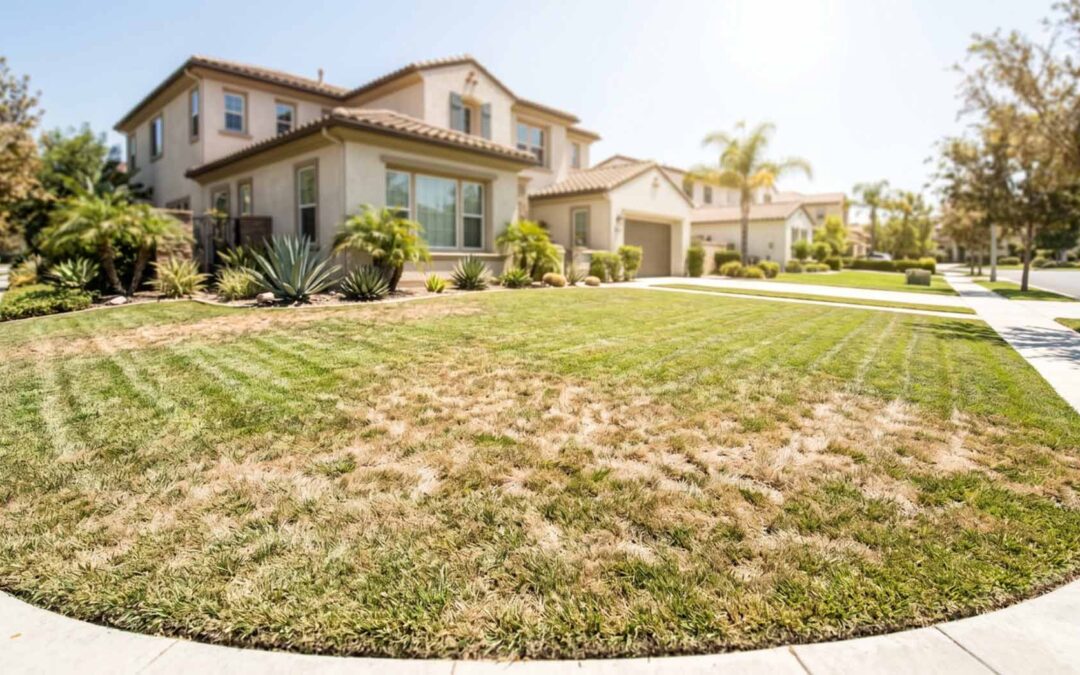
Summer water bills climb, local watering restrictions tighten, and more California homeowners let a thirsty lawn go brown or replace it with low-water landscaping. Then the violation letter shows up, demanding that the homeowner restore a green lawn or face a fine. The question is whether a California HOA has the power to do that.
In most of these situations, the answer is no, because California law limits an HOA sharply here. When a homeowner lets a lawn turn brown to comply with a declared drought emergency or government-imposed water restrictions, the HOA can’t fine the homeowner for it. An HOA also can’t ban drought-resistant landscaping or low-water plants on aesthetic grounds, even when neighbors complain or the HOA would prefer uniform green lawns across the community.
Those protections aren’t unlimited, though, and homeowners get into trouble when they assume otherwise. An HOA can still require architectural approval before a homeowner makes visible changes to a yard, and outside a declared emergency or an active watering restriction, an HOA may enforce genuinely reasonable maintenance standards (such as green lawns).
California also keeps tightening its water rules, and a new state law is now phasing in a ban on irrigating purely decorative grass with drinking water (i.e., potable water). Because of some stories about HOAs and brown lawns circulating on the internet, including some from other states, many homeowners are now aware of that law, but not its details. The detail that matters most is who that law actually governs. It restricts an HOA’s watering of decorative grass in the common areas, the medians, parkways, and entry strips the HOA itself maintains. It says nothing about a homeowner’s private yard. So a homeowner who hears “new law banning grass” or banning watering their lawns and panics has it backward, and an HOA that cites the new law to justify fining a homeowner over a brown front lawn has no ground to stand on.
This Fact Sheet does three things. First, it explains exactly when a California HOA can fine a homeowner over a brown or dying lawn, including the protections most homeowners have and the real limits on those protections that the quick online summaries gloss over. Second, it separates a homeowner’s own yard from the HOA’s very different common-area water duties under the new state law. Third, it gives a homeowner the concrete steps to take when an HOA ignores those lines and threatens a fine anyway.
Key Points
A brown-lawn dispute almost always involves two separate legal questions, not one, and a homeowner who blurs them together usually loses the argument. The first is what a California HOA can do about a homeowner’s own yard, which is partially governed by Civil Code 4735. The second is what an HOA must do about the decorative grass in its own common areas, which a new state water law called AB 1572 controls. The points below work through both, including the protections most homeowners have, the limits the quick online summaries skip, and the steps to take when an HOA threatens a fine anyway.
- Civil Code 4735 bars a California HOA from fining a homeowner for a brown lawn when the homeowner is complying with a drought emergency or mandated water restriction. Civil Code 4735 prohibits an HOA from penalizing a homeowner for reducing or stopping irrigation during a drought emergency declared by the state or a local government, or under a government-imposed water restriction. If, for example, a city limits outdoor watering to one day a week and a homeowner’s lawn browns as a result, the HOA can’t fine the homeowner for the brown grass, no matter how much the HOA dislikes the look. The protection is tied to the mandate, so the controlling fact is whether a declared emergency or active restriction is in effect.
- Civil Code 4735 also gives a homeowner a standing right to replace a lawn with drought-resistant landscaping, and that right doesn’t depend on any drought emergency. This protection is separate from the brown-lawn rule and applies all the time. An HOA can’t prohibit low-water or native plants, gravel, bark, or artificial turf on aesthetic grounds, even when no emergency is declared, even when neighbors complain, and even when the HOA would prefer uniform green lawns. So an HOA that rejects a homeowner’s artificial-turf or native-plant proposal because it “doesn’t match the neighborhood” is violating the statute. The law deliberately puts water conservation ahead of uniform appearance. [For a deeper dive on a homeowner’s right to install drought-resistant landscaping, see my article, “Drought-Resistant Landscaping & California HOAs: Your Legal Rights Explained.”]
- Outside a declared drought emergency or active water restriction, an HOA may still enforce reasonable lawn-maintenance standards. This is the limit most online summaries skip. Civil Code 4735’s anti-fine protection is tied to a mandate, so it shields a homeowner who browns a lawn to comply with a restriction, not a homeowner who simply stops watering to save money when no restriction is in effect. A homeowner who lets a yard collapse into dead dirt and weeds with no emergency in play can face a valid fine for failing to maintain the property.
- A homeowner still has to go through the HOA’s architectural approval process, even for protected water-wise landscaping. Civil Code 4735 protects the right to install drought-resistant landscaping, but it doesn’t erase an HOA’s right to require approval for visible changes and to impose genuinely reasonable conditions, such as the type of low-water plants permitted. What an HOA can’t do is deny a compliant proposal because it generally dislikes the look of drought-resistant plants (e.g., succulents or turf).
- An HOA can regulate the types of drought-resistant landscaping a homeowner installs, but only if its governing documents grant that power and only going forward. Civil Code 4735 protects a homeowner’s right to install drought-resistant landscaping, but it doesn’t strip an HOA of all say over what that landscaping looks like. If the governing documents give the HOA explicit authority to set landscaping standards, the HOA can require things like desert-style plantings or particular materials for new installations. Civil Code 4350 requires any such rule to be reasonable and properly adopted. What an HOA can’t do, therefore, is apply those standards retroactively by ordering a homeowner to tear out an existing, previously approved lawn or landscape at the homeowner’s own expense. Such actions are simply not reasonable under any objective standard. That timing distinction is the whole ballgame. Prospective standards grounded in the governing documents can stand. Retroactive mandates almost never do. It’s exactly why HOAs in hot, dry areas like Palm Springs have enforced rules requiring desert plantings for future landscaping changes while leaving prior, approved yards untouched.
- California’s AB 1572 will eventually bar an HOA from using drinking water on its decorative common-area grass. Effective January 1, 2029, AB 1572, codified in relevant part in Water Code 110 and Water Code 10608.114, institutes a ban on irrigating “nonfunctional” turf, meaning purely decorative grass, with potable (drinking) water. That statute effectively only applies to the decorative common-area grass the HOA maintains, like medians, parkways, and entry strips. It doesn’t touch a homeowner’s own front or back yard, and water agencies have said that even a front lawn the HOA happens to irrigate stays outside the law when the lawn is tied to an individual home. Notably, under AB 1572, grass actually used for recreation or gatherings is exempt as “functional” turf.
- Even though AB 1572 governs the common areas, homeowners can end up paying for it through a special assessment. The law won’t force an HOA to rip its grass out. It bars watering decorative common-area turf with drinking water, which leaves an HOA three ways to comply: switch that turf to recycled water, convert the turf to drought-resistant landscaping, or keep the grass only where it genuinely serves recreation and qualifies as exempt functional turf. The recycled-water option sounds easy but usually isn’t because recycled water runs through a separate “purple pipe” system that a lot of residential HOAs aren’t connected to. And building a connection is cost-prohibitive for a typical association. That leaves conversion as the realistic path for most HOAs, and conversion is a capital project. Replacing common-area turf with plants, drip irrigation, and mulch commonly runs from a few dollars to the low teens per square foot, so even a 10,000 to 20,000 square foot common-area conversion climbs well into the tens of thousands of dollars, and larger communities far more. Rebates offset part of the cost, with water-district programs currently paying anywhere from roughly $2 to $9 per square foot, though many cap the total dollars and run first-come, first-served until the earmarked funding is gone. An HOA that never budgeted or reserved for this may cover the gap with a special assessment, and because noncompliance carries penalties of up to $1,000 per day enforced by the State’s water agencies, an HOA that stalls toward the 2029 deadline will feel real pressure to spend. So for many homeowners, the practical effect of AB 1572 may be a special assessment.
- When an HOA threatens a fine over a brown or dying lawn, a homeowner’s job is to pin down the HOA’s authority and the homeowner’s own protections in writing before the dispute hardens. A homeowner who reacts with anger, or who simply ignores the violation letter and hopes it goes away, is just giving the HOA a needless hand up. The wise homeowner will build a clear, dated record of the controlling law and the facts, and then put the HOA on the defensive. Most of the steps outlined below cost nothing but a little time, and each one strengthens the homeowner’s position if the dispute escalates.
- Confirm whether a drought emergency or water restriction is in effect. Civil Code 4735’s protection against fines turns entirely on this point, so a homeowner should check with the city, the county, and the local water district to see whether a watering restriction or a declared drought emergency covers the period in question. If one does, the homeowner should save a dated copy of the order or notice and write down the exact dates it applies. That single document is often the strongest proof that a brown lawn is protected and the fine is illegal.
- Make the HOA cite its exact authority in writing. A homeowner should send a written demand requiring the HOA board to identify the specific CC&R provision, rule, or guideline the lawn supposedly violates, and then cite Civil Code 4735 and Civil Code 4350 back to the HOA in the same letter. This forces the HOA either to ground its position in a properly adopted, reasonable standard or to reveal that it has none. If the HOA can’t point to real authority, the fine almost certainly can’t stand, and the homeowner now has a written record showing the right questions were asked and dodged.
- Choose replacement over neglect. A homeowner who wants to stop pouring water and money into a lawn should replace it with drought-resistant landscaping through the HOA’s approval process, which Civil Code 4735 protects, rather than let the lawn die when no emergency is in effect. The difference is decisive because the statute shields a homeowner who installs low-water landscaping but offers nothing to a homeowner who simply lets a yard collapse into dead grass and weeds with no mandate in play. Replacing the lawn keeps the homeowner inside the protection. Neglecting it forfeits the protection.
- Keep every communication factual and calm. A homeowner should write each letter and email as though a judge or an arbitrator will eventually read it, since one might, and should leave out insults, threats, and exaggeration. Calm, specific, well-documented messages make a homeowner look credible and reasonable. Angry ones hand the HOA an easy excuse to recast the homeowner as the troublemaker instead of answering for its own conduct.
- Know the leverage. A fine that violates Civil Code 4735 is unenforceable, and the prevailing party in an enforcement action recovers attorneys’ fees under Civil Code 5975, which gives a well-prepared homeowner real weight. Experienced HOA attorneys, like the ones I employ at MBK Chapman, use that their knowledge of that exposure to push bad HOAs to back down.
- If your HOA is fining you over a brown or dying lawn, or attempting to block you from planting drought-resistant landscaping, call the HOA attorneys at MBK Chapman. A penalty that violates Civil Code 4735 is unenforceable, and an HOA that loses an enforcement action will be ordered to pay your attorneys’ fees under Civil Code 5975. The homeowner-side HOA attorneys at MBK Chapman know the difference between what an HOA may genuinely require and what it’s simply inventing, and they know how to separate a homeowner’s protected yard from the HOA’s own common-area water obligations. If an HOA is threatening a fine over a lawn that California law protects, contact us and we’ll set the HOA straight.
A brown or dying-lawn fight comes down to who controls what. Civil Code 4735 protects a homeowner two ways. It shields a homeowner who lets a lawn brown under a drought emergency or water restriction, and it shields a homeowner who replaces a lawn with drought-resistant landscaping. The HOA keeps real authority too. It can require approval, set prospective landscaping standards its governing documents authorize, and enforce reasonable upkeep when no mandate applies. AB 1572 stands apart from all of this because it governs the drinking water an HOA uses on its own decorative common-area grass starting in 2029. It has nothing to do with a homeowner’s private property. The likeliest way that law ever reaches a homeowner is through the cost of common-area conversion, which can surface as a special assessment. So confirm whether a mandate is in effect, make the HOA prove its authority in writing, and replace a lawn rather than neglect it.
FAQs
Can my California HOA fine me for a brown or dead lawn?
Usually not, if a drought emergency or government water restriction is in effect, because Civil Code 4735 bars an HOA from fining a homeowner for reducing or stopping irrigation to comply with a state or local mandate. The key fact is whether a declared emergency or active restriction actually covers the period in question, so a homeowner should confirm that with the city, county, or water district and save a dated copy. Outside a mandate, however, an HOA can enforce reasonable maintenance standards against a yard left to die.
Can my HOA stop me from replacing my lawn with drought-resistant landscaping or artificial turf?
No. Civil Code 4735 protects a homeowner’s right to install low-water plants, native landscaping, and artificial turf, and an HOA can’t deny that choice on aesthetic grounds, even when neighbors complain. An HOA can still require architectural approval for visible changes and impose reasonable, content-neutral conditions. If the governing documents authorize it, the HOA can also set standards for the type of landscaping, but only for future installations, never by forcing a homeowner to tear out an existing, previously approved yard.
Does the new California law banning grass mean I have to remove my lawn?
No. For your purposes, all AB 1572 does is ban HOAs from using drinking water on purely decorative “nonfunctional” grass. It only applies to an HOA’s common areas, not a homeowner’s private front or back yard, and the HOA deadline doesn’t arrive until January 1, 2029. It doesn’t require ripping grass out, and it doesn’t reach grass used for recreation.
Could AB 1572 cost me money even though it targets the HOA's common areas?
It could. A lot of residential HOAs aren’t connected to a recycled-water system, so other than paying to make that connection, which is extremely expensive, the more realistic solution for HOAs is to convert decorative common-area turf to drought-tolerant landscaping. But even that, while less expensive than the other option, could run well into the tens of thousands for larger communities. Rebates offset part of that cost, but an HOA that never budgeted or reserved for the work may fund the shortfall through a special assessment. So for many homeowners, the practical effect of AB 1572 will arrive as a special assessment.

About Michael Kushner
Michael Kushner is a California attorney with over 30 years of experience representing homeowners in disputes with their HOAs. He is widely regarded as California’s leading homeowner-side HOA attorney, and has built one of the state’s most prominent law practices dedicated to holding HOAs accountable under the Davis-Stirling Act and California law.
In addition to his law firm’s work, Michael is a recognized lecturer, author, and the host of the hit HOA HELL podcast, where he provides homeowners living in HOA-governed communities with clear, practical strategies for dealing with bad HOAs. He’s also the author of the best-selling book, HOA HELL | California Homeowners’ Definitive Guide to Beating Bad HOAs, which has become a go-to resource for both homeowners seeking real-world solutions to their HOA disputes, as well as those good HOA board members who are interested in doing a good job.
About MBK Chapman Fact Sheets
Homeowners searching for answers online will often come across articles that appear authoritative, but are actually written as search-engine marketing content rather than by an experienced HOA lawyer. These pieces tend to prioritize keyword density over clarity, accuracy, or legal context, which often leaves homeowners more confused than informed.
At MBK Chapman, our Fact Sheets are part of our HOA Law Library and are written by Michael Kushner, an HOA lawyer with decades of hands-on experience representing California homeowners. In fact, Michael Kushner is the HOA lawyer who pioneered the systems and strategies used by some of California’s most successful homeowner-side HOA law firms.
Each Fact Sheet is deliberately concise, statute-based, and designed as a quick-reference guide to help homeowners understand key HOA laws and enforcement rules at a glance.
AND DON’T FORGET TO TUNE INTO MY PODCAST, HOA HELL
YOU CAN ALSO ORDER MY GROUNDBREAKING BOOK
HOA HELL | California Homeowners’ Definitive Guide to Beating Bad HOAs
Amazon | Barnes & Noble
