
Overview
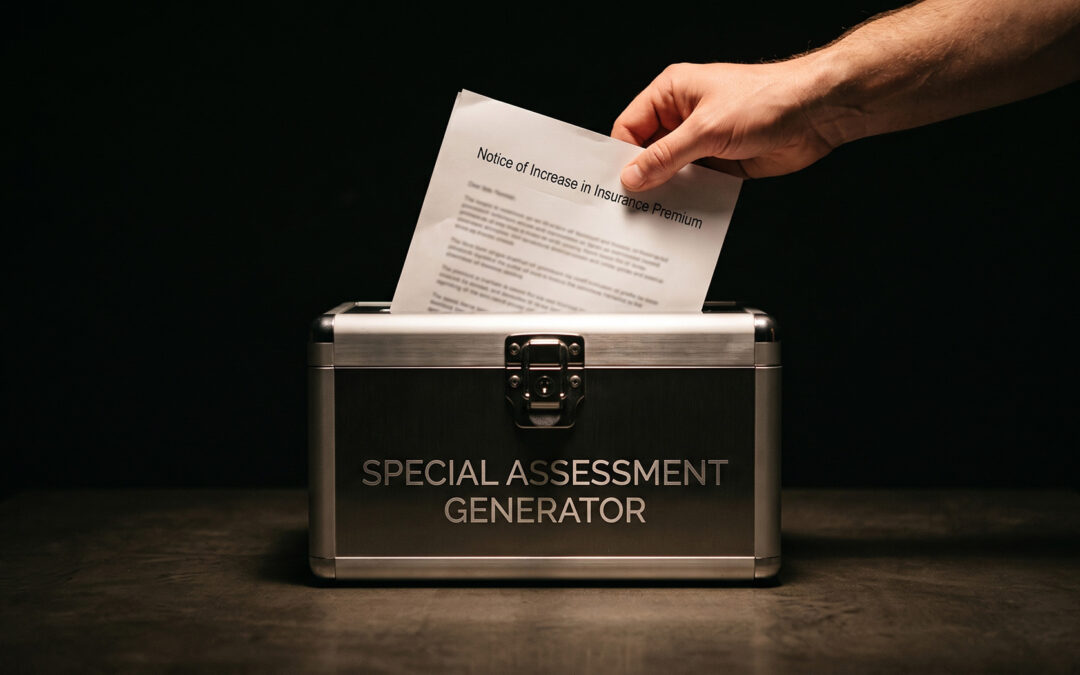
California is in the middle of an insurance crisis, and both good and bad HOAs are caught in it alongside the homeowners who live in them. Large carriers have pulled out of the state entirely or sharply limited what they’ll cover, and coverage that used to be routine has become expensive and hard to find. HOAs facing that crisis are turning to special assessments, which means homeowners are paying ever increasingly higher bills for insurance that they thought their dues already covered.
Some of those HOAs got caught by a market they couldn’t control. An HOA that budgeted honestly in the fall can get a notice of non-renewal in the spring and a replacement policy that costs three times as much, with a deadline that leaves no time to run an election. A bad HOA, on the other hand, might budget poorly, ignore years of warnings from their own industry, and then call the shortfall an emergency so that they don’t have to ask their members for permission.
The Davis-Stirling Act treats those two HOAs the same way. While special assessments over a certain size require a vote of the membership, HOAs can only bypass that vote in a few explicitly defined situations. None of those applies to funding an unexpected insurance-related shortfall. [There is, however, an argument championed by some HOA-side law firms in California who believe the opposite. I address that issue in detail below.]
This Fact Sheet explains when California HOAs can impose a special assessment to cover rising insurance costs, when the Davis-Stirling Act requires a vote of the membership first, and why the emergency exceptions HOA boards reach for don’t cover an insurance bill.
Key Points
California’s current insurance crisis has left a lot of HOAs with ever increasing bills that, for bad or for worse, they never budgeted for, and a lot of HOAs have turned to imposing special assessments to cover the shortfalls. Premiums have doubled (or worse), large carriers have completely left the market, or greatly reduced what used to be standard coverage, and deductibles have climbed steadily in the face of staggering insurance costs. And all of this must ultimately be paid for by the homeowners. The Davis-Stirling Act does let HOAs use special assessments to cover insurance costs, but as I’ve written in other Fact Sheets, it places strict limitations on what HOA boards can do without input from the members. The points below briefly explain the nature of the insurance crisis plaguing California HOAs (and homeowners), how and when HOAs can use the power to impose special assessments to help address the crisis, and why the emergency powers some HOA boards rely on during a crisis don’t apply to an insurance bill.
- California is in the middle of an insurance crisis, and HOAs are getting hit as hard as anyone. Numerous large and well-known carriers have stopped offering insurance to homeowners and HOAs, leaving many of them with no choice but to participate in California’s FAIR Plan, the state’s insurer of last resort. The state has expanded FAIR Plan commercial limits twice in recent years specifically because HOAs were getting priced out or shut out entirely. But FAIR Plan coverage is narrower than a standard master policy, so HOAs that land there frequently buy a second policy to fill the gaps, and even when that option is available, it’s extremely expensive. Meanwhile the “lucky” HOAs that are still in the normal market have found themselves facing massive increase for the same (or on some occasions, even less) coverage. [I explain what the FAIR Plan is in my Fact Sheet, “Altadena & Palisades Fires: Why California FAIR Plan Insurance Isn’t Enough to Rebuild.”]
- Many HOAs facing this crisis have cut premiums by raising deductibles, which just shifts the burden onto homeowners. An HOA facing a renewal it can’t afford can bring the premium down by accepting a much larger deductible, and carriers price that trade aggressively. For example, deductibles that used to sit at $5,000 might now be double or triple (or even more) in wildfire and water damage zones. The savings show up in the HOA’s budget, but the exposure shows up in the homeowners’ lives if a loss event occurs.
- HOAs can impose special assessments to cover increasing insurance costs. Civil Code 5605 prohibits HOA boards from imposing special assessments that in the aggregate exceed 5% of the HOA’s budgeted gross expenses for that fiscal year without approval from a majority of a quorum of the members. Below that ceiling, HOA boards can act alone, and an insurance premium is as legitimate a reason as any other to impose a special assessment. So, to the extent that special assessments fall below the 5% threshold, HOAs can impose them to pay for rising insurance costs. Likewise, any special assessments approved by homeowners in a secret ballot vote could also be used to pay for insurance-related expenses. [To learn about how special assessments work and the grounds for challenging one, read my Fact Sheet, “California HOA Special Assessments: What They Are, When They’re Legal, and How Homeowners Can Challenge Them.”]
- The Davis-Stirling Act uses the word “aggregate” for a reason. Civil Code 5605 exists to prevent bad HOAs from breaking one large assessment into two or three smaller ones across the same fiscal year as an end run around the 5% limitation. An HOA with $800,000 in budgeted gross expenses, for example, can levy $40,000 in total special assessments that year without asking for permission from the membership. But anything above that number, regardless of how that number is broken up, would require a membership vote.
- Civil Code 5610 lets HOAs skip the membership vote in the case of an emergency, but paying for insurance doesn’t qualify. Civil Code 5610 allows HOA boards to impose a special assessment over the 5% threshold without a membership vote if the expense falls into one of three narrow emergencies. The first covers an extraordinary expense a court orders the HOA to pay. The second covers an extraordinary expense necessary to operate, repair, or maintain the development when the HOA discovers a threat to personal health or safety, or another hazardous condition on the property. And the third covers an extraordinary expense necessary to repair or maintain the development that the HOA board couldn’t have reasonably foreseen when it prepared the annual budget report. Read those three together and the problem for HOAs becomes obvious. When it comes to paying for insurance, there’s rarely a court order behind it, it doesn’t qualify as a hazardous condition, and paying for insurance has nothing to do with maintaining or repairing the property. [I break down all three emergency exceptions and the rest of the no-vote rules in my Fact Sheet, “When Can a California HOA Raise Assessments Without a Vote?”]
- Some HOA-side lawyers read Civil Code 5610 to cover insurance premiums, but I think they’re dead wrong. I’m flagging this as a real dispute because at least one prominent HOA-side firm in California has published the opposite conclusion in an article. Its argument basically states that because Civil Code 5610(c) speaks of maintaining the “common interest development” rather than the “common area,” the exception includes operations (i.e., operational expenses). This argument would support an HOA’s authority to impose an emergency special assessment to cover a sudden, unbudgeted spike (beyond the 5% threshold) in insurance premiums without a membership vote. The firm goes further and argues that an expense like this couldn’t be put to the membership at all, reasoning that if the members voted it down the HOA would still have to buy the coverage its CC&Rs require, and that letting the policy lapse would expose the board to liability if a loss followed. I’ll grant that the first half of the argument isn’t frivolous. The Legislature does know the difference between “common interest development” and “common area,” and the Davis-Stirling Act uses the word “maintain” in the insurance sense elsewhere, including in Civil Code 5806. And yet, that reading ignores the text in Civil Code 5610(b), which describes the second emergency as an extraordinary expense necessary to “operate, repair, or maintain” the development (while 5610(c) only refers to an expense necessary only to “repair or maintain” the development). In other words, the Davis-Stirling Act used “operate” in 5610(b) and then explicitly left that word OUT of 5610(c)—the provision that these HOA-side firms rely on to justify their use of this emergency exception. If the word “maintain” already covered an HOA’s operating expenses, then what purpose did including the word “operate” serve in 5610(b)? None, it seems. The second half of the firm’s argument troubles me more because it treats the HOA board’s obligation to buy insurance as a reason to strip the members of a vote the Davis-Stirling Act mandates be given to them. Civil Code 5605 doesn’t contain an exception for assessments that an HOA board considers too important to lose. A board facing a coverage lapse has other options, including a regular assessment increase within the 20% ceiling, obtaining a loan, or using reserves. But the risk that members might vote no isn’t a legal basis for never asking them or for receiving their permission. Although I believe that my position is the far stronger one, I do acknowledge that no California appellate court has ruled on this issue, so nobody knows for sure whether HOAs can legally use 5610(c) to pass an emergency assessment to cover an unbudgeted insurance spike.
- If your California HOA levied a special assessment to cover its insurance costs, call the HOA attorneys at MBK Chapman. MBK Chapman is one of the most respected homeowner-side HOA law firms in California, and we’ve spent years forcing HOAs to justify assessments they never had the authority to impose. Our HOA attorneys know exactly what Civil Code 5605 lets an HOA board do on its own, what the Davis-Stirling Act requires it to put to the membership, and how to take apart an emergency claim built on a statute that isn’t supposed to apply to paying an insurance bill.
The insurance crisis is real, and HOAs didn’t create it. But nothing about a hard market suspends the Davis-Stirling Act. Civil Code 5605 lets HOA boards impose special assessments (including to pay for insurance) up to 5% of budgeted gross expenses. Anything beyond that threshold requires member approval in a secret ballot election. While many HOAs have taken the position that Civil Code 5610(c) authorizes HOAs to skip that vote under an emergency exception, I believe that such a position is contrary to the plain language of the statute. It’s true, however, that this debate won’t be resolved until the appellate court or the Legislature addresses it directly.
FAQs
Can my California HOA charge a special assessment to pay for insurance?
Yes, within limits. Civil Code 5605 lets an HOA board impose special assessments that in the aggregate stay at or below 5% of the HOA’s budgeted gross expenses for that fiscal year without asking anyone, and covering an insurance premium is a legitimate use of that authority. Above that 5% figure, Civil Code 5605 requires approval from a majority of a quorum of the members. So a special assessment for insurance is perfectly lawful if it falls under the ceiling, or if it clears the ceiling and the members approved it by secret ballot.
How much can my California HOA assess for insurance without a membership vote?
The ceiling is 5% of the HOA’s budgeted gross expenses for that fiscal year, and Civil Code 5605 measures every special assessment levied that year in the aggregate. An HOA with $800,000 in budgeted gross expenses can levy $40,000 in total special assessments without member approval, spread across the entire membership rather than charged per household. The word “aggregate” is what stops an HOA board from breaking one large assessment into two or three smaller ones across the same fiscal year to stay under the line. Anything beyond that total requires a vote no matter how the HOA divides it up.
Can my California HOA call an insurance premium increase an emergency and skip the vote?
Civil Code 5610 lets an HOA board exceed the 5% ceiling without a vote in three situations, and an insurance premium doesn’t fit any of them. The first requires a court order. The second requires the HOA to discover a threat to personal health or safety or another hazardous condition on the property. The third requires an extraordinary expense necessary to repair or maintain the development that the HOA board couldn’t have reasonably foreseen when it prepared the annual budget report. Paying an insurance premium isn’t ordered by a court, isn’t a hazardous condition anyone discovered, and doesn’t repair or maintain the property.
Isn’t there an argument that Civil Code 5610 does cover insurance costs?
There is, and at least one prominent HOA-side firm in California has published it. The argument is that Civil Code 5610(c) speaks of maintaining the “common interest development” rather than the “common area,” which those HOA-side law firms read as including operational expenses like insurance. That reading, however, ignores Civil Code 5610(b), which describes its emergency as an expense necessary to “operate, repair, or maintain” the development, while 5610(c) covers only an expense necessary to “repair or maintain” it. The Legislature used “operate” in one subdivision and left it out of the next. They did that for a reason. So if they meant “maintain” to mean “operate” in 5610(c), why didn’t the Legislature use the word “operate” in 5610(c) like it did in 5610(b)? That being said, no California appellate court has ruled on the question, so it stays open until an appellate court or the Legislature addresses it directly.

About Michael Kushner
Michael Kushner is a California attorney with over 30 years of experience representing homeowners in disputes with their HOAs. He is widely regarded as California’s leading homeowner-side HOA attorney, and has built one of the state’s most prominent law practices dedicated to holding HOAs accountable under the Davis-Stirling Act and California law.
In addition to his law firm’s work, Michael is a recognized lecturer, author, and the host of the hit HOA HELL podcast, where he provides homeowners living in HOA-governed communities with clear, practical strategies for dealing with bad HOAs. He’s also the author of the best-selling book, HOA HELL | California Homeowners’ Definitive Guide to Beating Bad HOAs, which has become a go-to resource for both homeowners seeking real-world solutions to their HOA disputes, as well as those good HOA board members who are interested in doing a good job.
About MBK Chapman Fact Sheets
Homeowners searching for answers online will often come across articles that appear authoritative, but are actually written as search-engine marketing content rather than by an experienced HOA lawyer. These pieces tend to prioritize keyword density over clarity, accuracy, or legal context, which often leaves homeowners more confused than informed.
At MBK Chapman, our Fact Sheets are part of our HOA Law Library and are written by Michael Kushner, an HOA lawyer with decades of hands-on experience representing California homeowners. In fact, Michael Kushner is the HOA lawyer who pioneered the systems and strategies used by some of California’s most successful homeowner-side HOA law firms.
Each Fact Sheet is deliberately concise, statute-based, and designed as a quick-reference guide to help homeowners understand key HOA laws and enforcement rules at a glance.
AND DON’T FORGET TO TUNE INTO MY PODCAST, HOA HELL
YOU CAN ALSO ORDER MY GROUNDBREAKING BOOK
HOA HELL | California Homeowners’ Definitive Guide to Beating Bad HOAs
Amazon | Barnes & Noble
