
Overview
Homeowners living in California HOAs often assume that if their HOA board is acting unfairly, abusively, selectively, retaliatorily, or even illegally, then the law will naturally protect them once the truth comes out. That assumption causes enormous damage. In the real world, homeowners frequently lose out against bad HOAs not because their underlying position lacks merit, but because they make avoidable strategic mistakes early in the dispute.
Some homeowners, for example, stop paying assessments out of frustration or because they genuinely believe the assessment to be illegal. Others rely on verbal conversations instead of creating a written paper trail. Many wait far too long before consulting experienced California HOA lawyers, like the ones at MBK Chapman. And some homeowners rely on misinformation spread through social media outlets like Reddit, Facebook, YouTube comments, AI-generated summaries, directors, or neighbors who confidently repeat legal myths that are flatly wrong under the Davis-Stirling Act. And perhaps most damaging of all, many homeowners allow HOA disputes to become emotional wars instead of disciplined, evidence-driven conflicts grounded in statutes, documentation, and strategy. [The AI-generated summaries to which I’m referring may well include those attorneys/professional promoters who aggressively market themselves as HOA experts despite the fact that their writing is full of massive legal errors. For a few examples of that, look at my various Fact Sheets featuring the “bad HOA attorney” (most of which are notated by a clown featured in the thumbnail).]
These mistakes create predictable problems across virtually every type of HOA dispute imaginable, including disputes involving assessments, liens, foreclosures, fines, architectural denials, selective enforcement, harassment, elections, maintenance obligations, neighbor conflicts, executive session abuse, Open Meeting Act violations, records requests, reserve issues, solar panels, parking disputes, hearing procedures, discipline, IDR, ADR, and attorneys’ fees. In many cases, homeowners unintentionally strengthen the HOA’s position by creating bad evidence, waiving rights, failing to preserve good evidence, missing critical deadlines, escalating conflicts emotionally, or misunderstanding how California HOA law operates in practice. Unfortunately, bad HOAs and their attorneys capitalize on these mistakes to the detriment of the homeowner.
This Fact Sheet identifies the five most common strategic mistakes that California homeowners make when fighting with their HOAs and explains why those mistakes can dramatically weaken an otherwise valid dispute. It also explains how experienced HOA attorneys, such as those at MBK Chapman, evaluate these situations, why documentation and timing matter so much, how homeowners accidentally sabotage their own credibility, and why many of the most widely repeated HOA “rules” online are legally inaccurate or dangerously incomplete. Understanding these issues early can significantly improve a homeowner’s leverage, reduce unnecessary legal exposure, and prevent a manageable dispute from spiraling into a financially devastating one.
Many homeowners enter HOA disputes believing that passion, persistence, or “common sense fairness” will ultimately control the outcome. Neither California law nor the real world operates that way. Homeowners who wish to defeat their HOAs from HELL must be smart about how they approach their disputes, and only then can they hope to win. Homeowners who understand that reality place themselves in a far stronger position than homeowners who react emotionally, rely on myths, or assume that a bad HOA board will eventually “do the right thing” on its own.
[An excellent companion piece to this Fact Sheet is one titled “How to Sue Your California HOA: A Step-by-Step Guide.” You can also watch our podcast episode dedicated to these same five mistakes:]
Key Points
Homeowners fighting their HOAs rarely lose because the facts or law are against them. Rather, they lose because they frequently lack an understanding of the applicable procedural and legal requirements and because they act emotionally instead of strategically. Bad HOA boards and their attorneys know this. They understand that many homeowners act impulsively, create or rely on weak evidence, ignore procedural requirements, rely on misinformation, or wait too long before seeking help from experienced HOA attorneys. Once those mistakes occur, correcting them becomes far more expensive and difficult, if not impossible. In many cases, the homeowner’s underlying complaint remains valid, but the homeowner’s own conduct significantly weakens the ability to resolve the problem efficiently or favorably.
The top five common mistakes discussed below are ones we see appear repeatedly across virtually every aspect of HOA life, from disputes involving assessments, liens, foreclosures, and fines, to those relating to selective enforcement, elections, maintenance obligations, architectural issues, and neighbor conflicts. Understanding these mistakes early allows homeowners to preserve their rights and their leverage, strengthen their evidence, avoid unnecessary escalation, and make far more intelligent strategic decisions before the situation spirals out of control.
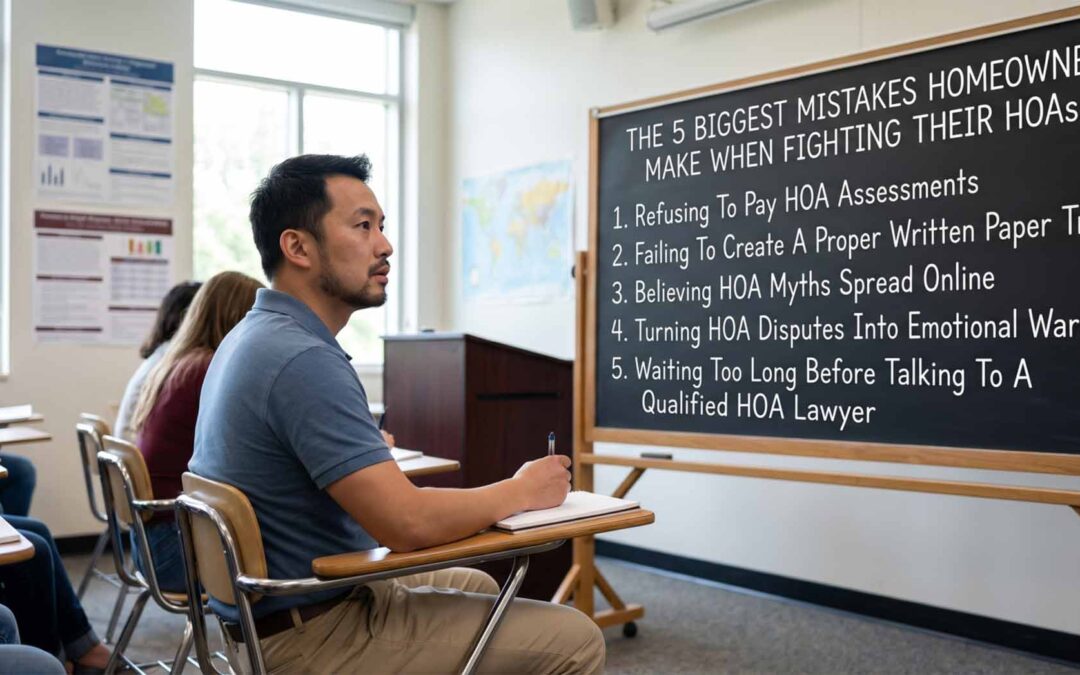
- Mistake No. 1: Refusing To Pay HOA Assessments Because You Believe The HOA Is Wrong. Let me be perfectly clear. Even if you’re 100% correct and the assessment in dispute is 100% illegal, homeowners do not have a right to withhold assessment payments. Few homeowners, however, understand that bright-line rule, and thus this is one of the most financially dangerous and unfortunately common mistakes that homeowners make.
- Homeowners do not have any right of “offset” when it comes to paying assessments, even “illegal” ones. Homeowners who stop paying often trigger a chain reaction involving: (i) late fees; (ii) interest; (iii) collection costs; (iv) attorney involvement; (v) liens; (vi) foreclosure threats; (vii) suspended privileges; and (viii) escalating attorneys’ fees that can, in some cases, even dwarf the original disputed amount. This issue becomes especially dangerous because many homeowners emotionally justify withholding payment by focusing on how unfair or illegal the HOA’s conduct feels or is, while completely overlooking the legal consequences that follow once the account becomes delinquent. For example, a homeowner angry about water intrusion, selective enforcement, election misconduct, or architectural abuse may believe withholding assessments creates leverage against the HOA. In practice, however, all it does is create leverage against the homeowner instead. Even worse, once the HOA’s attorneys get involved, many homeowners discover that the HOA’s attorneys’ fees continue increasing while the homeowner simultaneously loses negotiating leverage. That does not mean homeowners must simply tolerate unlawful HOA conduct. It means they must challenge the HOA strategically rather than financially detonating their own position in the process. [I briefly discussed the “no right of offset” issue in my Fact Sheet, “California HOA Special Assessments: What They Are, When They’re Legal, and How Homeowners Can Challenge Them.” If you haven’t read that Fact Sheet yet, I urge you to do so because I explain how to handle it if this situation ever arises with you.]
- Mistake No. 2: Failing To Create A Proper Written Paper Trail. Homeowners frequently damage their own cases by failing to properly document what occurred. They argue verbally with board members at meetings, rely on hallway conversations and phone calls, and rarely, if ever, follow up in writing. They also fail to take videos or photos, submit written records requests, preserve emails, or keep detailed factual logs, assuming, erroneously, that they’ll remember details months or years later. [They rarely do.] More importantly, judges, mediators, arbitrators, and HOA attorneys cannot evaluate undocumented conversations or vague recollections effectively. Written evidence drives HOA disputes. A homeowner who can present organized documentation places themselves in a dramatically stronger strategic position than a homeowner who relies primarily on memory or verbal conversations. So, for example, if your HOA repeatedly promises to repair a roof leak but you never confirm those conversations in writing, the HOA (or manager) will almost certainly later deny that the conversations occurred at all, or if they did occur, that they said what you’ve claimed they said. [I’ve given hundreds of seminars to other attorneys over the years, and one of my mantras, which I’ve also taught to every attorney who has ever worked for me, is simply: If it’s not in writing, it never happened.]
- Mistake No. 3: Believing HOA Myths Spread Online Instead Of Relying On Trustworthy Sources. California HOA law has become flooded with misinformation. Homeowners now receive HOA “advice” from Facebook, Reddit threads, TikTok videos, YouTube comments, AI-generated summaries, neighbors, frustrated former board members, and anonymous online posters who speak with enormous confidence despite having no understanding of the Davis-Stirling Act or HOA litigation. Some of the most dangerous myths homeowners frequently repeat include statements like: (i) “You can stop paying dues if the HOA violates the law”; (ii) “HOAs can’t foreclose anymore”; (iii) “CC&Rs can sometimes override California law”; (iv) “You should never attend disciplinary hearings”; (v) “HOAs can’t fine homeowners after AB 130”; (vi) “You have a right to record HOA meetings”; (vii) “The HOA can’t enforce old violations”; or (viii) “The HOA can’t recover attorneys’ fees against homeowners.” Some myths falsely minimize HOA power, while others wildly exaggerate it. Both create serious problems. California HOA disputes operate within a highly technical statutory framework involving the Davis-Stirling Act, governing documents, procedural requirements, evidentiary rules, fee-shifting statutes (i.e., laws requiring one side to pay the opposing side’s attorneys’ fees under specified circumstances), and litigation strategy. Homeowners who rely on bad information often make catastrophic strategic decisions long before they realize the advice was wrong. This is precisely why homeowners should rely on trustworthy sources grounded in actual California HOA law rather than emotionally satisfying internet commentary. [If you’d like more information on the various fee-shifting statutes found throughout the Davis-Stirling Act, read my Fact Sheet “When Can You Recover Attorney Fees from Your California HOA? Key Laws Explained.” You should also read my Fact Sheet, “How to Choose the Right HOA Lawyer in California: Experience, Costs, and Davis-Stirling Expertise,” where I walk homeowners step-by-step through how to ensure that the HOA attorney they hire actually has the HOA expertise that they claim to have.]
- Mistake No. 4: Turning HOA Disputes Into Emotional Wars Instead Of Strategic Ones. HOA disputes become intensely personal very quickly, and understandably so. Homeowners live inside these communities. They see board members at meetings, in parking lots, around the neighborhood, and sometimes directly next door. That constant proximity causes many homeowners to lose emotional discipline. They begin sending hostile emails, making personal attacks against directors, neighbors, managers, or vendors, posting inflammatory accusations on social media, screaming during meetings, threatening lawsuits impulsively, confronting neighbors publicly, sending excessive numbers of repetitive emails, or allowing anger to completely overtake strategy. The HOA’s attorneys will always capitalize on this behavior. They’ll portray such a homeowner as disruptive, irrational, unstable, threatening, or impossible to work with. They even send cease and desist letters to such homeowners in an effort to scare them into silence. The sad thing is that in a lot of such cases, the homeowner’s underlying complaint might be perfectly legitimate, but the homeowner’s conduct severely damages credibility and distracts from the actual legal issues. Emotional escalation also causes homeowners to make terrible strategic decisions, including sending damaging written statements, or making unsupported accusations, threatening conduct they never intend to pursue (which completely obliterates their credibility). Strategic-minded homeowners will focus on evidence, statutes, timelines, records, procedural violations, governing documents, and documented facts, while emotional homeowners will focus on winning arguments, humiliating directors, venting frustration, or “teaching the HOA a lesson.” Those are very different approaches, and they usually produce very different outcomes. [If you’d like to read my article about how bad HOAs weaponize harassment with bogus letters from their attorneys, read “How HOAs Weaponize “Harassment” to Silence Homeowners Who Push Back.”]
- Mistake No. 5: Waiting Too Long Before Talking To A Qualified HOA Lawyer. Too often, homeowners wait until the dispute has already spiraled out of control before consulting an experienced HOA attorney. By that point, the HOA may already have recorded liens, initiated foreclosure procedures, accumulated substantial attorneys’ fees, destroyed evidence, created a one-sided documentary record, imposed escalating fines, denied architectural applications repeatedly, manipulated hearing procedures, locked the homeowner into damaging written positions, or engaged in a whole host of other wrongful activities. When asked why they waited so long before turning to MBK Chapman for help, many homeowners told us that they believed that the dispute would calm down on its own. Many acknowledged that they grossly underestimated the seriousness of the situation, and many confessed that they sincerely believed that common sense would eventually prevail. [In bad HOAs, it rarely does.] Unfortunately, in almost all cases, such delays can have lasting repercussions, not the least of which is significantly greater expense in terms of attorney time. Timing matters in HOA disputes. Evidence disappears. Witnesses move away. Deadlines expire. Homeowners unintentionally waive arguments. Board-created narratives harden over time. And once the HOA’s attorneys fully control the dispute, the homeowner frequently enters the conflict from a far weaker position. Many homeowners wait too long because they keep asking themselves questions like: (i) “Can I still sue?”; (ii) “Did I wait too long?”; (iii) “Did I waive my rights?”; (iv) “What happens if I already paid the fine?”; (v) “What if the HOA already recorded a lien?”; (vi) “What if I missed the hearing?”; or (vii) “What if I already sent damaging emails?” Those are precisely the kinds of questions homeowners should ask experienced HOA attorneys before the situation deteriorates further. Early strategic intervention often prevents disputes from escalating into far more expensive litigation later.
The best HOA strategy combines documentation, timing, emotional discipline, and accurate legal information. Homeowners place themselves in the strongest position when they continue complying with lawful obligations while challenging improper HOA conduct strategically, create organized written evidence early, avoid emotional escalation or engagement, rely on trustworthy legal information grounded in the Davis-Stirling Act, and consult experienced California HOA lawyers before the dispute spirals out of control. Most HOA disputes do not improve through anger, assumptions, internet myths, or financial self-destruction. They improve through preparation, documentation, procedural leverage, and disciplined strategy.
In other words, while California HOA disputes reward homeowners who stay organized, disciplined, documented, informed, and proactive, they punish homeowners who act impulsively, rely on myths, escalate emotionally, or wait too long before obtaining experienced legal guidance. Understanding these five mistakes allows you to protect both your property and your financial future before a bad HOA board turns a manageable disagreement into a devastating legal conflict.
FAQs
Can I legally stop paying my HOA dues if my California HOA is violating the law?
No. Even if your HOA board is acting illegally, selectively enforcing rules, refusing to perform maintenance, violating the Open Meeting Act, or improperly imposing fines, homeowners generally do not have the legal right to withhold assessments. California law does not recognize a homeowner “offset” defense against assessment obligations. Once an account becomes delinquent, the HOA may begin imposing late fees, interest, collection costs, attorneys’ fees, liens, and even foreclosure-related procedures. Homeowners must challenge improper HOA conduct strategically rather than by refusing to pay assessments. In short, pay first, challenge second.
What kind of evidence should homeowners keep during an HOA dispute?
Homeowners should preserve every document, email, photograph, video, hearing notice, violation letter, text message, maintenance request, and timeline relating to the dispute. They should also confirm important conversations in writing immediately after they occur. For example, if a manager verbally promises to repair water intrusion or retract a violation notice, the homeowner should immediately send a calm follow-up email memorializing the conversation. Organized written evidence often determines which side will win in HOA disputes.
Can emotional or hostile emails hurt my case against the HOA?
Absolutely. Homeowners frequently damage otherwise legitimate disputes by sending hostile emails, making personal attacks, exaggerating facts, threatening lawsuits impulsively, or sending repetitive emotional communications that make them appear unstable or unreasonable. HOA attorneys routinely use those communications to portray the homeowner as disruptive, irrational, threatening, or impossible to work with. Strategic homeowners focus on statutes, timelines, governing documents, records, and objective facts rather than emotional venting.
Why do so many homeowners misunderstand California HOA law?
Because HOA misinformation has exploded online. Homeowners constantly receive inaccurate “legal advice” from Reddit threads, Facebook groups, YouTube comments, TikTok videos, neighbors, directors, AI-generated summaries (even from bad HOA lawyers), and anonymous internet posters who have little or no understanding of the Davis-Stirling Act or HOA litigation. Many of the most commonly repeated HOA “rules” online are legally incorrect, dangerously incomplete, or stripped of important context and nuance. Homeowners should rely on trustworthy California HOA attorneys and reliable statute-based sources instead of emotionally satisfying internet commentary.
How early should I contact an HOA attorney during a dispute?
Early enough to avoid permanent damage to your case. Many homeowners wait until liens have already been recorded, fines have escalated, evidence has disappeared, attorneys’ fees have accumulated, or damaging written communications already exist. Early legal guidance often prevents homeowners from making strategic mistakes that become extremely difficult or expensive to fix later. Even a short consultation early in the dispute can significantly improve a homeowner’s position and help avoid catastrophic missteps.
What is the single biggest strategic advantage homeowners can create in an HOA dispute?
A disciplined combination of documentation, emotional control, timing, and accurate legal information. Homeowners who stay organized, preserve evidence, communicate strategically, understand the Davis-Stirling Act, and avoid impulsive emotional escalation place themselves in a dramatically stronger position than homeowners who rely on assumptions, internet myths, or anger. In HOA disputes, preparation and strategy always outperform emotion and improvisation.

About Michael Kushner
Michael Kushner is a California attorney with over 30 years of experience representing homeowners in disputes with their HOAs. He is widely regarded as California’s leading homeowner-side HOA attorney, and has built one of the state’s most prominent law practices dedicated to holding HOAs accountable under the Davis-Stirling Act and California law.
In addition to his law firm’s work, Michael is a recognized lecturer, author, and the host of the hit HOA HELL podcast, where he provides homeowners living in HOA-governed communities with clear, practical strategies for dealing with bad HOAs. He’s also the author of the best-selling book, HOA HELL | California Homeowners’ Definitive Guide to Beating Bad HOAs, which has become a go-to resource for both homeowners seeking real-world solutions to their HOA disputes, as well as those good HOA board members who are interested in doing a good job.
About MBK Chapman Fact Sheets
Homeowners searching for answers online will often come across articles that appear authoritative, but are actually written as search-engine marketing content rather than by an experienced HOA lawyer. These pieces tend to prioritize keyword density over clarity, accuracy, or legal context, which often leaves homeowners more confused than informed.
At MBK Chapman, our Fact Sheets are part of our HOA Law Library and are written by Michael Kushner, an HOA lawyer with decades of hands-on experience representing California homeowners. In fact, Michael Kushner is the HOA lawyer who pioneered the systems and strategies used by some of California’s most successful homeowner-side HOA law firms.
Each Fact Sheet is deliberately concise, statute-based, and designed as a quick-reference guide to help homeowners understand key HOA laws and enforcement rules at a glance.
AND DON’T FORGET TO TUNE INTO MY PODCAST, HOA HELL
YOU CAN ALSO ORDER MY GROUNDBREAKING BOOK
HOA HELL | California Homeowners’ Definitive Guide to Beating Bad HOAs
Amazon | Barnes & Noble
