
Overview
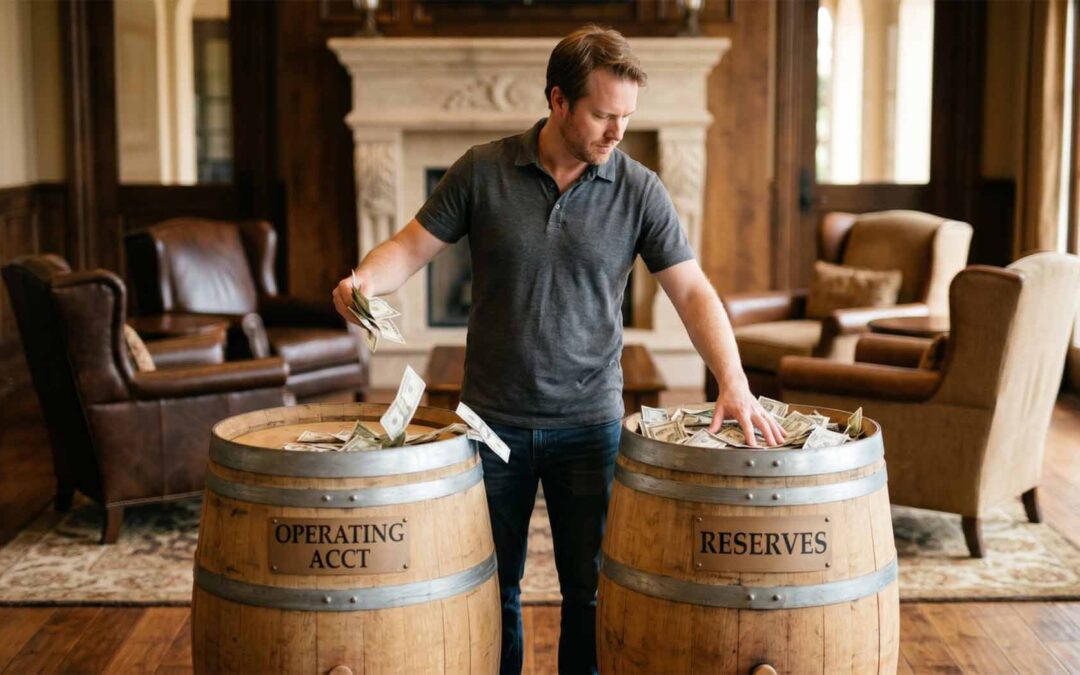
HOA boards in California increasingly turn to reserve funds to cover rising expenses, especially insurance premiums and short-term cash flow gaps. When that happens, homeowners often assume that such a decision requires their approval or a membership vote. It does not. California law allows HOA boards to borrow money from reserves without member consent, but only if they follow specific statutory requirements.
Civil Code 5515 governs when and how an HOA may borrow from reserves. That statute gives boards the authority to use reserve funds to meet short-term cash flow needs or other expenses, but it also imposes procedural safeguards designed to ensure transparency and accountability. Boards must disclose their intent in a properly noticed open meeting, explain why the loan is necessary, and outline how and when they will repay the funds. These are not optional steps. If a board fails to follow them, the borrowing decision is subject to challenge.
The ability to borrow from reserves exists as an exception to the general prohibition that reserve money must be used for the explicitly stated purposes set forth in Civil Code 5510. Every dollar an HOA moves out of its reserve account to cover operating costs carries a repayment obligation from the moment it leaves, whether or not the board ever calls the transfer a loan. Bad HOAs will sometimes attempt to describe these transfers as routine accounting adjustments or permanent reallocations, but such conduct violates the Davis-Stirling Act.
This Fact Sheet explains the legal rules governing reserve borrowing in California HOAs, including when boards may access reserves, what notice they must provide, how they must handle repayment, and when a member vote becomes necessary to fund that repayment. Understanding these requirements allows homeowners to distinguish between lawful financial management and improper use of reserve funds. [I addressed this topic in a two-minute HOA Q&A featured on my HOA HELL podcast.]
Key Points
Borrowing from reserves is one of those areas where the Davis-Stirling Act gives HOA boards clear authority to act without member approval. That authority arrives with tight statutory conditions, and it operates as a narrow exception to a rule that otherwise keeps reserve money off limits for anything but long-term component work. The Davis-Stirling Act regulates who can sign for the money, what the HOA must tell members before it moves, what the minutes must record afterward, and how fast the HOA has to put it back. Homeowners who understand those requirements can determine quickly whether their HOA is managing a cash flow problem lawfully or quietly draining the fund that pays for the next roof.
- Borrowing exists as an exception to a flat ban on spending reserve funds elsewhere. Civil Code 5510 prohibits HOAs from expending reserve funds for any purpose other than the repair, restoration, replacement, or maintenance of the major components that the HOA is obligated to handle and for which the reserve fund was established, along with litigation involving that same work. HOAs don’t, therefore, need to justify why they should keep reserve money in reserves. They just need to justify every dollar they take out, and the Davis-Stirling Act tells HOAs exactly how they have to do that.
- HOA boards can borrow from reserves without a membership vote. Homeowners often assume that tapping reserves requires approval because HOAs set aside reserves for major repairs. That assumption is incorrect. Civil Code 5515 authorizes HOA boards to use reserve funds to meet short-term cash flow requirements or to pay for other expenses. This authority exists even when the borrowing decision involves significant amounts of money, and it does not require prior approval from the membership. In real-world terms, this means that your HOA can unilaterally decide to borrow from reserves to cover an unexpected spike in insurance premiums or operating expenses without putting the issue to a member vote.
- Boards cannot borrow from reserves in secret. Before borrowing from reserves, an HOA board must disclose its intent in a properly noticed open meeting. The notice must do more than simply state that the board intends to borrow from reserves to meet short-term need. It must explain why the loan is necessary, describe potential repayment options, and indicate whether the board is considering a special assessment to repay the loan. This requirement ensures that homeowners remain informed before the board makes the decision and have an opportunity to attend the meeting and comment during the open forum. A board that moves forward without providing this level of notice exposes the decision to challenge and undermines its ability to justify the borrowing after the fact, particularly if the use of funds or repayment plan later comes under scrutiny.
- Meeting minutes must support the board’s approval following the open meeting through a written finding. If the board votes to borrow from reserves at the open meeting, the minutes of that meeting must include a written explanation of why the loan is necessary and how and when the board will repay it. This is not a formality. If the board borrows from reserves to cover operating expenses but fails to document a repayment plan, that omission strips the board of the statutory justification for the loan and leaves the decision vulnerable if homeowners challenge it.
- Two people must sign for any withdrawal from the reserve account. Civil Code 5510 requires the signatures of at least two directors, or one officer who is not a director plus one director, before an HOA withdraws moneys from its reserve accounts. That requirement carries no dollar threshold and no exception for small or routine transactions. This is one of those requirements that a lot of HOAs (both good and bad) violate frequently, typically as a result of standing bank instructions, automatic sweeps, or via transfers a management company initiates electronically without anyone signing anything. A vote at an open meeting doesn’t satisfy this requirement because the statute attaches the signature obligation to the withdrawal itself, not to the decision authorizing the withdrawal.
- Management companies face a separate approval requirement on reserve transfers. Civil Code 5380 bars managers from authorizing transfers out of HOA reserve or operating accounts without prior written approval from the HOA boards unless the transfer amounts fall below a statutory floor. For HOAs with 50 or fewer separate interests, that floor is the lesser of $5,000 or 5% of the estimated income in the annual operating budget. For HOAs with 51 or more separate interests, it’s the lesser of $10,000 or 5% of that estimated income. Civil Code 5380 also requires managing agents to keep a separate record of the receipt and disposition of all HOA funds, including any interest earned on those funds, which gives homeowners a paper trail to demand when the HOA claims it can’t reconstruct where reserve money went.
- HOA boards must exercise prudent management when borrowing from reserves. Civil Code 5515(e) requires that boards manage reserve funds prudently and avoid borrowing if the transfer would prevent the HOA from meeting its immediate repair or replacement obligations. This means that an HOA cannot borrow funds to pay for operating expenses if those same funds are necessary for a major project scheduled to begin within the one-year repayment window. For example, if an HOA must replace a clubhouse roof in three months, the board violates its duty of prudent management if it borrows the roofing funds to cover a temporary insurance shortfall. In that scenario, the board creates a foreseeable financial crisis because it has prioritized short-term cash flow over a non-discretionary maintenance obligation.
- The HOA must generally repay the reserve loans within one year. Civil Code 5515 requires that HOAs restore any funds they borrowed from reserves within one year of the initial transfer. This requirement reinforces the idea that reserve borrowing is a temporary measure, not a permanent reallocation of funds. For example, if a board borrows from reserves to cover an insurance shortfall, it must have a plan in place to return those funds within the following year.
- An HOA may delay repayment to the reserve account, but only if it makes a documented finding after notice. The HOA may extend the repayment period beyond one year, but only if it provides notice and makes a formal finding that delaying repayment is in the best interest of the HOA. This requirement prevents boards from indefinitely postponing repayment without justification. In practice, this means the board must revisit the issue in an open meeting, explain why it cannot repay the funds within the requisite one-year deadline, and document that reasoning in the minutes. The board must then update its intended repayment deadline for the record.
- The Davis-Stirling Act bans permanent transfers out of reserves. Civil Code 5515 provides exactly one path for moving reserve money into the operating fund, and that path requires restoration within one year. The only relief the statute allows is, as I stated above, a temporary delay, and that delay demands fresh notice and a finding supported by documentation. This means that an HOA may never book a transfer from reserves as a permanent reallocation, an operating subsidy, a budget correction, or an accounting reclassification.
- Repaying a reserve loan may require a membership vote. While boards can borrow from reserves without member approval, the method they use to repay that loan may trigger voting requirements. If, for example, the HOA board decides to impose a special assessment to restore the reserves and that assessment exceeds 5% of the association’s budgeted gross expenses for the fiscal year, the board must obtain approval from a majority of a quorum of the membership in a formal election. This creates a practical distinction, meaning boards can access reserves on their own, but they may need homeowner approval to replenish them. [If you’d like to learn about reserve study requirements in general, read my Fact Sheet “California HOA Reserve Study Requirements: How Often They’re Required and What Must Be Included.”]
- Borrowing from reserves is not an emergency for assessment purposes. Even when the initial borrowing decision is urgent, repayment of the loan does not qualify as an emergency under California law. This means boards cannot bypass the statutory limits on special assessments by labeling the repayment as urgent. If the repayment requires a large assessment, the board must follow the standard approval process. [I wrote about misuse of the emergency assessment by bad HOAs in several prior Fact Sheets, including “Emergency or Excuse? How HOAs Use “Safety” to Justify Illegal Emergency Assessments.”]
- Interest earned on reserve funds belongs to the reserve fund. Reserve accounts generate interest, and some HOAs treat that interest as free money because it arrived as earnings rather than as an assessment contribution. The Davis-Stirling Act, however, draws no such distinction. Interest accrues on money the HOA already set aside for reserves, inside the account that the HOA already established for that purpose. Moving interest into the operating fund is no different from moving principal from the reserves (i.e., it’s still borrowing from reserves), and thus every requirement described in this Fact Sheet applies to it.
- Illegal reserve borrowing typically involves procedural failures, not lack of authority. Most disputes over reserve borrowing do not arise because the HOA board lacks authority to borrow funds. They arise when an HOA fails to follow the required procedures, such as providing adequate notice, documenting its decision, or establishing a clear repayment plan.
- Build the record, and then pursue violations. Reserve borrowing disputes turn on documents, and Civil Code 5200 entitles you to reserve account balances and records of payments made from reserve accounts, which is the ledger that shows what left and when. Request those records, then pull the board meeting notices covering the period in question, then pull the minutes for the meetings those notices announced. You’re looking for five things: (a) a notice that stated the reasons for the transfer, along with some repayment options; (b) whether the HOA might consider a special assessment; (c) minutes containing a written finding explaining the need and describing when and how the HOA will repay; (d) signatures on the withdrawal itself; and (e) evidence of actual restoration within one year (or a proper explanation for extending that time period).
- Compare your annual budget reports year over year. Your HOA delivers a reserve summary and an Assessment and Reserve Funding Disclosure Summary with every annual budget report. Including in those disclosures is your HOA’s reserve balance. A balance that dropped without any corresponding major component project gives you a specific date range to target in your records request. It also gives you a number the HOA has already certified to the entire membership, which becomes difficult to walk back later.
- Put the gap in writing and make your HOA answer for it. If the records show a transfer and/or the notices and minutes show no compliance, write to the entire board and to management, identify the transfer by date and amount, quote the specific requirements the HOA skipped, and demand the missing documentation, along with a written repayment schedule. Send it by a method that proves delivery. If you HOA ignores your demand or responds with an explanation invented after the fact, then you’ll just have that much more leverage to apply when you need it.
- If your HOA violated its obligations regarding borrowing or repaying a loan from reserves, call the HOA attorneys at MBK Chapman. Reserve funds exist for long-term repair and replacement obligations, and improper borrowing can create significant financial risk for your HOA. If your HOA has borrowed from reserves without following the statutory requirements, let California’s most experienced homeowner-side HOA attorneys force your HOA’s compliance.
Reserve borrowing is a lawful tool when HOAs use it correctly, but it comes with clear limits. When HOAs follow the statute, borrowing from reserves can address short-term financial issues. HOAs that skip those steps leave a documented trail of their own violations that diligent homeowners can capitalize on in demanding compliance with the law.
FAQs
Can my California HOA borrow money from reserves without a membership vote?
Yes. Civil Code 5515 allows HOA boards to borrow from reserves without member approval to meet short-term cash flow needs or other expenses. That authority is broad, but it is not unlimited. The board must comply with specific notice, disclosure, and documentation requirements before and after making the decision. The HOA must also avoid violating its duty of prudent management when deciding to borrow from reserves.
What notice must an HOA give before borrowing from reserves?
The board must disclose its intent to borrow from reserves in a properly noticed open meeting. That notice must explain why the loan is necessary, outline options for repaying it, and state whether a special assessment is being considered. If the board does not provide this information in advance, the borrowing decision can be challenged for failing to comply with Civil Code 5515.
How quickly does an HOA have to repay money borrowed from reserves?
Civil Code 5515 requires that borrowed reserve funds be repaid within one year. The board may extend that timeline only if, after providing notice, it makes a documented finding that delaying repayment is in the best interest of the HOA.
Will homeowners ever need to vote to repay a reserve loan?
Sometimes. While the board can borrow from reserves on its own, the method of repayment may trigger voting requirements. If the board proposes a special assessment to restore the reserves and that assessment exceeds 5% of the HOA’s budgeted gross expenses for the year, it must be approved by a majority of a quorum of the members in a formal election.

About Michael Kushner
Michael Kushner is a California attorney with over 30 years of experience representing homeowners in disputes with their HOAs. He is widely regarded as California’s leading homeowner-side HOA attorney, and has built one of the state’s most prominent law practices dedicated to holding HOAs accountable under the Davis-Stirling Act and California law.
In addition to his law firm’s work, Michael is a recognized lecturer, author, and the host of the hit HOA HELL podcast, where he provides homeowners living in HOA-governed communities with clear, practical strategies for dealing with bad HOAs. He’s also the author of the best-selling book, HOA HELL | California Homeowners’ Definitive Guide to Beating Bad HOAs, which has become a go-to resource for both homeowners seeking real-world solutions to their HOA disputes, as well as those good HOA board members who are interested in doing a good job.
About MBK Chapman Fact Sheets
Homeowners searching for answers online will often come across articles that appear authoritative, but are actually written as search-engine marketing content rather than by an experienced HOA lawyer. These pieces tend to prioritize keyword density over clarity, accuracy, or legal context, which often leaves homeowners more confused than informed.
At MBK Chapman, our Fact Sheets are part of our HOA Law Library and are written by Michael Kushner, an HOA lawyer with decades of hands-on experience representing California homeowners. In fact, Michael Kushner is the HOA lawyer who pioneered the systems and strategies used by some of California’s most successful homeowner-side HOA law firms.
Each Fact Sheet is deliberately concise, statute-based, and designed as a quick-reference guide to help homeowners understand key HOA laws and enforcement rules at a glance.
AND DON’T FORGET TO TUNE INTO MY PODCAST, HOA HELL
YOU CAN ALSO ORDER MY GROUNDBREAKING BOOK
HOA HELL | California Homeowners’ Definitive Guide to Beating Bad HOAs
Amazon | Barnes & Noble
