
Overview
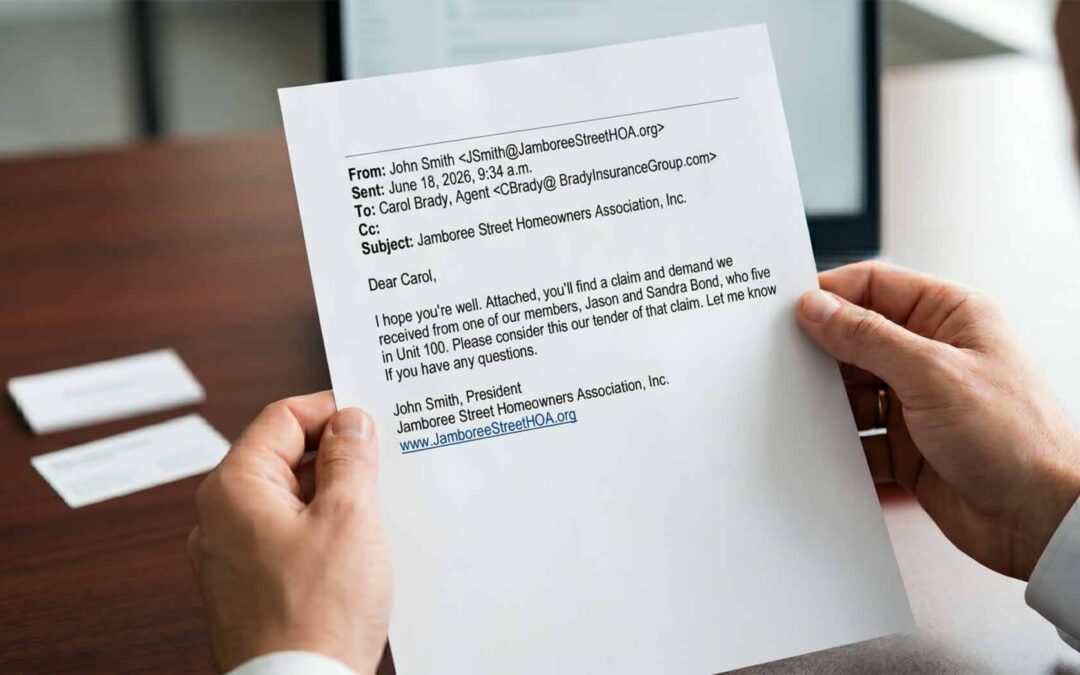
A homeowner with a claim against the HOA almost always wants the HOA to turn that claim over to its insurance carrier. And when an HOA refuses to do that, such homeowners frequently approach us to determine whether they can force that to happen. We’ve received that question enough to merit a response, hence my decision to write this Fact Sheet.
The blunt answer to that question is, unfortunately, no. The insurance policy is a contract between the HOA and its insurer, the homeowner isn’t a party to it, and the decision to report a claim and tender it for coverage belongs to the HOA, not to the person pressing the claim. California law reinforces that limitation rather than softening it. An injured claimant can’t hand a claim to someone else’s insurer or order that insurer to take it. So the direct route a frustrated homeowner imagines, ordering the HOA or its carrier to take the claim, isn’t a route the law provides.
A homeowner is far from powerless, though, and the leverage runs through indirect channels rather than a direct command. HOAs carry strong incentives to tender claims because the right coverage is what shields the HOA and its volunteer directors from exposure to personal liability. A board that sits on a claim it should report risks breaching the fiduciary duties its directors owe the membership. When a board declines to tender a covered claim, it gambles the members’ money on the bet that handling the matter alone will cost less than the claim would, and that bet fails whenever the uninsured exposure the HOA absorbs runs higher than the added premium the members would have paid had the claim gone to the carrier. A board that exposes the membership to the larger loss to avoid the smaller one has put its own preferences ahead of the HOA’s financial interest.
That exposure often moves a reluctant board more effectively than any demand to tender ever could. And it’s that type of exposure that matters most sooner rather than later because a board that never reports a claim can forever waive the right to the very coverage a homeowner hopes to reach. Indeed, it’s that threat of a waiver, along with its consequences, that give homeowners real leverage in these types of tender demands.
This Fact Sheet explains who actually controls the decision to tender a claim, why some boards resist handing a claim to their carrier, the personal risk directors take on when they refuse, and the practical steps a homeowner can take to get a claim in front of the HOA’s insurer even in the absence of the power to compel it.
Key Points
Whether a homeowner can force an HOA to tender a claim turns on a single fact about how insurance works, which is that the policy belongs to the HOA, not to the homeowner pressing the claim. That fact decides the direct question and points a homeowner toward the indirect tools that actually might move their HOA to tender the claim. The points below explain what homeowners need to know when it comes to getting their claims in front of their HOAs’ insurance carriers.
- The decision to report and tender a claim belongs to the HOA and its insurer, not to the homeowner pressing the claim. An insurance policy is a contract between the HOA and its carrier, and a homeowner with a claim against the HOA is never a party to that contract. California gives homeowners no power to hand the claim to the carrier or to order the carrier to accept it. So the mechanics foreclose the direct route, and a homeowner who wants the claim tendered has to make the HOA want to tender it.
- The Davis-Stirling Act forces an HOA to carry only one kind of insurance and merely rewards the rest, so most of what an HOA insures traces back to its own governing documents. Most homeowners assume that the law requires their HOAs to carry liability and director coverage. That is not, however, the case. The Davis-Stirling Act only requires HOAs to carry a single type of coverage, leaving the rest solely to what the CC&Rs say, or if not in conflict with the CC&Rs, whatever coverage a board might wish to obtain. Knowing which coverage the law commands, which it only incentivizes, and which the governing documents require is what tells a homeowner whether the HOA even holds a policy the claim could be tendered to.
- The Davis-Stirling Act only requires HOAs to maintain one type of coverage. Civil Code 5806 requires all California HOAs to maintain crime, employee dishonesty, or fidelity bond coverage, along with protection against computer fraud and funds transfer fraud, in an amount at least equal to the HOA’s reserves plus three months of total assessments. It also bars HOAs from relying on “self-insurance” to satisfy that requirement. This coverage guards the HOA’s funds against theft, so it rarely touches the liability claim a homeowner wants tendered. Even so, it’s the one policy the law guarantees the HOA actually carries.
- Civil Code 5800 and Civil Code 5805 don’t command coverage, but they reward it. Civil Code 5800 shields a volunteer officer or director from personal liability beyond the policy limits, but only if the HOA carries both general liability and director-and-officer coverage at the stated minimums, which run at least $500,000 for an HOA of 100 or fewer separate interests and at least $1,000,000 for a larger one. Civil Code 5805 routes certain tort claims against individual owners, those arising solely from tenancy-in-common ownership of the common area, onto the HOA alone. But here too, this only applies if the HOA carries general liability coverage at higher minimums of at least $2,000,000 or $3,000,000, depending on size. Neither statute forces an HOA to buy the coverage. Instead, each dangles a protection that the HOA forfeits the moment it goes without.
- Most HOAs carry director-and-officer (D&O) because the CC&Rs require that coverage. Because most CC&Rs require their HOAs to carry D&O and liability insurance, even in HOAs where that’s not the case, most of those still carry that coverage rather than leaving their volunteer directors exposed. That CC&R requirement gives a homeowner something to work with because an HOA that fails to carry the coverage its own governing documents demand has breached those documents, which is a separate problem an owner can press. [This Fact Sheet is aimed at addressing only the insurance issues unique to HOAs. It doesn’t, therefore, cover the kinds of insurance an HOA must carry simply because it operates like any other organization with employees, such as workers’ compensation coverage under Labor Code 3700.]
- HOA boards frequently refuse to tender claims to protect themselves, not the membership. A board that could report a claim sometimes chooses not to, and the motives tend to be self-protective. Reporting a claim can raise the HOA’s premiums at renewal, can force the HOA to pay the deductible the policy carries before it pays anything, and on a director-and-officer claim, can put the directors’ own decisions under the carrier’s (and members’) scrutiny. A board worried about a premium increase, or more likely, about what an insurer might conclude after examining the board’s conduct, has a personal incentive to keep the claim quiet, even when reporting it would protect the HOA’s treasury and the members who fund it. Whether a given claim falls within the policy depends on the specific coverage, so a homeowner shouldn’t assume every claim is covered, but a board’s reluctance frequently reflects its own exposure rather than a real coverage gap.
- Refusing to tender a claim that the board should reasonably report may constitute a breach of fiduciary duty. Failing to tender isn’t a violation in the abstract, but Corporations Code 7231 requires directors to act in good faith, in the HOA’s best interests, and with the care and reasonable inquiry a prudent person would use. A board that lets a covered claim go unreported is gambling with the homeowners’ money on the bet that handling the matter alone will cost less than the claim would. If a homeowner can demonstrate that the board’s decision to do this stems from their putting their own individual interests ahead of what’s best for the HOA and its members as a whole, then those board members have breached their fiduciary duties. [And a board that drops the coverage altogether compounds the problem because Civil Code 5800 strips its directors of their personal-liability shield the moment the HOA stops carrying the coverage the statute rewards, leaving those directors personally exposed on the very claim they tried to bury.]
- A homeowner who wants a claim tendered should build a written record that turns the board’s refusal into a documented fiduciary risk. Because a homeowner can’t compel a tender, the practical goal is to make refusal more dangerous to the board than compliance, and the steps below do that while preserving the homeowner’s options.
- Demand the tender in writing and identify the coverage. A homeowner should send the HOA board a written demand that it report the claim to its general liability or D&O carrier, point to the policy if the homeowner knows it exists, and ask the board to confirm in writing whether it has tendered (or is intending to tender). A written demand fixes the date the board learned of the claim and strips away any later claim of ignorance. It also makes it easier to later prove a fiduciary breach if the worst happens.
- Put the board members on notice of their individual personal exposure. Homeowners should remind the HOA’s board members in writing that Corporations Code 7231 measures their decisions against a prudent-director standard and that Civil Code 5800 protects the directors personally only while the HOA carries the coverage at issue. Directors who grasp their own exposure will often decide to tender a claim that they may have initially been inclined to sit on. [If you’d like to learn more about holding directors personally liable for their conduct, read either or both of the following Fact Sheets: “Can You Hold HOA Board Members Personally Liable in California?” or “Can I Sue My HOA Board Members Personally in California?”]
- Request the HOA’s insurance policies to confirm what coverage exists. Since each insurance policy is actually a contract between the HOA and the insurance carrier, homeowners can obtain copies of HOA’s insurance policies under Civil Code 5200. Reviewing those policies confirms whether the HOA carries general liability or director-and-officer coverage a claim could be tendered to. And while Civil Code 5200 won’t hand a homeowner proof that the board actually reported a claim, at least knowing the coverage exists can allow a homeowner to focus on pressing the HOA to tender.
- Don’t count on collecting from the carrier after a judgment. A homeowner with some knowledge of the Insurance Code might think that if they can’t move the board to tender, the fallback is to win a judgment against the HOA and then collect from its insurer under Insurance Code 11580. That statute, however, doesn’t neatly fit this situation, and will thus likely fail. Insurance Code 11580 only lets a homeowner reach coverage that still exists, so it does nothing when the board’s own failure to tender has already resulted in a forfeiture of the coverage, which frequently occurs when an insured doesn’t tender a claim in a timely fashion. That statute also reaches the insurer only on a judgment based on bodily injury, death, or property damage, which excludes many governance and economic-loss claims against an HOA. The realistic takeaway, therefore, runs the other direction. Because a blown tender can destroy the coverage a judgment would otherwise have tapped, the homeowner’s leverage is strongest before the tender window closes, not after.
- A homeowner fighting to get a claim tendered should call the HOA attorneys at MBK Chapman. Coverage and tender disputes turn on the specific policy, the governing documents, and the fiduciary duties owed by each director. The HOA attorneys at MBK Chapman know how to read an HOA’s coverage, how to frame a demand that puts the directors’ personal exposure squarely in front of them, and how to position a claim so that the board’s refusal to tender becomes its own liability. Homeowners whose HOAs refuse to report a claim should contact MBK Chapman rather than let a covered claim go to waste.
A homeowner can’t reach into the HOA’s insurance relationship and force a tender because that decision sits with the HOA and its carrier. What a homeowner can do is make refusal the more dangerous choice, by documenting the claim, exposing the cost gamble a board takes when it sits on covered exposure, and reminding directors that the shield protecting them personally depends on the coverage they’re tempted to bypass. The law that merely rewards an HOA for carrying coverage turns into real leverage once a board realizes it has forfeited that personal liability protection.
FAQs
Can I force my HOA to turn my claim over to its insurance company?
No. The insurance policy is a contract between the HOA and its carrier, and you aren’t a party to it, so the decision to report and tender a claim belongs to the HOA. California gives you no power to hand the claim to the carrier yourself or to order the carrier to accept it. What you can do is make refusing to tender more dangerous to the board members than tendering, and you do this by documenting the claim in writing and putting the directors on notice of their potential personal exposure if they refuse to tender a valid covered claim.
Does my HOA have to carry insurance that would cover my claim?
Not necessarily. The Davis-Stirling Act requires HOAs to carry only one type of coverage, the crime, employee dishonesty, or fidelity bond coverage described in Civil Code 5806, which protects the HOA’s funds from theft rather than answering a homeowner’s liability claim. Civil Code 5800 and Civil Code 5805 don’t require general liability or D&O coverage, but they do reward an HOA for carrying it. The real requirement usually lives in the CC&Rs, which is why most HOAs carry D&O and liability coverage even though no statute forces them to.
Why would my HOA board refuse to tender a valid claim?
The reasons are usually self-protective rather than principled. Reporting a claim can raise the HOA’s premiums at renewal, can trigger the deductible the policy carries, and on a D&O claim, can put the board members’ own decisions under the carrier’s (and members’) scrutiny. Directors worried about a rate increase, or about what an insurer might conclude after examining their conduct, has an incentive to keep the claim quiet, even when reporting it would protect the HOA’s treasury and the members who fund it (i.e., you).
If my HOA won’t tender and I win a lawsuit, can I collect from its insurer?
Usually not, and counting on it is a mistake. Insurance Code 11580 only lets you reach coverage that still exists, so it does nothing once the board’s failure to tender has forfeited the policy, which often happens with the claims-made D&O coverage these disputes involve. The statute also reaches the insurer only on a judgment based on bodily injury, death, or property damage, which excludes many governance and economic-loss claims against an HOA. That’s why your leverage is strongest before the tender window closes, not after.

About Michael Kushner
Michael Kushner is a California attorney with over 30 years of experience representing homeowners in disputes with their HOAs. He is widely regarded as California’s leading homeowner-side HOA attorney, and has built one of the state’s most prominent law practices dedicated to holding HOAs accountable under the Davis-Stirling Act and California law.
In addition to his law firm’s work, Michael is a recognized lecturer, author, and the host of the hit HOA HELL podcast, where he provides homeowners living in HOA-governed communities with clear, practical strategies for dealing with bad HOAs. He’s also the author of the best-selling book, HOA HELL | California Homeowners’ Definitive Guide to Beating Bad HOAs, which has become a go-to resource for both homeowners seeking real-world solutions to their HOA disputes, as well as those good HOA board members who are interested in doing a good job.
About MBK Chapman Fact Sheets
Homeowners searching for answers online will often come across articles that appear authoritative, but are actually written as search-engine marketing content rather than by an experienced HOA lawyer. These pieces tend to prioritize keyword density over clarity, accuracy, or legal context, which often leaves homeowners more confused than informed.
At MBK Chapman, our Fact Sheets are part of our HOA Law Library and are written by Michael Kushner, an HOA lawyer with decades of hands-on experience representing California homeowners. In fact, Michael Kushner is the HOA lawyer who pioneered the systems and strategies used by some of California’s most successful homeowner-side HOA law firms.
Each Fact Sheet is deliberately concise, statute-based, and designed as a quick-reference guide to help homeowners understand key HOA laws and enforcement rules at a glance.
AND DON’T FORGET TO TUNE INTO MY PODCAST, HOA HELL
YOU CAN ALSO ORDER MY GROUNDBREAKING BOOK
HOA HELL | California Homeowners’ Definitive Guide to Beating Bad HOAs
Amazon | Barnes & Noble
