
Overview
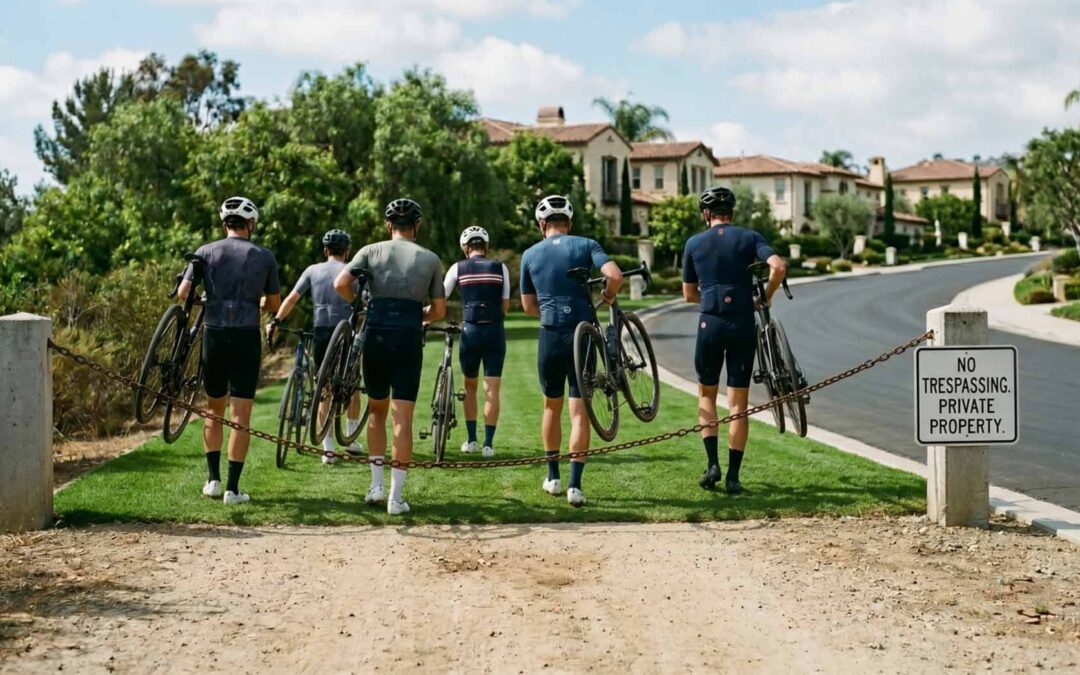
Most California HOA disputes involve conflicts between homeowners and their boards. This one is different. It involves people who have no relationship with the HOA at all, no ownership interest, no membership rights, and no legal basis for being there, yet who regularly use HOA-owned private streets and common areas as a shortcut between public trails or other destinations. The scenario plays out across California in gated and semi-gated communities that sit adjacent to parks, open space, hiking trails, and other public recreational areas. The outsiders are rarely hostile. Some are simply unaware that the property they cut through is privately owned. Most are indifferent to it. What none of them are thinking about, however, is who bears the legal and financial consequences if something goes wrong while they are there, and the answer to that question is the HOA and the members who own the property.
The legal framework governing this situation is straightforward even if enforcement is not. California HOA streets that qualify as common area are private property. The HOA owns them, maintains them, and bears responsibility and liability for them. Outsiders who enter without permission are trespassers, and California law, specifically Penal Code 602 and Penal Code 602.8, gives HOAs and their members specific tools to address that trespass, both by demanding that trespassers leave and by building a documented record that escalates the legal consequences for repeat offenders. The fact that the trespassers are recreational users rather than criminals does not change the legal analysis. Uninvited entry onto private property is trespass regardless of the entrant’s intent.
Before going further, one critical distinction must be made. In a recent Fact Sheet, “Can an HOA Block Access to a Public Park? Fake Video, Real Problem,” I examined the Mulholland Estates and Fossil Ridge Park situation, where an HOA wrongfully (and obnoxiously) blocked public access to a public park through a community whose own CC&Rs had established recorded public easements specifically to provide that access. That situation and this one sit at opposite ends of the same legal spectrum. In the Fossil Ridge situation, the public had a recorded legal right of access directly through that HOA that the HOA illegally suppressed. In the situation this Fact Sheet addresses, the outsiders have no legal right of access whatsoever. No easement exists. No public right of way runs through the community. The HOA-owned streets are private common area, and the outsiders are there without permission. The legal outcome in each situation flows directly from that distinction.
The trespass problem also carries real legal and financial consequences beyond the immediate inconvenience. An HOA that tolerates recurring unauthorized entry onto its private streets and common areas faces potential liability exposure if an uninvited user is injured on the property. It also faces nuisance-related concerns when recurring trespassers generate litter, noise, and other interference with the community’s quiet enjoyment. And in communities where the HOA’s insurance coverage is tied to the nature and use of its common area, the presence of regular unauthorized users can create coverage complications that most homeowners and boards never anticipate until after a loss occurs.
This Fact Sheet explains what legal rights a California HOA and its members have when uninvited outsiders wrongfully use HOA-owned private streets and common areas, what tools California law provides to stop recurring trespass, what practical steps an HOA can take to strengthen its position, and what liability exposure the HOA faces if it does nothing. For a deeper understanding of the nuisance issues that trespass-related conduct can trigger, read “California HOA Nuisance Laws: The Complete Homeowner Guide.”]
Key Points
California HOA-governed communities that sit adjacent to public trails, open space, or recreational areas frequently face a trespass problem that most governing documents were never written to address specifically. The legal framework that applies, however, is not ambiguous. HOA-owned streets and common areas are private property, and California law gives HOAs and their members specific, enforceable tools to stop unauthorized entry, document repeat offenders, manage liability exposure, and address the nuisance-related consequences that recurring trespass creates.
- HOA-owned streets and common areas are private property, and outsiders who enter without permission are trespassers. When an HOA’s streets qualify as common area under the Davis-Stirling Act, those streets belong to the HOA membership collectively. The HOA owns them, maintains them, and must pay for them under Civil Code 4775, and thus bears legal responsibility for conditions on them. That ownership status means outsiders who enter without permission have no legal right to be there, regardless of how they enter, how long they stay, or what their purpose is. A mountain biker cutting through a gated community to connect two trail heads is not a guest, not a licensee, and not a member of the public exercising a public right. That person is a trespasser the moment they enter HOA property without authorization, and California law treats them accordingly. [I want to make it clear that nothing in this Fact Sheet is meant to suggest that mountain bikers, hikers, or other recreational users who cut through private HOA communities are bad people or acting with malicious intent. By and large, they are not. They are simply enjoying the outdoors and taking the most convenient route available to them. The problem is not their character. The problem is the real-world financial and legal consequences their presence creates for the members who own that property, including potential liability if someone gets hurt, wear and tear on privately maintained streets and common areas, litter cleanup costs, and insurance complications, all of which ultimately land on the membership in the form of higher assessments.]
- Penal Code 602 gives the HOA its most direct tools to address trespass on private streets and common areas. Penal Code 602 defines criminal trespass in California and covers a broad range of unauthorized entry scenarios. For the HOA trespass problem this Fact Sheet addresses, three subdivisions are particularly relevant. Penal Code 602(l) covers willful entry onto enclosed lands or lands posted with trespass signs where the person refuses to leave when asked. Penal Code 602(m) covers entering and occupying real property without the owner’s consent. Penal Code 602(o) covers refusing or failing to leave private property not open to the general public after being asked to leave by the owner, their agent, or a peace officer acting at the owner’s request. Each of these subdivisions makes the conduct a misdemeanor, giving the HOA and law enforcement real criminal enforcement authority against trespassers who refuse to comply.
- Penal Code 602(o) is the strongest provision for recurring trespassers. It applies to any person who refuses or fails to leave private property that is not open to the general public after being requested to leave by the owner, the owner’s agent, or a peace officer acting at the owner’s request. It does not matter how the trespasser arrived, whether on foot, by bicycle, or by vehicle. It does not require the trespasser to have caused damage or to have displayed hostile intent. The only elements are that the property is not open to the general public, that an authorized person asked the trespasser to leave, and that the trespasser refused or failed to do so. For an HOA whose gated streets are clearly not open to the public, that standard is straightforward to satisfy.
- For purposes of Penal Code 602(o), an “authorized person” includes the property owner, the owner’s agent, and any person in lawful possession of the property. In the HOA context, that includes board members, property managers, and security personnel. Individual homeowners occupy a slightly less certain position, but because HOA members collectively own the common area, a homeowner acting on behalf of the ownership has a strong argument for standing to make the request. The safest approach is for the HOA board to pass a resolution formally authorizing all residents to act as agents of the HOA for trespass enforcement purposes. On the question of whether police must be present when the warning is issued: they do not. [I’m often asked whether a police officer has to be present to “trespass” someone before they can be arrested for trespass. This is usually what one sees in videos plastered all over YouTube, at least. But that is not how the law actually works. A verbal request to leave by an authorized person is sufficient. If the trespasser refuses, the homeowner calls law enforcement, reports the refusal, and officers can respond and enforce. The police need not have witnessed the original request.]
- A “Letter of Agency” lets law enforcement enforce trespass on HOA property for up to 12 months without a separate call each time. Penal Code 602(o) contains a powerful and underused provision that allows the HOA, as property owner or agent, to submit a single notarized written request to the local law enforcement agency authorizing officers to enforce trespass on the property for a period of up to 12 months. This document is commonly referred to as a “Letter of Agency.” Once the HOA submits a valid Letter of Agency, law enforcement officers can respond to and enforce trespass on the HOA’s private streets and common areas without requiring the HOA or an individual homeowner to make a separate request on each occasion. The Letter of Agency must identify the property by specific dates and must be submitted on a notarized form provided by the law enforcement agency. The HOA must notify the agency in writing when it no longer wants the assistance, and the authorization expires automatically upon a transfer of ownership or change in lawful possession.
- An HOA that submits a Letter of Agency creates a standing enforcement mechanism that removes the burden from individual homeowners. Without a Letter of Agency, stopping a trespasser requires a homeowner or HOA representative to be present, confront the trespasser directly, and either demand they leave or call law enforcement and wait for a response. That process is inconsistent, depends on individual homeowners being willing to engage strangers, and creates its own confrontation risks. A Letter of Agency shifts that burden to law enforcement and gives officers independent authority to act without waiting for a fresh request. For communities dealing with recurring weekend trespass by groups of mountain bikers, cyclists, or hikers, a Letter of Agency converts an ongoing enforcement problem into a standing legal authorization that operates across the entire “trespass season.”
- Penal Code 602.8 builds escalating legal pressure against repeat offenders. While Penal Code 602 provides the primary criminal trespass framework, Penal Code 602.8 provides a separate and complementary tool specifically designed for recurring unauthorized entry onto privately owned lands where trespass signs are posted. Under Penal Code 602.8, willful entry onto unenclosed lands where signs forbidding trespass are displayed at the required intervals is a public offense. The penalty structure escalates with each offense on the same or contiguous land: a first offense is an infraction punishable by a $75 fine, a second offense on the same or contiguous land is an infraction punishable by a $250 fine, and a third or subsequent offense becomes a misdemeanor. For the HOA facing recurring weekend trespassers, that escalating structure creates a documented legal record that grows more serious with each violation. A mountain biker cited under Penal Code 602.8 on one Saturday who returns the following weekend is already facing a $250 fine. A third visit becomes a misdemeanor. The statute thus rewards the HOA for consistent enforcement and increases the legal consequences for trespassers who treat the first citation as an acceptable cost of the shortcut.
- This situation is the legal opposite of the Fossil Ridge Park situation. As explained in my prior Fact Sheet about the fake viral video related to the real Fossil Ridge Park situation, the Mulholland Estates HOA at issue in that case spent more than two decades wrongfully blocking public access to Fossil Ridge Park despite the fact that its own CC&Rs had established recorded public easements over their private roads specifically to provide that access to the public. The HOA in that situation had no legal authority to block access because the public held a recorded property right running directly through the HOA (including over its private streets). The situation this Fact Sheet addresses is the mirror image of that. No recorded easement gives outsiders the right to use this HOA’s private streets. No public right of way runs through the community. No government agency has established access rights over the HOA’s common area. The outsiders are there without any legal basis whatsoever, and the HOA has every right to exclude them. The legal outcome in each situation flows entirely from whether a recorded right of access exists. Where it does, the HOA cannot block it. Where it does not, the HOA can and should enforce its property rights.
- These seemingly harmless trespasses create real liability exposure for the HOA and its members. Most HOA boards and homeowners assume that if an outsider gets hurt while trespassing on HOA property, the trespasser cannot recover because they had no right to be there. That assumption is incorrect and potentially costly. California premises liability law does not operate on a simple trespasser-gets-nothing basis.
- California premises liability law does not automatically shield owners from liability just because the injured person was a trespasser. Under California’s common laws, property owners have a general duty to exercise ordinary care in the management of their property to avoid injury to others. California courts evaluate premises liability claims by weighing multiple factors, including the foreseeability of harm, the degree of certainty that the plaintiff suffered injury, the closeness of the connection between the defendant’s conduct and the injury, and the burden on the defendant of imposing a duty of care. Trespasser status is one factor in that analysis, not an automatic bar to recovery. When trespass is recurring, foreseeable, and known to the HOA, the foreseeability of harm to those trespassers increases, and with it, the HOA’s potential exposure.
- An HOA that tolerates recurring unauthorized entry weakens its legal position if an injury occurs. An HOA that knows outsiders regularly cut through its private streets on weekends, has received complaints about it, has done nothing to address it, and has taken no steps to warn or exclude those outsiders, has built a factual record that a plaintiff’s attorney will use to argue that the injury was foreseeable and that the HOA failed to act reasonably. By contrast, an HOA that posts trespass signs, submits a Letter of Agency, enforces the trespass provisions of Penal Code 602 and 602.8, and documents its enforcement efforts builds a record demonstrating that it took reasonable steps to exclude unauthorized users. That record does not guarantee immunity, but it materially strengthens the HOA’s legal position and demonstrates that the HOA did not simply accept recurring trespass as an acceptable condition of the property.
- Recurring trespass creates nuisance-related problems that affect the entire membership. The liability exposure is only part of the problem. Recurring unauthorized entry by groups of mountain bikers, hikers, or other outsiders generates secondary consequences that directly affect the quality of life inside the community. Litter left on private streets and common areas becomes the HOA’s maintenance obligation under Civil Code 4775. Noise generated by groups of riders or hikers cutting through residential streets during weekend mornings creates exactly the kind of recurring interference with quiet enjoyment that California nuisance law addresses under Civil Code 3479. Damage to landscaping, common area surfaces, or HOA infrastructure caused by repeated unauthorized use creates repair and replacement obligations that the membership ultimately funds through assessments. And the cumulative effect of outsiders regularly moving through a community that residents chose precisely because it was private and gated undermines the basic expectation of security and exclusivity that HOA membership is supposed to provide. [That last point is worth a brief clarification. Describing the expectation of privacy and exclusivity that comes with living in a gated community is not meant to sound elitist or dismissive of those who live in open communities. It simply reflects what HOA members in gated communities actually paid for and what their assessments continue to fund. The right to exclude unauthorized users from privately owned property is a basic property right, not a statement about social status.]
- HOA boards have practical enforcement tools beyond calling the police. Law enforcement is an important part of the enforcement picture, but it is not the only tool available. HOA boards dealing with recurring trespass should consider a layered approach that combines legal, physical, and procedural measures. On the legal side, submitting a Letter of Agency under Penal Code 602(o) creates standing law enforcement authority without requiring individual homeowners to make separate calls. Posting trespass signs that satisfy the requirements of Penal Code 602.8, at the entry points where unauthorized users enter, strengthens both the criminal trespass case and the HOA’s premises liability defense. On the physical side, improving gate coverage at service road entry points, installing additional signage, adding cameras at known entry points, and coordinating with adjacent public land agencies to post complementary signage on the public trail side of those entry points all reduce the frequency of unauthorized entry. On the procedural side, the board should document every known trespass incident, maintain a log of complaints from residents, and preserve any photographs or video footage of unauthorized users on the property. That documentation supports both enforcement efforts and the HOA’s legal defense if an injury claim arises.
- Individual homeowners also have rights when outsiders trespass through the HOA. An individual homeowner who encounters a trespasser on HOA-owned private streets or common areas has the right to ask that person to leave under Penal Code 602(o), since the statute extends that authority to the owner’s agent, and in many HOA contexts, to residents acting on behalf of the HOA. If the trespasser refuses, the homeowner can call law enforcement, and if a Letter of Agency is in place, officers can respond and enforce the trespass without a fresh authorization request. Individual homeowners should not physically confront or attempt to detain trespassers, both for their own safety and to avoid creating separate legal exposure. The appropriate response is a clear, calm request to leave, followed by a call to law enforcement if the person refuses. Homeowners who document the encounter with photographs or video, note the time and description of the trespasser, and report the incident to the HOA management add to the evidentiary record that supports the HOA’s broader enforcement efforts.
- If outsiders regularly trespass through your California HOA and your board refuses to act, call the HOA attorneys at MBK Chapman. An HOA board that ignores recurring unauthorized entry onto its private streets and common areas is not just failing its members, but it’s also building a factual record of inaction that will work against the HOA if an injury claim arises. It’s also allowing a preventable nuisance to continue at the membership’s expense, which could make the HOA liable to homeowners who want the HOA to stop the trespasses. MBK Chapman’s HOA attorneys are the most respected homeowner-side HOA lawyers in California for a reason. We have the experience to evaluate the HOA’s current enforcement posture, identify the legal tools that apply to the specific trespass situation, and force the board to take the reasonable steps California law supports.
Trespass through an HOA community is not a minor inconvenience to be tolerated indefinitely. It is a legal problem with real liability consequences, real nuisance implications, and real enforcement tools available to address it. California law gives HOAs and their members the authority to exclude unauthorized users, document repeat offenders, and build a record that protects the community both legally and practically. The difference between an HOA that acts and one that does not is not just a matter of community character. It is a matter of legal exposure, financial risk, and the basic obligation every HOA board owes to the members it serves.
FAQs
Can outsiders legally cut through my California HOA's private streets to access public trails?
No. HOA-owned streets are private common area, and outsiders who enter without permission are trespassers under California law regardless of their intent or destination. The fact that the trespassers are recreational users rather than what most people consider “criminals” makes no legal difference. Uninvited entry onto privately owned property is trespass, and California’s Penal Code 602 and Penal Code 602.8 give the HOA and its members specific tools to address it. The HOA has every right to exclude unauthorized users, post trespass signs, submit a Letter of Agency to law enforcement, and document repeat offenders to build an escalating legal record against them.
Can my California HOA post "no trespassing" signs to keep outsiders off its private streets?
Yes, and doing so serves two important legal purposes. First, posted trespass signs strengthen the HOA’s position under Penal Code 602.8, which applies specifically to lands where signs forbidding trespass are displayed. Without posted signs, that statute does not apply. Second, consistent signage at every entry point where unauthorized users enter the property builds the factual record that the HOA took reasonable steps to exclude outsiders, which matters significantly if an injury claim arises. Signs should be posted at all entry points, including service road access points and trail connections where outsiders most commonly enter. The HOA should also document the placement and condition of those signs periodically with dated photographs, since a trespasser’s claim that no signs were visible is far harder to make when the HOA can produce a photographic record showing otherwise.
What happens if a mountain biker or hiker gets hurt while cutting through my California HOA without permission?
That’s the problem. The HOA and its members may face liability exposure even though the injured person was trespassing. California premises liability law does not automatically shield property owners from claims simply because the injured person had no right to be there. When trespass is recurring and known to the HOA, the foreseeability of harm increases, and California courts weigh foreseeability heavily in evaluating liability claims. An HOA that tolerates recurring unauthorized entry, takes no steps to exclude outsiders, and maintains no documentation of enforcement efforts builds a factual record that works against it if an injury claim arises. The practical solution is consistent enforcement, proper signage, a Letter of Agency with local law enforcement, and thorough documentation of every known trespass incident.
What is a Letter of Agency and how does it help my California HOA deal with trespassers?
A Letter of Agency is a notarized written request submitted by the HOA to the local law enforcement agency under Penal Code 602(o). It pre-authorizes officers to enforce trespass on the HOA’s private streets and common areas for up to 12 months without requiring the HOA or an individual homeowner to separately establish ownership authority each time officers respond to a trespass call. Without a Letter of Agency, responding officers must verify the caller’s authority to request enforcement before acting, which slows the response. With one in place, officers can act immediately upon arrival.

About Michael Kushner
Michael Kushner is a California attorney with over 30 years of experience representing homeowners in disputes with their HOAs. He is widely regarded as California’s leading homeowner-side HOA attorney, and has built one of the state’s most prominent law practices dedicated to holding HOAs accountable under the Davis-Stirling Act and California law.
In addition to his law firm’s work, Michael is a recognized lecturer, author, and the host of the hit HOA HELL podcast, where he provides homeowners living in HOA-governed communities with clear, practical strategies for dealing with bad HOAs. He’s also the author of the best-selling book, HOA HELL | California Homeowners’ Definitive Guide to Beating Bad HOAs, which has become a go-to resource for both homeowners seeking real-world solutions to their HOA disputes, as well as those good HOA board members who are interested in doing a good job.
About MBK Chapman Fact Sheets
Homeowners searching for answers online will often come across articles that appear authoritative, but are actually written as search-engine marketing content rather than by an experienced HOA lawyer. These pieces tend to prioritize keyword density over clarity, accuracy, or legal context, which often leaves homeowners more confused than informed.
At MBK Chapman, our Fact Sheets are part of our HOA Law Library and are written by Michael Kushner, an HOA lawyer with decades of hands-on experience representing California homeowners. In fact, Michael Kushner is the HOA lawyer who pioneered the systems and strategies used by some of California’s most successful homeowner-side HOA law firms.
Each Fact Sheet is deliberately concise, statute-based, and designed as a quick-reference guide to help homeowners understand key HOA laws and enforcement rules at a glance.
AND DON’T FORGET TO TUNE INTO MY PODCAST, HOA HELL
YOU CAN ALSO ORDER MY GROUNDBREAKING BOOK
HOA HELL | California Homeowners’ Definitive Guide to Beating Bad HOAs
Amazon | Barnes & Noble
