

HOA RESPONSIBILITIES FOR CRIME AND SAFETY IN CALIFORNIA COMMUNITIES
OVERVIEW
When crimes occur in HOA-governed communities, they create fear, frustration, and confusion, especially when homeowners are told that their HOAs have “no responsibility” for what happens in the neighborhood. Bad HOA boards often lean on that talking point to avoid spending money, addressing repeated break-ins, or fixing security features that clearly are not working. But that position is wrong.
While California HOAs are not required to act as private police forces or guarantee that crime will never occur, they do have real, enforceable legal duties when it comes to crime-prevention and safety in the common areas they control. At its core, an HOA’s responsibility for crime and safety flows from two overlapping obligations. First, an association must exercise reasonable care in maintaining the common areas under its control. Second, it must comply with and enforce its own governing documents. When those duties intersect with known safety risks, such as broken lighting or security cameras, malfunctioning gates, or repeated criminal activity in a particular location, an HOA’s failure to act can expose the association to liability. Ignoring problems once the board is on notice is not a neutral decision. In many cases, it constitutes negligence.
California courts have recognized that while HOAs are not government actors, they exercise control over shared property in ways that carry responsibilities similar to those imposed on municipalities. HOAs manage shared infrastructure, control access points, regulate common spaces, and make decisions that directly affect resident safety. Because of that role, the law expects boards to take reasonable steps to reduce foreseeable risks in the areas they manage. That expectation does not mean an HOA must prevent crime altogether. That would be impossible and impracticable to require. It does, however, mean that HOA boards cannot turn a blind eye to hazards or patterns of criminal activity that make harm predictable.
This article explains what California law requires HOAs to do when safety risks arise in the common areas they control, how those duties intersect with criminal activity, where the limits of a board’s responsibility lie, and how homeowners can distinguish lawful discretion from unlawful inaction. Understanding that line is critical. It allows homeowners to compel their boards to take legally required action, while avoiding demands that go beyond what the law actually requires.
I also discuss HOA crime and safety obligations in detail on an episode of my podcast, HOA HELL, titled “California HOAs and Crime: What Your Board Is Required to Do,” which you can watch for a deeper, real-world breakdown of these issues.
THE LEGAL FRAMEWORK GOVERNING HOA DUTIES FOR CRIME AND SAFETY
California law does not treat HOAs as insurers of resident safety, nor does it impose on them the impossible task of preventing all crime. But the law also does not permit HOA boards to disclaim responsibility for member safety or crime prevention. Instead, an HOA’s legal obligations in this area arise from well-established principles of property control, contract, and negligence.
At the foundation of those obligations is the HOA’s duty to exercise reasonable care in the common areas it controls. When an HOA assumes control over shared property, such as garages, walkways, entrances, stairwells, elevators, gates, and other common spaces, it also assumes responsibility for maintaining those areas in a condition that does not unreasonably expose residents to foreseeable harm. That duty exists regardless of whether the harm arises from a dangerous physical condition, a safety hazard, or criminal activity that predictably exploits those conditions.
Now, reasonable care does not require perfection. It requires attentiveness, responsiveness, and action proportionate to known (i.e., foreseeable) risks. When lighting fails in a parking garage, handrails become loose, access controls stop functioning, or when locks, gates, or cameras—all safety-related/crime-prevention amenities—fall into disrepair, the HOA cannot ignore those conditions. Once the board receives notice, either through homeowner complaints, prior incidents, or its own inspections, the law expects the board to evaluate the risk and take reasonable corrective steps within a reasonable time.
That duty operates alongside, and is reinforced by, the HOA’s contractual obligations under its governing documents (e.g., CC&Rs, Bylaws, Rules, etc.). In fact, subject only to explicit limitations contained in an HOA’s governing documents, the Davis-Stirling Act requires HOAs to maintain, repair, and replace common area components (Civ. Code, § 4775). When those components serve a safety or security function, such as lighting, handrails, controlled access systems, gates, or surveillance equipment, the board’s failure to maintain them does not merely violate good practice. It violates the HOA’s contractual obligations to its members.
California courts have consistently recognized that although HOAs are private entities, they exercise a level of control over shared property that carries real consequences for resident safety. Because boards regulate access, manage infrastructure, and control the condition of common spaces, the law evaluates their conduct through the lens of foreseeability and reasonable response. When known hazards or recurring criminal activity make harm predictable, an HOA board’s decision to do nothing is not protected discretion. It is exposure.
At the same time, however, the legal framework imposes clear limits. The duty focuses on conditions and risks tied to areas that the HOA controls, not on guaranteeing outcomes. Boards must act reasonably in light of known conditions. They do not have to eliminate all risk, nor do they have to adopt extreme or financially ruinous measures. The line between lawful discretion and unlawful inaction turns on notice, foreseeability, and the reasonableness of the board’s response under the circumstances.
WHAT CALIFORNIA HOAs ARE REQUIRED TO DO ABOUT CRIME AND SAFETY
When crime or safety risks arise in areas an HOA controls, California law does not leave boards with unlimited discretion. While the required response depends on the facts, several core obligations consistently apply. These duties focus on maintenance, responsiveness, decision-making, and communication, not on guaranteeing outcomes.
Maintain and Repair Common Area Safety and Security Features
HOAs must maintain, repair, and replace common area components that serve a safety or security function, consistent with Civil Code § 4775 and the HOA’s governing documents. This obligation applies regardless of whether the component exists solely for security or also serves another safety-related purpose.
Lighting, gates, locks, access controls, elevators, windows, doors, and surveillance equipment all fall within this category when they exist in the common areas. If a parking garage light goes out, a gate stops closing, or a door fails to lock properly, the HOA cannot defer action indefinitely or ignore repeated complaints. Once the HOA receives notice, it must act within a reasonable time.
Boards sometimes argue that a broken security feature does not require urgency unless a crime has already occurred. That position misstates the law. The duty arises from control and foreseeability. A dark garage, a propped-open gate, or a nonfunctioning lock creates an obvious safety risk, whether or not a crime has already taken place. Failure to correct those conditions after notice can expose the HOA to liability if harm follows.
Respond Reasonably to Known Risks
An HOA’s obligations do not stop with fixing what is broken. When the HOA becomes aware of repeated criminal activity in a particular location, the law expects the board to evaluate whether additional reasonable measures are necessary to reduce foreseeable risk.
For example, if an HOA knows that break-ins repeatedly occur in a specific area of a parking structure, the board cannot treat each incident as isolated and unrelated. At some point, the pattern itself creates foreseeability. Depending on the circumstances, reasonable steps may include improving lighting, adjusting access controls, repositioning existing cameras, or exploring other targeted deterrents.
This does not mean the HOA must adopt the most aggressive or expensive solution available. It does, however, mean that the HOA must make a reasoned decision grounded in the facts, rather than dismissing the problem or doing nothing.
Sometimes, HOAs Are Required to Spend Money on Safety and Security
When crime or safety concerns arise, boards must also act responsibly with HOA funds. The law does not permit a board to bankrupt the HOA in response to isolated incidents, nor does it allow an HOA to refuse necessary expenditures simply to avoid short-term costs. In other words, if the HOA has an obligation to maintain or repair a safety feature, the board does not get to decline action because the repair is inconvenient or expensive. Conversely, when the issue involves discretionary upgrades rather than required maintenance, the board must weigh cost, effectiveness, and overall impact on the HOA.
What the law requires is good-faith decision-making after reasonable inquiry. A board that investigates options, considers alternatives, and documents its reasoning stands on very different legal ground than a board that refuses to engage in the discussion at all.
HOA’s Must Follow Their Own Governing Documents When It Comes Crime and Safety Measures
HOAs must also do what their governing documents require. If the CC&Rs or Rules mandate specific security measures, such as controlled access, staffed gates, or patrol services, the board cannot suspend or abandon those obligations simply to save money or reduce effort.
Homeowners buy into an HOA based on the rights and protections promised in the governing documents. An HOA board that unilaterally eliminates required security measures without properly amending those documents violates both the HOA’s contractual obligations and its duty of care.
HOA Boards Must Notify Members When Safety Risks Become Known
In certain circumstances, an HOA must also inform homeowners of known safety risks affecting common areas. While a single isolated incident may not trigger a duty to notify, patterns of criminal activity or known hazards almost certainly will.
When an HOA knows that break-ins, assaults, or other crimes repeatedly occur in a particular location, silence can itself increase risk and liability. Notifying homeowners allows them to take personal precautions while the HOA evaluates longer-term responses. An HOA that stays silent in the face of known danger may increase its own exposure if harm occurs.
WHAT CALIFORNIA HOAs ARE NOT REQUIRED TO DO ABOUT CRIME AND SAFETY
Just as important as understanding what an HOA must do is understanding where the law draws the line. While HOAs must address foreseeable risks in the common areas they control, the law does not require boards to take every possible measure or guarantee results. Understanding these limits helps homeowners focus their efforts on legally supportable demands.
- HOAs are not required to act as private police forces. California law does not require an HOA to patrol its property, intervene in crimes as they occur, or act as a substitute for law enforcement. An HOA’s role focuses on maintaining common-area conditions and reducing foreseeable risk, not confronting suspects or responding to crimes in real time.
- HOAs are not automatically required to hire private security. Unless an HOA’s governing documents require security personnel, the law does not obligate a board to hire guards or provide 24-hour patrols simply because crime has occurred. An HOA may choose to add security as a discretionary measure, particularly if crime patterns justify it and the HOA can afford it, but homeowners cannot compel it absent a contractual requirement. The extent of an HOA’s legal duty remains tied to reasonable risk reduction, not maximum protection.
- HOAs are not required to install surveillance cameras throughout the property. California law does not require blanket camera coverage in hallways, stairwells, elevators, or every common-area location. While targeted camera placement may be reasonable (or required) in response to recurring incidents, demands for full surveillance coverage generally exceed what the law requires.
- HOAs do not guarantee crime prevention or resident safety. No matter how many lights, locks, cameras, or gates an HOA installs, crime can still occur. California law recognizes that reality in evaluating whether the HOA acted reasonably in response to known risks, not whether a criminal act ultimately occurred.
- HOAs are not required to adopt extreme or financially ruinous security measures. A single break-in does not require an HOA to install new gates, overhaul access systems, or impose emergency assessments. Boards retain discretion to reject measures that far exceed what the circumstances justify, so long as they do not ignore real and foreseeable risks.
These limits matter because they define the boundary between reasonable safety measures and demands the law does not support. Knowing where that line sits allows homeowners to focus on actions they can actually compel, rather than wasting time on measures an HOA has no legal duty to provide.
COMMON HOA CRIME AND SAFETY SITUATIONS THAT REQUIRE BOARD ACTION
Most disputes over crime and safety in HOAs follow predictable patterns. Courts do not analyze these issues in the abstract. They look closely at notice, foreseeability, and whether the HOA controlled the area where the risk arose.
Lighting issues provide one of the clearest examples. When homeowners repeatedly complain that a walkway, stairwell, or parking garage remains dark, and incidents occur in that same location, the HOA cannot treat the condition as a cosmetic issue. Poor lighting directly increases the risk of both accidental injury and criminal activity. Once the HOA receives notice and fails to act within a reasonable time, liability becomes a real concern if harm follows. [In my opinion, because lighting repairs or upgrades are often inexpensive and straightforward, an HOA will have a much harder time justifying inaction in this context than it would if the dispute involved costly measures such as security patrols or new gates.]
Access-control failures raise similar problems. If a vehicle gate, pedestrian gate, or secured entry door stops functioning and remains unrepaired for an extended period, unauthorized access becomes foreseeable. An HOA that delays repairs despite complaints cannot later argue that a resulting break-in was unforeseeable. The failure lies not in the crime itself, but in allowing known security features to remain nonfunctional.
Recurring crime tied to a specific location also shifts the analysis. When break-ins repeatedly occur in the same portion of a parking structure or building, the HOA cannot credibly treat each incident as unrelated. At some point, the pattern itself establishes foreseeability. That does not require the HOA to adopt extreme measures, but it does require the board to evaluate whether reasonable, targeted steps could reduce the risk.
Communication failures often compound these problems. When an HOA knows that crimes or safety incidents repeatedly occur in a particular common area, silence can increase danger. Informing homeowners allows them to take basic precautions while the HOA considers longer-term responses. An HOA that keeps residents in the dark may increase its exposure by depriving them of the opportunity to protect themselves.
By contrast, the law draws a clear line when a single isolated incident occurs after years of relative safety. One break-in does not automatically require cameras, patrols, or major upgrades. Crime happens even in well-maintained properties, and California law does not require HOAs to react to every incident as if it were an emergency.
Disputes also arise when homeowners demand new security features that never previously existed. Sometimes the facts justify adding a new light, gate, or deterrent, particularly when the absence of that feature combines with known conditions to create foreseeable risk. Other times, the request reflects understandable fear rather than a legal obligation. The distinction depends on whether the conditions make harm predictable, not on whether additional measures might offer peace of mind.
Courts tend to view modest, targeted measures favorably when risks are clear. Simple fixes, such as lighting improvements or minor access adjustments, often cost little relative to the danger they address. Sweeping demands for guards, full surveillance systems, or major construction projects typically require much stronger justification.
WHAT HOMEOWNERS CAN DO TO COMPEL HOA ACTION ON CRIME AND SAFETY
When an HOA fails to address crime or safety risks in the common areas it controls, homeowners do not have to jump straight to lawyers or lawsuits. California law gives homeowners practical tools to force movement, create leverage, and narrow the board’s room to stall. The goal at this stage is simple: put the HOA on clear notice, build a record, and compel a legally required response. Here’s how to do it:
- Document conditions. Gather photographic or video evidence of unsafe conditions. Photos and short videos of broken lights, nonfunctioning gates, unsecured doors, or darkened walkways are worth their weight in gold. Dates also matter, as does documentation of different events (i.e., repetition). If the same condition persists over time, the record should show that persistence. Documentation turns a vague complaint into a concrete safety issue that the HOA cannot plausibly dismiss.
- Provide the HOA with written notice of the unsafe condition. Verbal complaints disappear. Written complaints create duty. Homeowners should notify the HOA in writing of the specific condition, where it exists, how long it has existed, and why it presents a safety risk. If crimes or incidents have occurred, that fact should be stated plainly. Once the HOA receives written notice, the clock starts. At that point, inaction becomes a decision rather than a justifiable oversight.
- If you need documents to support your concern, use your rights under 5200. Requests under Civil Code § 5200 allow homeowners to obtain board minutes, agendas, and related records. Those documents often reveal whether the board discussed the issue, ignored it, or quietly deferred action. If homeowners complained repeatedly but the minutes show no discussion, that gap strengthens the argument that the HOA failed to act reasonably. If you’d like to read an article on the power of your 5200 rights, read “Forcing HOA Transparency: The Power of Civil Code § 5200 to Demand Records.”
- Ask to have the issue added to a board meeting agenda and then attend that board meeting. Open meetings provide another pressure point. Homeowners have the right to raise safety concerns during open session and to ask that those concerns appear on the agenda. Public discussion matters. Boards behave differently when they have to explain their inaction in front of other homeowners. Silence and delay become harder to defend once concerns move out of private emails and into the official record.
- Get your fellow homeowners involved. Coordination with other homeowners can be a powerful tool, especially because crime and safety concerns are important to everyone. A single complaint can be brushed aside. Multiple homeowners raising the same concern signal that the issue affects the community, not just one person. Group communication also helps counter the board’s frequent claim that a problem reflects isolated fear rather than a real safety risk. You have a right under Civil Code § 5200 to everyone’s name and address (and for those who have not specifically opted out, their email addresses).
- Report criminal activity to law enforcement. Reporting incidents to law enforcement can also play a role. While HOAs do not control police response, police reports create an independent record of criminal activity. That record can reinforce foreseeability when the HOA evaluates risk. Homeowners do not need the HOA’s permission to contact law enforcement, and boards cannot treat that step as hostile or improper.
- If you think it will be worth your time, demand IDR. If the HOA still refuses to act, homeowners can escalate through Internal Dispute Resolution. The Davis-Stirling Act requires an HOA to participate in IDR when a homeowner properly invokes the procedure (Civ. Code, § 5910). That requirement forces the HOA to meet, respond, and explain its position on the record, which often creates immediate leverage. By the time a dispute reaches that stage, a homeowner who has documented conditions, provided notice, requested records, and raised the issue publicly has already built substantial leverage. If you’re interested in learning more about IDR, you can read my Fact Sheet, “How to Prepare for IDR With Your California HOA and What to Expect When You Get There.”
- If IDR fails (or if you opted not to engage), and you’re serious about proceeding, demand ADR. An ADR offer is required before filing when the action: (i) seeks to enforce the governing documents and seeks only declaratory, injunctive, or writ relief; or (ii) seeks those remedies, plus money damages of $12,500 or less. If you’d like more information on when ADR is or isn’t mandatory, you can read my Fact Sheet, “California HOA Mediation: When ADR Is Mandatory Under Civil Code 5930.” If your prior efforts to resolve things with your HOA prove unsuccessful and you’re ready to escalate, then ADR is probably going to be required (and if not required, still recommended). At that point, you’d want to call us at MBK CHAPMAN. As an explanation as to why it’s a good idea to involve an experienced HOA attorney once you get to the ADR demand stage, take a look at the following graphic that’s featured in my book, HOA HELL | California Homeowners’ Definitive Guide to Beating Bad HOAs.
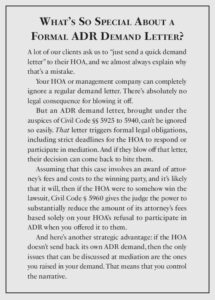
At the ADR stage, a demand letter is a legal leverage document. An experienced HOA attorney should draft it.
CONCLUDING THOUGHT
The Davis-Stirling Act does not require HOAs to prevent crime or guarantee resident safety. But it does require them to act reasonably when safety risks arise in the common areas they control. That obligation includes maintaining and repairing security-related features, responding to recurring risks, informing homeowners when danger becomes foreseeable, and engaging in required dispute-resolution processes when homeowners demand action.
For homeowners, the takeaway is practical rather than abstract. The question is not whether an HOA can stop crime entirely. The question is whether the HOA has done what the law requires in light of known conditions and risks. When boards refuse to act, delay repairs, or hide behind blanket disclaimers of responsibility, the law provides tools to force movement and compel compliance.
If your HOA ignores safety risks or refuses to meet its legal obligations, do not let the issue drift. Call us at MBK CHAPMAN, and we’ll set your HOA straight.