
Overview
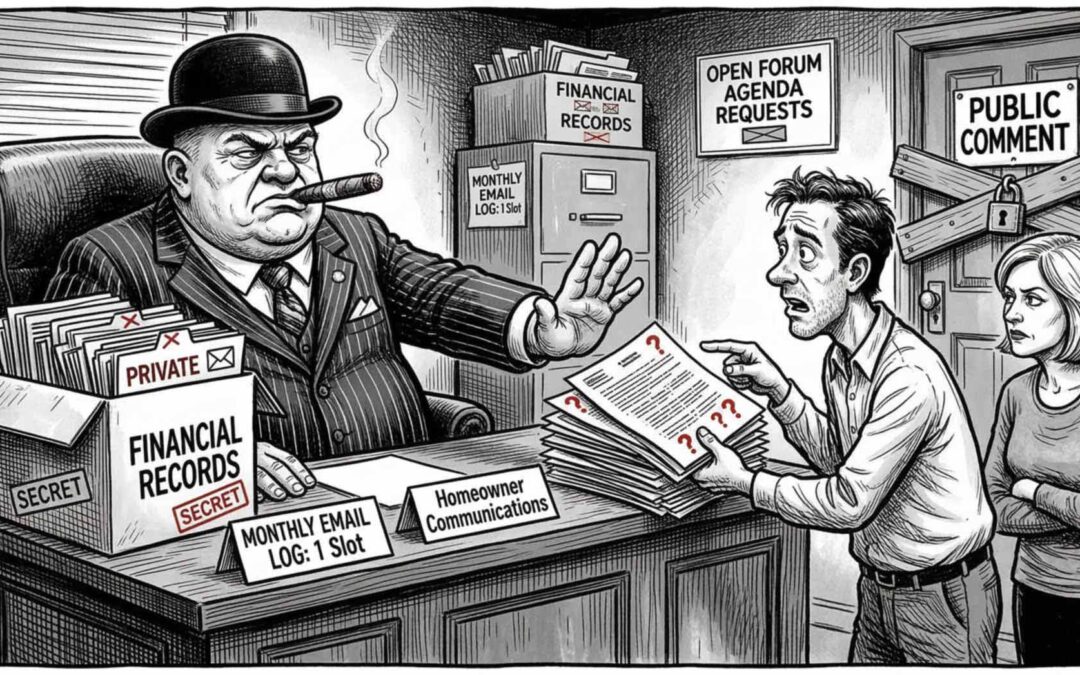
Homeowners frequently ask a version of the same question: Can my HOA just refuse to deal with me if I send too many emails? The issue comes up when a homeowner starts pressing management for answers about finances, maintenance problems, or board decisions, and the HOA responds by trying to control how often that homeowner can communicate. Sometimes the board simply stops responding. In other situations, the HOA’s lawyer sends a letter imposing a rule such as “one email per month.” When that happens, the communication dispute quickly turns into a much larger governance problem.
That is exactly the situation raised by a listener of the HOA HELL podcast. The listener explained that the HOA’s lawyer sent a letter telling the homeowner and a friend that they were limited to sending management one email per month. According to the HOA, any additional comments or requests would need to wait until the next month. The restriction appeared shortly after the homeowners began asking pointed and direct questions about financial records and requesting that certain issues be placed on the HOA board’s meeting agenda. The listener wanted to know whether a decision by the HOA or management like that is legally acceptable. [If you’d like to learn more about abusive and over-the-top letters sent by the lawyers representing bad HOAs, you can watch an episode of the podcast called “Weaponizing Harassment: How HOAs Use that Word to Silence You.”]
While there’s no specific right under the Davis-Stirling Act to send unlimited emails to the HOA or management, HOA boards do not have a free pass to silence members who raise legitimate concerns. Instead, the legality of communication restrictions must be evaluated through several other legal principles that govern how HOA boards exercise their authority. Those principles include the rule of reasonableness governing HOA operating rules, the fiduciary duties imposed on directors, and the statutory rights homeowners have to participate in HOA governance and demand transparency.
When those legal principles are applied together, a “one email per month” restriction often raises serious red flags. A communication limit that appears only after homeowners start asking questions about financial transparency, maintenance issues, or board conduct may look a lot less like reasonable management and much more like an attempt to shut down “inconvenient” inquiries. This Fact Sheet explains how California law evaluates HOA communication restrictions like the one demonstrated in the question, why arbitrary limits can become legally problematic, and what homeowners should understand if an HOA attempts to control or suppress communication with management or the HOA board.
Key Points
Disputes about homeowner communications often arise when a homeowner begins asking persistent questions about finances, repairs, or board conduct. While HOA boards do have a significant degree of authority to manage the day-to-day operations of their associations, including how management handles communications from members, that authority is limited. Indeed, the Davis-Stirling Act and other California laws work together to prevent bad HOAs from using communication restrictions as a tool to silence legitimate concerns.
- HOA boards may manage how communications with management are handled, but not for improper purposes. HOAs must be able to conduct business without being overwhelmed by constant or duplicative emails. This means that HOA boards are not required to respond to every repetitive or disruptive message from a member. At the same time, communication restrictions cannot be used as a tool to silence homeowners who raise legitimate questions about association finances, maintenance issues, safety concerns, or wrongful board conduct. When a communication limit appears designed to block legitimate inquiries rather than to reasonably manage workflow, a court will likely view that restriction as unreasonable and illegal.
- HOAs are not required to respond to excessive, abusive, or harassing communications. Some homeowners send dozens of repetitive emails demanding immediate and lengthy responses to every question they raise. HOA boards and management are not obligated to devote unlimited time to responding to communications that are duplicative, abusive, or unreasonably disruptive. In those situations, HOAs and their managers may adopt reasonable protocols governing how communications from such homeowners are submitted and handled. Whether a communication restriction is justified, therefore, often depends on the facts, including the volume, tone, and purpose of the communications involved.
- A restriction imposed only on specific homeowners raises questions about targeted treatment. When a communication limit appears in a letter sent by the HOA’s lawyer to particular homeowners, it is not a formally adopted operating rule governing the HOA. Instead, it functions as a directive aimed at one or more specific members. Selective communication restrictions can (and do) raise serious concerns about whether the HOA is attempting to suppress “inconvenient” questions rather than manage communications for the benefit of the entire HOA.
- HOA directors have a fiduciary duty to remain informed about association affairs. Corporations Code 7231 requires directors to act with the care an ordinarily prudent person would exercise in similar circumstances. That obligation includes making reasonable inquiries when a homeowner raises credible issues about finances, maintenance, safety, or other matters affecting the HOA. Directors cannot avoid that responsibility by instructing management or legal counsel to shut down communications from members raising legitimate concerns.
- Communication limits cannot interfere with homeowners’ participation rights. Civil Code 4925 guarantees homeowners the right to attend and speak at open board meetings. Homeowners often communicate with management in advance of meetings to request that certain topics be placed on the agenda or to provide information the HOA should consider. While HOA boards are not required to place every homeowner request on the agenda, a blanket restriction that allows homeowners to submit such requests only once per month may create an unreasonable barrier to meaningful participation in HOA governance.
- Restrictions imposed after financial questions are raised may raise retaliation concerns. Courts often defer to HOA boards when they make discretionary business decisions for the HOA. That judicial deference, often referred to as the Business Judgment Rule, weakens when an HOA board’s actions appear unreasonable, retaliatory, or taken in bad faith. If, for example, a communication restriction appears shortly after homeowners begin requesting financial records or questioning board conduct, a court may view the restriction as an attempt to suppress transparency rather than manage communications. [If you’d like to learn more about the Business Judgment Rule, you can tune into an episode of my HOA HELL podcast, “California HOAs: The Business Judgment Rule,” or read any one of a number of Fact Sheets that I’ve written on the topic, including “How California HOAs Abuse the Business Judgment Rule.”]
- An HOA cannot use a communication policy to evade its statutory duties to produce records. When a homeowner requests records covered by Civil Code 5200 et seq., the HOA must respond within the deadlines imposed by those statutes. An HOA cannot avoid those obligations by telling the homeowner to wait until next month’s email, by refusing to accept follow-up communications, or by hiding behind a general policy about limiting contact with management. A communication protocol may regulate how requests are submitted, but it cannot suspend statutory deadlines or give the HOA a license to ignore a proper records demand. If an HOA uses a communication restriction to ignore or “slow-walk” a records request, the homeowner may bring an action in court to enforce their rights. Under Civil Code 5235, if the court finds that the HOA wrongfully withheld records, the court will award the homeowner their attorneys’ fees, as well as up to $500 in statutory damages for each category of documents wrongfully withheld.
- Homeowners should carefully evaluate and document communication restrictions imposed on them by the HOA, management, or the HOA’s counsel. If an HOA attempts to impose a communication limit, homeowners should keep copies of all correspondence and carefully document when the restriction was imposed and why. Patterns matter. A restriction that appears after homeowners begin raising financial or governance concerns may reveal the board’s true motivations. Likewise, a restriction applied to only certain homeowners may indicate targeted treatment rather than a neutral policy.
- HOA boards may adopt policies governing how all members communicate with management, but those policies must be applied uniformly. HOAs may implement reasonable communication protocols to prevent excessive, duplicative, or abusive emails from consuming management’s time and increasing costs for the entire community. For example, an HOA may require homeowners to use designated channels for requests, consolidate multiple issues into a single communication, or limit repetitive follow-ups within a short time frame. Those types of policies can be appropriate when they are applied consistently to all members and tied to legitimate operational concerns. The problem arises when the HOA applies the policy selectively, enforces it only against certain homeowners, or uses it to avoid responding to specific types of requests, such as financial inquiries or complaints about board conduct. Even a facially neutral policy can become legally problematic if the HOA uses it as a pretext to ignore legitimate issues or to burden homeowners who are actively exercising their rights.
- If your HOA attempts to unreasonably silence or limit your legitimate communications, then call the HOA attorneys at MBK Chapman. Communication restrictions sometimes signal deeper governance problems within an HOA. If your HOA attempts to limit your ability to raise concerns, request transparency, or participate in governance, you should call us at MBK Chapman, widely recognized as California’s most experienced homeowner-side HOA lawyers. We are experts at defeating attempts by bad HOAs to silence participation by controlling the narrative.
Communication limits are not inherently improper, but the context in which they are imposed matters. When an HOA uses those limits to manage unreasonably excessive or abusive communications, they may be justified. When the same limits appear only after homeowners begin asking pointed questions or requesting transparency, they often reveal a deeper governance problem. The key is not how many emails a homeowner sent, but why the HOA is trying to control the conversation in the first place.
FAQs
Can my California HOA limit how often I email management?
HOAs may adopt reasonable communication protocols to manage excessive or disruptive emails, but they cannot impose arbitrary limits that prevent homeowners from raising legitimate concerns. A restriction such as “one email per month” is legally problematic if it interferes with a homeowner’s ability to report issues, request records, or participate in governance of the HOA.
Is my HOA allowed to ignore my emails?
No. While HOAs are not required to respond to repetitive, abusive, or excessive communications, they cannot ignore legitimate inquiries about finances, maintenance issues, safety concerns, or governance matters. They also cannot stand in the way of a homeowner’s statutory rights, such as a member’s right to demand and receive HOA-related records in the time periods specified by the Davis-Stirling Act.
Can an HOA single me out and limit only my communications?
Targeting specific homeowners with communication restrictions raises serious legal concerns. While HOAs may manage communications generally, selectively restricting only certain members, particularly those asking difficult questions, often indicates unreasonable or retaliatory conduct.
Can my HOA use an email policy to avoid responding to records requests?
No. When a homeowner requests records covered by Civil Code 5200 et seq. the HOA must comply within the applicable statutory deadlines. A communication policy cannot delay, block, or override those obligations, even if the HOA claims that the homeowner is sending too many emails.
What should I do if my HOA tells me to stop emailing or limits my contact?
You should document all communications, including when the restriction was imposed and what triggered it. If the restriction followed requests for financial records, maintenance issues, or governance concerns, that context may be critical in evaluating whether the HOA acted improperly. If you don’t get anywhere, then call my law firm, MBK Chapman, to help you. My firm’s HOA attorneys are among the most widely respected homeowner-side HOA lawyers in California.
Can my HOA retaliate against me for asking too many questions or requesting too many records?
No. An HOA cannot take action against a homeowner simply because they asked too many questions about finances, requested records, or raised concerns about the HOA’s management. If a communication restriction appears shortly after a homeowner begins making those types of inquiries, it may be viewed as retaliatory. Courts are a lot less likely to defer to HOA decisions when the evidence shows the board acted to suppress transparency rather than to manage legitimate operational issues.

About Michael Kushner
Michael Kushner is a California attorney with over 30 years of experience representing homeowners in disputes with their HOAs. He is widely regarded as California’s leading homeowner-side HOA attorney, and has built one of the state’s most prominent law practices dedicated to holding HOAs accountable under the Davis-Stirling Act and California law.
In addition to his law firm’s work, Michael is a recognized lecturer, author, and the host of the hit HOA HELL podcast, where he provides homeowners living in HOA-governed communities with clear, practical strategies for dealing with bad HOAs. He’s also the author of the best-selling book, HOA HELL | California Homeowners’ Definitive Guide to Beating Bad HOAs, which has become a go-to resource for both homeowners seeking real-world solutions to their HOA disputes, as well as those good HOA board members who are interested in doing a good job.
About MBK Chapman Fact Sheets
Homeowners searching for answers online will often come across articles that appear authoritative, but are actually written as search-engine marketing content rather than by an experienced HOA lawyer. These pieces tend to prioritize keyword density over clarity, accuracy, or legal context, which often leaves homeowners more confused than informed.
At MBK Chapman, our Fact Sheets are part of our HOA Law Library and are written by Michael Kushner, an HOA lawyer with decades of hands-on experience representing California homeowners. In fact, Michael Kushner is the HOA lawyer who pioneered the systems and strategies used by some of California’s most successful homeowner-side HOA law firms.
Each Fact Sheet is deliberately concise, statute-based, and designed as a quick-reference guide to help homeowners understand key HOA laws and enforcement rules at a glance.
AND DON’T FORGET TO TUNE INTO MY PODCAST, HOA HELL
YOU CAN ALSO ORDER MY GROUNDBREAKING BOOK
HOA HELL | California Homeowners’ Definitive Guide to Beating Bad HOAs
Amazon | Barnes & Noble
