
Overview
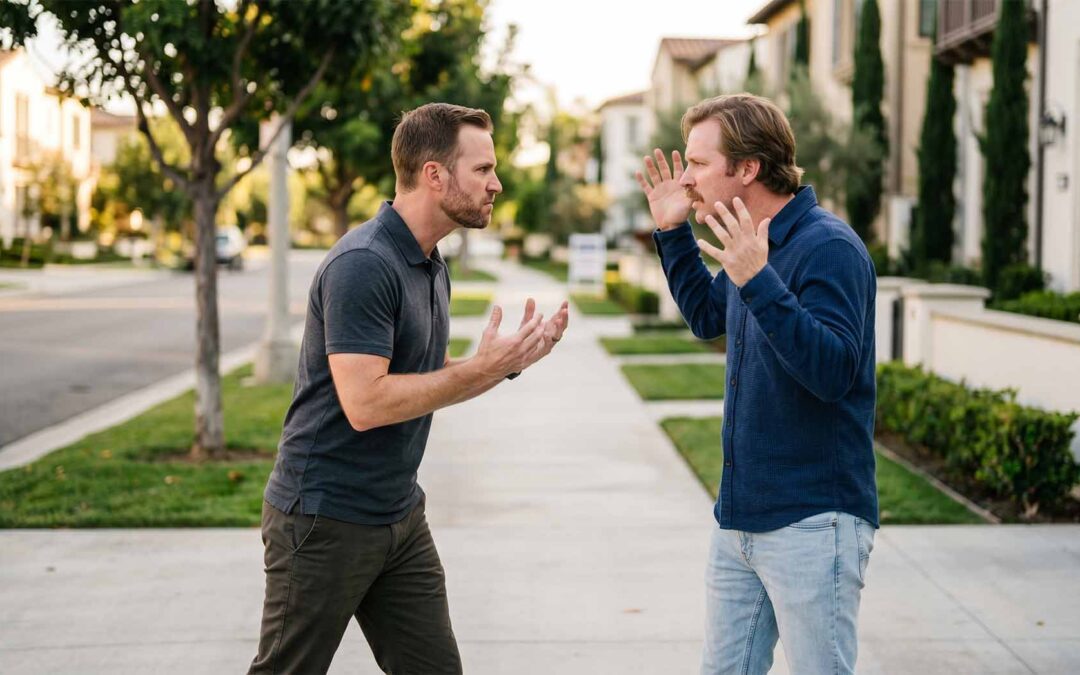
Few issues create more tension inside California HOA communities than nuisance disputes. Homeowners complain about excessive noise, secondhand smoke, barking dogs, offensive odors, bright exterior lighting, harassment from neighbors, poorly maintained properties, and disruptive conduct that interferes with their ability to peacefully enjoy their homes. HOA boards often struggle to determine when ordinary neighbor conflict crosses the line into a legally actionable nuisance, when the HOA must intervene, and when the dispute remains a purely private disagreement between residents.
California nuisance law does not operate under a subjective “I find this annoying” standard. Instead, California courts apply an objective framework to determine whether the conduct at issue substantially and unreasonably interferes with another person’s use and enjoyment of property. That’s an important distinction because living in an HOA necessarily requires homeowners to tolerate a certain amount of ordinary residential activity. Neighbors will make noise. People will cook. Dogs will bark occasionally. Children will play. The legal issue is not whether conduct irritates someone. The issue is whether the interference becomes excessive under the circumstances.
In HOA communities, nuisance disputes also involve an additional layer of complexity because most CC&Rs contain broad nuisance prohibitions that empower and often require HOA boards to regulate disruptive conduct within the community. Those nuisance provisions frequently overlap with California nuisance statutes, common law nuisance principles, architectural restrictions, use restrictions, and the HOA’s broader enforcement authority under the Davis-Stirling Act. As a result, many nuisance disputes involve not only the conduct of the homeowner accused of creating the nuisance, but also questions concerning whether the HOA investigated the issue reasonably, enforced the governing documents consistently, or ignored complaints that it had a duty to address.
This Fact Sheet explains the legal framework governing nuisance disputes inside California HOAs, including the objective legal standard courts apply, the role nuisance provisions play within HOA governing documents, the HOA’s authority and obligations when nuisance complaints arise, how nuisance claims intersect with the Business Judgment Rule, and why enforcement strategy matters when nuisance disputes escalate into litigation. It also serves as the starting point for a broader series of Fact Sheets examining specific categories of nuisance disputes commonly arising inside California HOA communities.
If your dispute involves excessive noise, barking dogs, hard-surface flooring violations, or disruptive short-term rental activity, see the next Fact Sheet in this series, “California HOA Noise Complaints: When Noise Becomes a Nuisance.” If the problem involves visual blight, bright lighting, neglected property conditions, or architectural violations, the third Fact Sheet in this series, “California HOA Nuisances: Ugly Properties, Bright Lights, and Visual Blight,” addresses those disputes. If your dispute involves smoke intrusion, offensive odors, trash accumulation, or pet waste, the fourth Fact Sheet in this series, “California HOA Odor Complaints: Smoke, Trash, and Other Nuisances,” examines those issues in detail. If your situation involves threatening, harassing, or intimidating conduct by another resident, the fifth Fact Sheet, “Toxic Neighbors in California HOAs: Harassment, Threats, and Nuisance Conduct,” focuses specifically on those issues. Finally, if your HOA refuses to investigate or address legitimate nuisance complaints, the sixth Fact Sheet in this series, “Does Your California HOA Have to Investigate Nuisance Complaints?,” explains when HOA boards have a duty to act and when the Business Judgment Rule does not protect HOA inaction.
Key Points
Nuisance disputes inside California HOA communities often become highly emotional because they directly affect how homeowners live inside their homes on a daily basis. But despite the emotional nature of these disputes, California law applies a structured legal framework that focuses on objective reasonableness, substantial interference, governing document enforcement, and the HOA’s obligations once serious complaints arise. In HOA communities, nuisance disputes rarely involve only one source of law. Instead, they often involve overlapping issues concerning Civil Code 3479, the governing documents, HOA enforcement authority, fiduciary obligations, and the limits of the Business Judgment Rule. Understanding how those concepts interact is critical because homeowners frequently misunderstand what legally qualifies as a nuisance, what duties the HOA owes once complaints arise, and what legal strategies create leverage when disputes escalate.
- California law defines a nuisance as anything that is injurious to health or indecent or offensive to the senses. Civil Code 3479 provides the foundational definition of a nuisance in California, describing it as an obstruction to the free use of property that interferes with the comfortable enjoyment of life or property. This statutory definition applies to all property owners in California, including those living within HOAs. But homeowners frequently misunderstand how courts apply the statute in practice. Civil Code 3479 does not prohibit every irritating, unpleasant, or inconsiderate act occurring inside a residential community. Instead, California courts apply an objective legal standard to determine whether the conduct substantially and unreasonably interferes with another person’s use and enjoyment of their property.
- California law distinguishes between private nuisances and public nuisances. Civil Code 3480 defines a public nuisance as conduct affecting an entire community or a considerable number of people, while Civil Code 3481 defines a private nuisance as everything not included in Civil Code 3480. Most HOA nuisance disputes involve private nuisances because the alleged interference typically affects neighboring owners rather than the public or community at large. For example, constant smoke intrusion affecting one neighboring condominium unit usually involves a private nuisance. By contrast, dangerous conditions or activities substantially affecting an entire HOA community may implicate broader public nuisance principles.
- Ordinary residential activities can become legal nuisances when they become excessive under the circumstances. HOA nuisance disputes frequently arise from activities that are otherwise perfectly lawful and expected inside residential communities. Dogs bark. Children play. Neighbors cook outdoors. Residents walk across upstairs floors. Homeowners use recreational amenities. The legal issue is not whether the activity exists at all. The issue is whether the activity becomes excessive because of its timing, duration, frequency, intensity, location, or resulting impact on surrounding homeowners. For example, occasional footsteps from an upstairs condominium unit rarely create an actionable nuisance. But repeated late-night impact noise caused by unauthorized hard-surface flooring or unreasonable activities in a poorly insulated building may.
- A nuisance requires an objectively substantial and unreasonable interference with another person’s use and enjoyment of their property. Minor annoyances, isolated incidents, personality conflicts, and ordinary neighborhood friction generally do not qualify as actionable nuisances under Civil Code 3479. Courts instead evaluate nuisance claims under an objective lens by examining not only whether an ordinary person, with ordinary sensibilities, would find the conduct substantial and unreasonable, but also by looking at the totality of the circumstances, including the nature of the community, the severity of the interference, the duration of the conduct, the time of day, and whether the interference ultimately affects another homeowner’s ordinary use or enjoyment of their property.
- California HOA nuisance disputes arise in many different forms. Nuisance disputes come in a variety of flavors such as noise disputes, smoke intrusion, odor-related complaints, visual blight issues, harassment-related conduct, parking conflicts, and misuse of common areas. While the legal framework governing nuisance disputes remains largely consistent across different categories of conduct, the evidence, investigation, enforcement strategies, and practical realities often differ substantially depending on the type of nuisance involved. For example, a barking dog dispute may depend heavily on incident logs, recordings, and witness corroboration. A hard-surface flooring dispute may require architectural records, flooring specifications, or acoustic analysis. Smoke intrusion disputes often require evidence showing repeated odor infiltration into neighboring units, while harassment-related nuisance claims may depend far more heavily on threatening communications, surveillance footage, witness testimony, or police reports.
- Most California HOA CC&Rs contain broad nuisance prohibitions that give HOA boards authority to regulate offensive or disruptive conduct within the community. Nearly all HOA governing documents prohibit homeowners from engaging in conduct that unreasonably interferes with other residents’ quiet enjoyment of their property. Those nuisance provisions frequently become the primary enforcement mechanism inside HOA communities because they allow HOA boards to investigate complaints, conduct hearings, impose fines, suspend privileges, seek injunctive relief, and otherwise enforce restrictions against homeowners creating nuisance-related conditions. They also become the primary enforcement mechanism because of the Davis-Stirling fee-shifting statutes, which I discuss more fully below.
- Homeowners have a direct right to enforce nuisance provisions in the CC&Rs against their neighbors. If an HOA board refuses to act, the Davis-Stirling Act grants individual homeowners the right to file a lawsuit directly against a neighbor to enforce the CC&Rs. This provides a critical safety valve for homeowners trapped in a nuisance situation where the HOA board is either incompetent or indifferent.
- An HOA’s enforcement authority also creates an obligation for HOA boards to reasonably investigate legitimate nuisance complaints. Once credible complaints arise involving conduct potentially violating the governing documents, the HOA board cannot simply ignore the complaint or tell homeowners to “work it out themselves.” Rather, the Davis-Stirling Act and California case law require HOA boards to conduct a reasonable investigation and determine whether a violation of the governing documents has occurred.
- The Business Judgment Rule does not protect HOA boards that refuse to conduct a reasonable investigation into serious nuisance complaints. While the Business Judgment Rule provides HOA boards with deference for discretionary decisions, it does not allow an HOA board to ignore its mandatory duty to enforce the governing documents. In other words, the Business Judgment Rule does not shield HOA boards that refuse to investigate credible nuisance complaints or blindly ignore evidence of substantial nuisance-related conduct occurring within the community. [I’ve written extensively about the Business Judgment Rule. If you type that term into the search bar on MBK Chapman’s website, you’ll find helpful Fact Sheets on the topic. But if you prefer, you can also watch an episode of my podcast, HOA HELL, where Sam and I did a deep dive into the Business Judgment Rule: “California HOAs: The Business Judgment Rule.”]
- HOA boards cannot enforce nuisance provisions selectively or arbitrarily. HOA boards must enforce nuisance restrictions consistently and in good faith. An HOA that aggressively pursues nuisance violations against one homeowner while ignoring nearly identical conduct by another risks claims of selective enforcement, arbitrary enforcement, or discriminatory treatment. [I wrote a comprehensive article on selective enforcement, “Selective Enforcement in California HOAs: What It Is and How Homeowners Can Fight Back,” if you’d like to learn more about that. You can also watch an episode of the podcast on the topic, “California HOAs and Selective Enforcement: How to Spot it and How to Stop It.”]
- California HOA nuisance disputes often involve overlapping nuisance claims under Civil Code 3479 and enforcement claims under the governing documents. Many homeowners incorrectly assume nuisance disputes exist solely under California nuisance statutes. Inside HOA communities, however, nuisance disputes frequently involve parallel enforcement rights arising under the CC&Rs themselves. That distinction becomes strategically important because the legal theory pursued in litigation can dramatically affect available remedies and attorneys’ fees exposure.
- CC&R-based nuisance enforcement claims can create fee-shifting rights that do not exist in standalone nuisance claims brought under Civil Code 3479. When litigation seeks to enforce nuisance-related provisions contained in the governing documents, Civil Code 5975 may entitle the prevailing party to recover attorneys’ fees and costs because the lawsuit involves enforcement of the governing documents. A plaintiff pursuing only a standalone nuisance claim under Civil Code 3479 may lose access to those Davis-Stirling Act fee-shifting protections. [The concept of fee-shifting, which addresses when a party who wins in court will be awarded their attorneys’ fees, is both complex and nuanced. I broke those complexities down for you in a comprehensive Fact Sheet, “When Can You Recover Attorney Fees from Your California HOA? Key Laws Explained,” in which I explained how all of the Davis-Stirling Act’s fee-shifting statutes worked and how to use them strategically.]
- An HOA can create or worsen a nuisance through its own common area decisions and operations. HOA nuisance disputes do not always involve misconduct by individual homeowners. In some situations, the HOA itself creates or substantially contributes to nuisance-related conditions through its management of the common areas. For example, take the tennis court-to-pickleball court conversions that I wrote about recently. HOAs who convert tennis courts to pickleball courts without adequately addressing the resulting noise or lighting issues may find themselves liable for the interference such conversions cause to surrounding homeowners’ quiet enjoyment of their property.
- Proper evidence collection substantially improves a homeowner’s ability to prove nuisance-related conduct. Nuisance disputes frequently become fact-intensive conflicts where credibility and documentation determine the outcome. Homeowners should preserve photographs, videos, written complaints, emails, text messages, witness statements, incident logs, decibel readings where appropriate, and other evidence demonstrating the nature, frequency, duration, and severity of the alleged nuisance conduct. The stronger the evidentiary record becomes, the harder it becomes for the HOA or the offending homeowner to dismiss the complaints as exaggerated, isolated, or unsupported.
- If your HOA refuses to address serious nuisance-related conduct, call California’s most respected homeowner-side HOA attorneys at MBK Chapman. Nuisance disputes inside California HOA communities often involve overlapping issues concerning Civil Code 3479, governing document enforcement, HOA authority, selective enforcement, unreasonable interference, and the limits of the Business Judgment Rule. The HOA attorneys at MBK Chapman have decades of combined experience representing California homeowners in complex HOA nuisance disputes. If your HOA refuses to reasonably address serious nuisance-related conduct affecting your property rights, contact MBK Chapman today.
The legal framework governing California HOA nuisances ensures that homeowners do not have to tolerate excessive or unreasonable interference with their property rights. By balancing the statutory protections of Civil Code 3479 with the private contract rights found in the CC&Rs, California law provides a clear path for resolving nuisance-related disputes. Whether you’re dealing with a defiant, loud, or abusive neighbor or a bad HOA board, understanding these objective standards is the first step toward restoring the peaceful enjoyment of your home.
FAQs
What legally qualifies as a nuisance in a California HOA?
Civil Code 3479 defines a nuisance broadly as conduct that is injurious to health, offensive to the senses, obstructive to the free use of property, or that interferes with another person’s comfortable enjoyment of life or property. But not every irritating or unpleasant activity qualifies as a legal nuisance. In HOA communities, the issue is whether the conduct substantially and unreasonably interferes with another homeowner’s use and enjoyment of their property under an objective standard. Courts do not ask whether a particularly sensitive homeowner found the conduct annoying. They ask whether a reasonable person living under similar circumstances would consider the interference excessive.
Can my California HOA ignore nuisance complaints from homeowners?
Not if your HOA is like most California HOAs. Most California HOA governing documents contain nuisance restrictions that prohibit offensive or disruptive conduct within the community. Once credible complaints arise involving conduct potentially violating those restrictions, the HOA board must reasonably investigate the issue and determine how to respond. An HOA’s refusal to investigate or enforce its governing documents exposes the HOA itself to liability.
What is the difference between a private nuisance and a public nuisance in a California HOA?
Civil Code 3480 defines a public nuisance as conduct affecting an entire community or a considerable number of people, while Civil Code 3481 basically states that everything else is a private nuisance. Most HOA nuisance disputes involve private nuisances because the alleged interference typically affects neighboring homeowners rather than the public at large. For example, constant smoke intrusion affecting one neighboring condominium unit or repeated late-night noise disturbing several nearby homes will usually qualify as a private nuisance. By contrast, dangerous conditions or widespread activities substantially affecting an entire HOA community may implicate broader public nuisance principles.
Can an HOA itself create a nuisance?
Yes. HOA nuisance disputes do not always involve misconduct by individual homeowners. In some situations, the HOA itself creates or substantially contributes to nuisance-related conditions through its management of the common areas or operational decisions. Examples may include converting tennis courts into pickleball courts without adequately addressing resulting noise impacts, installing excessively bright lighting near homes, permitting repeated overcrowding of recreational amenities, or allowing common area activities that substantially interfere with surrounding homeowners’ quiet enjoyment of their property.

About Michael Kushner
Michael Kushner is a California attorney with over 30 years of experience representing homeowners in disputes with their HOAs. He is widely regarded as California’s leading homeowner-side HOA attorney, and has built one of the state’s most prominent law practices dedicated to holding HOAs accountable under the Davis-Stirling Act and California law.
In addition to his law firm’s work, Michael is a recognized lecturer, author, and the host of the hit HOA HELL podcast, where he provides homeowners living in HOA-governed communities with clear, practical strategies for dealing with bad HOAs. He’s also the author of the best-selling book, HOA HELL | California Homeowners’ Definitive Guide to Beating Bad HOAs, which has become a go-to resource for both homeowners seeking real-world solutions to their HOA disputes, as well as those good HOA board members who are interested in doing a good job.
About MBK Chapman Fact Sheets
Homeowners searching for answers online will often come across articles that appear authoritative, but are actually written as search-engine marketing content rather than by an experienced HOA lawyer. These pieces tend to prioritize keyword density over clarity, accuracy, or legal context, which often leaves homeowners more confused than informed.
At MBK Chapman, our Fact Sheets are part of our HOA Law Library and are written by Michael Kushner, an HOA lawyer with decades of hands-on experience representing California homeowners. In fact, Michael Kushner is the HOA lawyer who pioneered the systems and strategies used by some of California’s most successful homeowner-side HOA law firms.
Each Fact Sheet is deliberately concise, statute-based, and designed as a quick-reference guide to help homeowners understand key HOA laws and enforcement rules at a glance.
AND DON’T FORGET TO TUNE INTO MY PODCAST, HOA HELL
YOU CAN ALSO ORDER MY GROUNDBREAKING BOOK
HOA HELL | California Homeowners’ Definitive Guide to Beating Bad HOAs
Amazon | Barnes & Noble
