
Overview
UPDATED ON 12/23/25
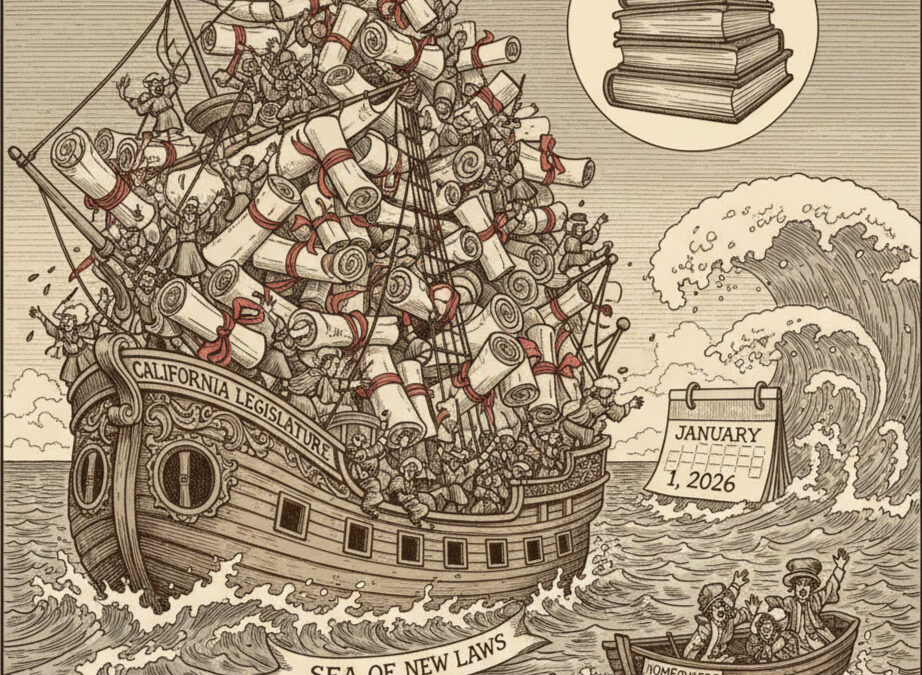
Here we are again. Another year, another round of new laws from our industrious hive in Sacramento. Every January, business owners, landlords, and HOA members brace for the latest batch of mandates, prohibitions, and procedural “clarifications” that promise to make life easier for everyone…at least that’s what our Legislature say.
The 2026 legislative cycle delivered its usual mix of employer compliance headaches, tenant protections, wage adjustments, and workplace reforms. Some are modest. Others will have significant operational or financial consequences.
This Fact Sheet highlights the new laws taking effect in 2026 that I find most relevant to my clients. Whether you own a business, manage residential rental properties, or live in a California HOA, these are the changes that I think you need to know about.
Key Points
Each January, dozens of new California laws go into effect. These laws impact employers, landlords, tenants, and HOA members alike. Below is a summary of the most significant changes for 2026 (and a few late 2025 laws that kick in during the new year). These are the ones that I’ve curated because I believe they are the ones most likely to impact your business operations, property management duties, or homeowner rights. Unless I state otherwise, the new laws described below will go into effect as of January 1, 2026.
- SB 770—EV Charging Stations in CA HOAs. This law amends Civil Code 4745 to further reduce HOA obstacles to EV charger installations by eliminating the remaining requirement that an owner’s liability insurance related to an EV charging station name the association as an additional insured. Owners still must maintain liability coverage and provide the association a certificate of insurance, but HOAs can no longer use the “additional insured” requirement as a bottleneck to delay or deny installations.
- SB 543—Junior ADU Reform. This law clarifies and strengthens California’s existing junior accessory dwelling unit (JADU) mandates by limiting JADUs to 500 square feet of interior livable space, confirming that owner-occupancy requirements apply only in circumstances where a JADU shares sanitation facilities with the main residence, and requiring JADUs to be rented only for terms longer than 30 days. The law also curbs local resistance by rendering non-compliant JADU ordinances unenforceable and by imposing strict application completeness, notice, and appeal timelines.
- SB 625—Disaster Rebuild Protections Inside HOAs. This law creates Civil Code 4752, which voids and renders unenforceable HOA governing-document provisions that prohibit, directly or indirectly, a substantially similar reconstruction of a residential structure destroyed or damaged in a declared disaster. The statute defines “substantially similar” using objective limits, including a 110 percent cap on interior livable square footage and height, subject to the statute’s terms, and requires courts to award attorney’s fees to prevailing homeowners enforcing compliance. SB 625 also adds Civil Code 4766, which forces HOAs to process rebuild applications under streamlined procedures that include written completeness determinations, fixed review timelines, an appeal process, and mandatory attorney’s fee awards for homeowners who prevail. [HOA governing documents often included restrictive architectural language because boards drafted them long before large-scale wildfire destruction became common and without considering post-disaster reconstruction. Boards then used those provisions to delay, downsize, or block homeowners from rebuilding homes that complied with the law when constructed. This law closes that loophole and prevents HOAs from using architectural rules as a post-disaster veto, allowing homeowners to rebuild substantially similar homes without forced redesigns, delay tactics, or unnecessary litigation.]
- SB 547—This law adds Insurance Code 675.55, which bars insurers from canceling or refusing to renew commercial property insurance policies for properties located within or adjacent to a wildfire perimeter for one year following a state of emergency declaration when the insurer relies solely on wildfire location as the stated reason. [Insurers previously used wildfire proximity alone to justify mass cancellations and non-renewals, leaving HOAs and other commercial property owners uninsured and triggering mortgage violations, frozen sales, special assessments, and financial instability. This law imposes a one-year stabilization period that prevents immediate insurance collapse based solely on location rather than actual risk or damage.]
- Minimum Wage Increase. The increase in the statewide minimum wage to $16.90 per hour, along with the corresponding increase in the minimum salary for overtime-exempt employees, is not a result of a new bill, but rather it’s part of the automatic annual adjustment based on California Labor Code 1182.12(c) and the Consumer Price Index. This raises the minimum salary rate for exempt employees to $70,304. Keep in mind, however, that many cities have higher minimum wage requirements than these minimums set by California State law.
- AB 246—Temporary Eviction Defense for Social Security Payment Interruptions. Signed into law just a few days ago (on October 25, 2025) as the new Civil Code 1946.3, and valid through January 20, 2029, this law provides a defense to eviction for nonpayment of rent when a tenant’s Social Security benefits are delayed or interrupted through no fault of the tenant, such as in the case of the current government shutdown. The tenant must provide a hardship declaration as defined. The law also adjusts notice timing and content during such declared interruptions.
- SB 261—Unpaid Wage Judgments. This law adds substantial risk for employers who delay payment after losing a wage case involving an employee (or ex-employee). Employers who fail to pay a wage judgment within 180 days after the appeal period expires can face civil penalties of up to three times the unpaid amount. Courts must also award reasonable attorney’s fees and costs to employees (or the Labor Commissioner or public prosecutor) who bring successful actions to enforce a final wage judgment.
- SB 291—Workers’ Compensation Penalties. This law increases penalties for contractors operating without required workers’ compensation insurance. The maximum civil penalties are now: (a) $10,000 per violation for sole proprietors; (b) $20,000 per violation for LLCs, corporations, partnerships, or tribal-business licensees; and (c) $30,000 per violation for repeat offenders. Licensed contractors and applicants should confirm that coverage is current and properly documented to avoid these heightened penalties.
- SB 294—Workplace Know Your Rights Act / Notice and Arrest Notifications. SB 294 (titled the Workplace Know Your Rights Act) requires employers to distribute a new standalone notice summarizing key California workplace rights (including workers’ compensation, immigration-related protections, and union rights).
- Employee Notice Requirement. The Labor Commissioner will post a model notice by January 1, 2026, along with educational videos for employees and employers. Employers must deliver the notice: (a) to current employees by February 1, 2026, and every subsequent year, using normal communication channels such as email, text, or direct delivery (so long as it is received within one business day); (b) to all new hires; (c) annually to any authorized representative of an employee, starting on March 30, 2026. [For purposes of this new law, “authorized representative” means someone whom the employee designates to receive the workplace notice on their behalf (e.g., a parent, spouse, domestic partner, legal guardian, or someone with power of attorney).] In addition, notices must be provided in the employee’s primary workplace language if the template is available in that language. Employers must, therefore, keep proof of distribution for three years.
- Emergency Contact Notification. SB 294 also requires employers to notify an employee’s designated emergency contact if the employee is arrested or detained at work. If the arrest happens elsewhere while the employee is working, notification is required only if the employer has actual knowledge of it. Employers must give all existing employees an opportunity to list an emergency contact by March 30, 2026, and provide the same opportunity to new hires after that date.
- SB 303—Bias Training & Protections. This new law encourages employers to provide unconscious-bias training by adding specific protections under the Fair Employment and Housing Act (FEHA). An employee’s honest acknowledgment or assessment of personal bias during an approved “bias-mitigation training” cannot be used against that person as evidence of discrimination. Likewise, conducting such training itself does not amount to discriminatory treatment. “Bias-mitigation training” includes any education or activity that helps employees recognize, understand, and reduce the influence of conscious or unconscious bias, such as assessments, workshops, toolkits, and follow-up programs to track progress. These clarifications aim to remove disincentives for companies that want to invest in meaningful workplace bias-awareness efforts.
- AB 406—Expanded Leave for Violence Victims (Paid sick leave part took effect October 1, 2025; 1/1/26 for the expanded leave related to attending judicial proceedings, etc.). Under prior law, employees could take time off for reasons related to domestic violence, sexual assault, stalking, or other qualifying crimes. AB 406 now broadens those rights (granted as part of FEHA under Gov’t Code 12945.8) to protect employees and family members of victims from being fired or retaliated against for taking leave to attend judicial proceedings, including bail hearings, pleas, sentencing, post-conviction proceedings, or any hearing that affects the victim’s rights. Covered crimes include violent or serious felonies, theft or embezzlement felonies, vehicular manslaughter while intoxicated, felony child abuse, felony domestic violence, elder or dependent-adult abuse, felony stalking, solicitation for murder, hit-and-run causing injury or death, DUI with injury, and sexual assault. The state’s paid-sick-leave law is also updated so employees can now use paid leave for these same reasons, such as appearing in court as a witness, responding to a subpoena, or serving on a jury. While the paid-sick-leave portions of the new law took effect on October 1, 2025, the rest of the requirements under AB 406 go into effect on January 1, 2026.
- AB 414—Security Deposit Refund & Delivery Reforms. This law expands and amends Civil Code 1950.5 regarding the manner in which landlords must return security deposits and deliver the itemized statement of deductions. If the landlord received security deposits or rent payments electronically, then the remaining deposit must be returned electronically unless another method is agreed in writing. When multiple adult tenants are on the lease, the landlord must either issue a refund check made payable to all adult tenants or have a mutual written agreement that specifies another method and distribution.
- SB 464—Demographics Reporting. Employers with 100 or more workers already file annual pay-data reports with the California Civil Rights Department (CRD), similar to the federal EEO-1 form. Beginning on January 1, 2027, those reports will require data across 23 job categories instead of the current 10, further refining demographic transparency. Courts must now impose penalties for non-reporting whenever the CRD requests enforcement. In addition, beginning on January 1, 2026, employers subject to this law (i.e., those with at least 100 employees) must keep demographic data gathered for these reports separate from personnel files. To comply, employers should review record-keeping systems and confirm that sensitive demographic information is stored independently and protected with appropriate access controls.
- SB 477—Stronger FEHA Enforcement. SB 477 enhances the CRD’s ability to handle complex discrimination cases under FEHA. The agency now has broader discretion to pause, investigate, or prosecute complaints when both parties consent. Previously, the employee’s statute of limitations paused only while the CRD investigated and until it issued a right-to-sue notice. Under the new law, if an employee appeals the CRD’s decision to close a case, and the CRD affirms that closure, the employee gets an additional one-year tolling period from the date of the appeal decision to file suit. This ensures claimants are not penalized for pursuing an internal appeal.
- SB 513—Additional Rights to Personnel Records. Employees already have the right to review their personnel files. SB 513 expands that right to include records of employee training and education. Employers must keep details such as the employee’s name, training provider, duration and date, covered competencies, and resulting certification or qualification.
- SB 590—Extended Family Leave for Certain Designated People. Beginning July 1, 2028, California’s Paid Family Leave program will cover leave to care for a “designated person.” This includes anyone related by blood or anyone whose relationship with the employee is equivalent to family (within the meaning of applicable law). Employees claiming benefits for such leave must identify the individual and attest, under penalty of perjury, to the nature of the relationship.
- AB 628—Refrigerator & Stove Requirements for Rentals. This new law requires that any residential leases entered into, renewed, or amended on or after January 1, 2026 must include a working stove and refrigerator as part of the unit’s condition. Landlords must maintain these appliances throughout the tenancy and must repair or replace any unit subject to a recall within 30 days. Certain housing types (such as permanent supportive housing, residential hotels with common kitchens, or shared-kitchen models) are exempt. As long as it’s in writing, tenants may waive the right to have a refrigerator installed if they wish to supply their own.
- SB 642—Pay Transparency and Equal Pay Updates. I’ll break those items out as follows:
- Pay Transparency. California already requires employers to share pay ranges in job postings and upon request. Starting on January 1, 2026, the definition of “pay scale” becomes more precise. It now refers to the employer’s good-faith estimate of the salary or hourly rate the company realistically expects to pay when hiring for a given position. For example, today, employers could post a job listing saying something like: “Salary: $60,000 to $100,000” without any internal analysis or basis for that upper figure and without regard to what employers realistically expect to pay. Beginning January 1, 2026, however, employers would have to post a “good-faith estimate of the expected salary or hourly wage range the employer reasonably expects to pay for the position upon hire.” In other words, employers are going to need to be able to articulate documentation or a rationale showing that the range is realistic. This means that employers should review job postings and internal procedures to make sure the pay ranges shown are genuine, defensible estimates rather than broad or generic ranges.
- Equal Pay. SB 642 now prohibits paying an employee of “another sex” less than others performing substantially similar work based on the “sex” of the employee. This language also makes clear that the law protects non-binary employees as well. “Wages” and “wage rates” are now defined broadly to include every form of compensation, such as salary, overtime, bonuses, stock or stock options, profit-sharing plans, life insurance, vacation or holiday pay, travel reimbursements, allowances, hotel accommodations, and other benefits. The statute of limitations for equal-pay claims extends to three years, and employees can recover up to six years of underpaid wages. The law also clarifies that an equal-pay claim accrues upon the first occurrence of any of the following: (a) when a pay practice or decision is first adopted; (b) when an employee becomes subject to that practice; or (c) each time wages or benefits are paid under a discriminatory practice. Employers should review compensation systems to ensure all forms of pay are considered when evaluating pay equity and should train HR and management on these changes, maintaining documentation to support compensation decisions.
- AB 692—Ban on “Stay-or-Pay” Employment Contracts. California’s long-standing ban on non-compete agreements now extends to “stay-or-pay” contracts. Under AB 692, California employers cannot require a worker to repay money or other value to the employer, training provider, or debt collector if employment ends; authorize collection of a debt if employment ends; or pay any fee or penalty simply for leaving a job. For purposes of this new law, “debt” includes any amount owed for employment or education-related costs, even if voluntarily incurred, and “penalty, fee, or cost” includes quit fees, replacement-hire fees, retraining charges, lost profits, or reimbursement of immigration-related expenses. These protections apply to employees and job applicants (but not independent contractors—at least for now). There are some exceptions, including tuition reimbursement agreements for transferable credentials and signing-bonus retention agreements, provided they meet strict conditions such as separate agreements, prorated repayment terms, no acceleration, and no interest. Contracts violating these rules are void as against public policy, and workers may sue for damages (actual or $5,000 minimum per worker), attorney’s fees, and injunctive relief.
- SB 721—Extension Deadline for Multi-Family Rental/Apt. Buildings. Effective as to multi-family rental/apt. buildings, SB 721 mandates that exterior elevated elements (such as balconies, elevated walkways, stairs, or decks six feet or more above ground) be visually inspected by a licensed professional in developments of three or more units. The initial inspection deadline was previously extended to January 1, 2026, and after that inspections must recur at least every six years. [Note: Some have argued that the January 1, 2026 extension applied to condominiums located in California HOAs. In my opinion, however, such confusion was never justified. First, AB 2579, which is the bill that first extended the deadline from January 1, 2025 to January 1, 2026, explicitly excluded “common interest developments.” Even without that explicit language, however, it seems obvious that given the “every six years” versus “every nine years” difference in subsequent inspection times, there should’ve been no confusion. In short, as far as California HOAs go, the compliance deadline for the Balcony Law was January 1, 2025.]
- AB 806—Mobilehome Park Residents May Install Air Conditioning. This law prohibits mobilehome park operators from banning or restricting the installation or use of air-conditioning systems in residents’ mobilehomes that meet reasonable installation standards. This applies to mobilehome park tenancies and may affect landlords/operators of mobilehome parks. This law also bans managers of mobilehome parks from charging fees related to the installation or use of cooling systems. Penalties for non-compliance include a civil penalty of up to $2,000 for entities that willfully violate the law, in addition to attorney’s fees and actual damages.
- SB 809—Independent Contractors & Vehicle Reimbursements. SB 809 clarifies two key points of employment law: (a) simply owning a vehicle used to perform job duties, whether personal or commercial, does not automatically make a person an independent contractor; and (b) even though employers are already required under Labor Code 2802 to reimburse employees for business use of personal or commercial vehicles, this new law reaffirms that vehicle-related expenses fall under required employee reimbursements.
- AB 1414—Tenant Opt-Out of Bulk Internet Subscription. For any tenancy commencing or renewing on or after January 1, 2026, landlords (and their agents or associations) must provide tenants the option to opt out of any bundled internet-service subscription offered as part of the lease. If the landlord fails to honor this right, the tenant may deduct the cost of the subscription from the rent. The law expressly prohibits retaliation against the tenant for exercising this right. The law does not prohibit offering bulk billing—it only mandates that participation cannot be forced.
These are the new laws most likely to affect day-to-day operations for California businesses, HOA members, and residential landlords. While some are small adjustments, others impose new record-keeping, disclosure, and compliance burdens. Take a moment to review which ones apply to your situation now because as always, compliance is easier (and far less expensive) when you’re ahead of the curve.
About MBK Chapman Fact Sheets
Homeowners searching for answers online will often come across articles that appear authoritative, but are actually written as search-engine marketing content rather than by an experienced HOA lawyer. These pieces tend to prioritize keyword density over clarity, accuracy, or legal context, which often leaves homeowners more confused than informed.
At MBK Chapman, our Fact Sheets are part of our HOA Law Library and are written by Michael Kushner, an HOA lawyer with decades of hands-on experience representing California homeowners. In fact, Michael Kushner is the HOA lawyer who pioneered the systems and strategies used by some of California’s most successful homeowner-side HOA law firms.
Each Fact Sheet is deliberately concise, statute-based, and designed as a quick-reference guide to help homeowners understand key HOA laws and enforcement rules at a glance.
AND DON’T FORGET TO TUNE INTO MY PODCAST, HOA HELL
YOU CAN ALSO ORDER MY GROUNDBREAKING BOOK
HOA HELL | California Homeowners’ Definitive Guide to Beating Bad HOAs
Amazon | Barnes & Noble
