
UPDATED ON NOVEMBER 5, 2025 TO INCLUDE ADDITIONAL SELECTIVE ENFORCEMENT-RELATED Q&As
Overview
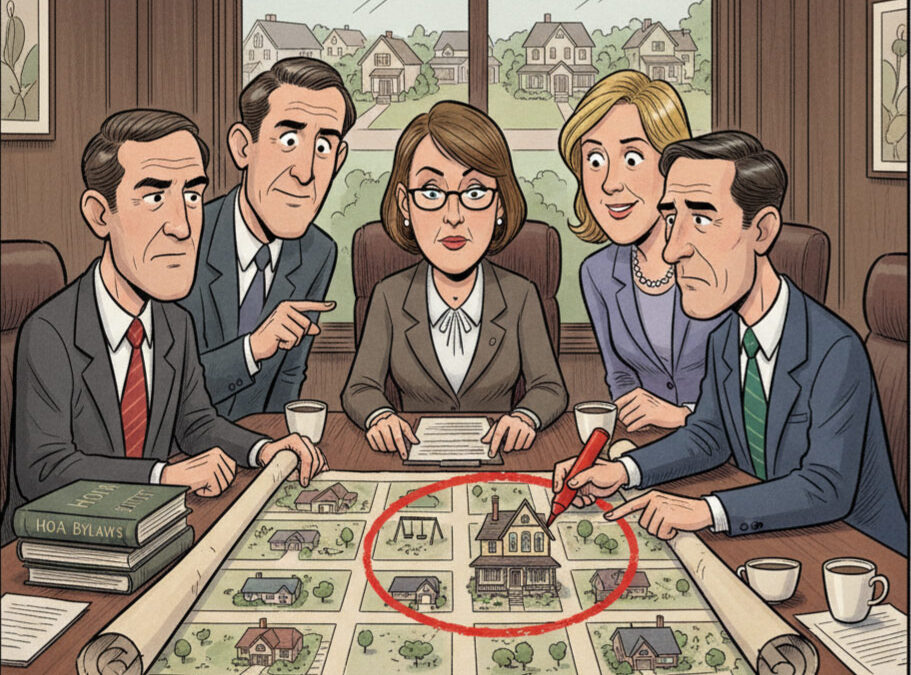
Selective enforcement occurs when HOA boards apply rules inconsistently, punishing some homeowners while overlooking identical violations by others. California law prohibits this type of arbitrary and capricious conduct. To successfully fight back, homeowners must prove the double standard with clear, documented evidence.
For a deeper analysis, see my article: “HOA Selective Enforcement in California: What It Is and How Homeowners Can Fight Back.”
Key Points
Here are the basic requirements and principles every California homeowner should know about proving selective enforcement:
- Start With Comparisons. If you are fined for an infraction or denied approval of an improvement, look around your community. Document other properties with the same violation or improvement. Photographs of neighboring pergolas, hedges, paint colors, or basketball hoops can directly support your case.
- Use Association Records. Civil Code 5200 gives homeowners the right to inspect a wide array of association records, including board and committee minutes. These can reveal whether similar applications were approved or violations ignored. If records are missing, that absence itself is a red flag. For more information on how to best take advantage of your right under Civil Code 5200, ready my article: “Forcing HOA Transparency: The Power of Civil Code § 5200 to Demand Records.”
- Check Architectural Decisions. Civil Code 4765 requires HOAs to make architectural decisions fairly, in good faith, and not arbitrarily or capriciously. If your architectural application was denied while other, materially similar applications were approved, that inconsistency is strong evidence of selective enforcement.
- Look for Due Process Failures. If you were denied a fair hearing, or the board failed to give you a written explanation for its decision (as Civil Code 4765(a)(4) requires), those process violations add weight to your claim.
- Build a Pattern. A single example may not be enough. Collect multiple instances that demonstrate favoritism, retaliation, or abuse of authority. The stronger the pattern, the stronger your ability to prove that the board is enforcing rules unfairly and unlawfully.
- Layer Your Proof. The most effective approach stacks visual comparisons, association records, and due process violations to demonstrate that the board is enforcing rules selectively, unfairly, and unlawfully.
Proving selective enforcement requires more than suspicion. By documenting comparable violations, gathering board records, and exposing process failures, homeowners can demonstrate that their HOA is enforcing rules unfairly and in violation of California law.
FAQs
What is selective enforcement in a California HOA?
It’s when the board applies the same rule inconsistently, penalizing some owners while ignoring identical violations by others.
What specific HOA rules are often cited in cases of selective enforcement?
At MBK CHAPMAN, when we see cases of selective enforcement (and we seem such cases all the time), we see such examples within the context of the following types of scenarios:
Exterior & Aesthetic Rules. These rules are often enforced against some but ignored for others, particularly when an HOA board has personal biases against certain homeowners.
- Lawn/Landscaping Maintenance: Requiring specific grass height, prohibiting certain types of plants, or mandating immediate removal of weeds.
- Architectural/Color Schemes: Rules requiring pre-approval for exterior paint colors, door colors, or specific roofing materials.
- Accessory Structures: Restricting the placement, size, or appearance of items like sheds, swing sets, basketball hoops, or trampolines.
Vehicle & Parking Rules. These rules can be easy targets for selective enforcement, especially when parking is limited.
- Oversized Vehicles/Commercial Vehicles: Prohibiting trucks with commercial lettering, RVs, boats, or trailers from being parked in driveways or on the street overnight.
- Inoperable Vehicles: Enforcing the removal of cars that are visibly damaged or have expired registration, but only for certain residents.
- Garage Usage: Rules requiring garages to be used for parking vehicles only, not storage, which is highly intrusive and difficult to enforce uniformly.
Leasing & Usage Rules. These regulations involve the use of the property and can be selectively applied to control the neighborhood’s demographic or rental population.
- Leasing Restrictions: Rules that limit the percentage of homes that can be rented out, which can be selectively waived for friends of the board.
- Short-Term Rentals: Restricting or banning rentals through services like Airbnb, with enforcement focused only on homeowners who are not well-connected.
- Pet Restrictions: Rules regarding the number, size, or breed of pets allowed, with grandfathering clauses or exceptions granted selectively.
Common Area & Nuisance Rules. Enforcement of these often subjective rules depends heavily on who is complaining and who the accused homeowner is.
-
Noise and Nuisance: Vague rules against “excessive noise” or “disturbances,” where complaints from some residents are prioritized over others.
-
Common Area Misuse: Selective ticketing or warnings for minor infractions in shared spaces, like children’s unsupervised play or leaving personal items near a pool.
Why is selective enforcement unlawful?
Because HOA rules must be enforced fairly and uniformly. Inconsistent enforcement violates California public policy and the Davis-Stirling Act (Civil Code 4350).
What kind of evidence helps prove selective enforcement?
Comparative photos, architectural approvals or denials, violation letters, and board minutes. Civil Code 5200 lets you demand records to show how rules were applied to other homeowners.
Does the prohibition against selective enforcement apply to architectural denials?
Yes. If other owners were approved for similar projects but your application was denied, that inconsistency is illegal, and the approvals for others is strong evidence of that illegal selective enforcement.
Can I recover attorney’s fees if I prove selective enforcement?
Yes. Under Civil Code 5975(c), prevailing homeowners in enforcement actions may recover reasonable attorney’s fees and costs.
About MBK Chapman Fact Sheets
Homeowners searching for answers online will often come across articles that appear authoritative, but are actually written as search-engine marketing content rather than by an experienced HOA lawyer. These pieces tend to prioritize keyword density over clarity, accuracy, or legal context, which often leaves homeowners more confused than informed.
At MBK Chapman, our Fact Sheets are part of our HOA Law Library and are written by Michael Kushner, an HOA lawyer with decades of hands-on experience representing California homeowners. In fact, Michael Kushner is the HOA lawyer who pioneered the systems and strategies used by some of California’s most successful homeowner-side HOA law firms.
Each Fact Sheet is deliberately concise, statute-based, and designed as a quick-reference guide to help homeowners understand key HOA laws and enforcement rules at a glance.
AND DON’T FORGET TO TUNE INTO MY PODCAST, HOA HELL
YOU CAN ALSO ORDER MY GROUNDBREAKING BOOK
HOA HELL | California Homeowners’ Definitive Guide to Beating Bad HOAs
Amazon | Barnes & Noble
