

Overview
Water intrusion (i.e., water leak) disputes in California HOAs rarely go off the rails because the law is unclear. They often go off the rails because bad HOAs skip the required analysis and rely on oversimplified shortcuts that the law simply doesn’t recognize. For example, bad HOA boards and managers frequently tell homeowners that responsibility for water intrusion damage (and repairs/replacements) turns on vague concepts like “studs-in,” “walls-in,” or newly adopted board “rules,” even though those phrases do not appear anywhere in the Davis-Stirling Act.
This confusion worsens when HOAs attempt to shift repair or damage responsibility through board-adopted rules or policies that the membership never approved and never recorded as amendments to the CC&Rs. In those situations, boards often leave homeowners questioning whether the HOA can legally enforce its position, especially when that position conflicts with the statute.
This Fact Sheet does two things. First, it defines the core terms used in HOA water intrusion analysis so homeowners understand what boards, managers, and the law all mean when they invoke those concepts. Second, it explains why board-adopted “rules” cannot override the allocation of responsibility established by Civil Code 4775, and why only a properly adopted amendment to the CC&Rs can alter those statutory defaults.
To see how these definitions and principles apply in practice, you may also want to review the related Fact Sheets in this Water Intrusion series, including “HOA Water Damage: Who Is Responsible When Water Invades Your Unit?” and “HOA Water Damage Claims: What the HOA Pays, What You Pay, and Why.” You can also watch Part 1 of my podcast episode titled “Water Intrusion in California HOAs (Part 1),” which walks through these issues step-by-step in greater detail.
Key Points
Disputes over water leaks in HOA communities become far easier to analyze once homeowners understand the correct terms and apply the proper legal hierarchy of governing documents. In addition to defining the core terms used throughout this Fact Sheet, this section also corrects a common legal error made on the HOA side, often repeated, erroneously, as authoritative.
- Understanding the defined terms used in HOA water intrusion analysis is critical before responsibility, payment, or liability for damage to property can be assessed. In water intrusion disputes, outcomes turn on how the law classifies property, identifies the point of origin, and allocates responsibility under the CC&Rs and Civil Code 4775. The graphic below summarizes the core terms used throughout this Fact Sheet and in Part 1 of the podcast, so homeowners can follow the analysis without relying on oversimplified or misleading shortcuts used by bad HOAs. Those definitions, in no particular order, include the following:
- Water Intrusion / Water Leak. Often used interchangeably. In this episode, both mean unwanted water entering a structure or unit from a failed component or event.
- Point Of Origin. Where the water started. This drives responsibility more than where the stain appears.
- Separate Interest. The portion of the property you own inside your unit, as defined by your CC&Rs.
- Common Area. Property the HOA controls for everyone, such as roofs, exterior walls, and shared plumbing, as defined by your CC&Rs.
- Exclusive Use Common Area. Common area reserved for one owner’s use, such as a balcony or patio, as defined by your CC&Rs.
- Maintenance. Routine care to keep a component working and prevent deterioration.
- Repair. Fixing a component that has failed or is not functioning properly.
- Replacement. Swapping out a component that cannot be repaired or is at the end of its useful life.
- Real Property. Permanently attached parts of the structure, such as drywall, flooring, built-ins, and fixtures.
- Personal Property. Movable items, such as furniture, electronics, clothing, rugs, and contents.
- Studs-In / Walls-In. A common shorthand for interior structure versus finished surfaces. Your CC&Rs and policy language control.
- Mitigation. Reasonable steps taken promptly to prevent the damage from getting worse.
- HO-6 Policy. Condo policy that often covers interior finishes, personal property, and loss of use, depending on coverage.
- Master Policy. HOA policy that typically covers common areas and may cover certain unit components, depending on policy language.
- Deductible. The amount paid before insurance coverage applies under a policy.
- Allocation. How the CC&Rs, statutes, and policies assign who must repair, and who pays for specific losses.
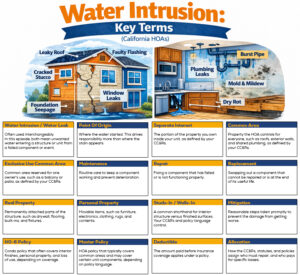
These definitions explain the legal terms used to analyze water intrusion disputes in California HOAs, including how property is classified, how responsibility is determined under Civil Code 4775, and why board “rules” cannot override the CC&Rs.
- Civil Code 4775 supplies default responsibility rules only when CC&Rs say nothing. When the CC&Rs do not allocate responsibility (which is actually quite rare), Civil Code 4775 assigns repair, maintenance, and replacement obligations between the HOA and owners.
- Only the CC&Rs can alter the allocation established in Civil Code 4775. Despite what a well-known HOA-side law firm has published on its website, an HOA board cannot pass a rule that overrides the default provisions contained in Civil Code 4775. On that firm’s website, they wrote that, “Unless the governing documents of a common interest development state otherwise, associations must maintain, repair, and replace the association’s common areas. (Civ. Code § 4775).” (emphasis added) That statement is wrong because the term “governing documents” goes beyond what’s contained in the plain language of the relevant code section. Civil Code 4775 explicitly states that HOAs are responsible for repairing, replacing, and maintaining the common area unless otherwise provided in the CC&Rs. Not the rules. Not the architectural guidelines. And not any other “governing documents.” The CC&Rs, and only the CC&Rs (referred to as the “declaration” in 4775). If your HOA were to adopt a rule altering such maintenance, repair, or replacement responsibilities, the rule would be unenforceable.
- Even a valid amendment to the CC&Rs cannot retroactively shift responsibility for past water intrusion events or existing damage. While the CC&Rs are the only governing document that can alter the default allocation set by Civil Code 4775, any such change operates prospectively only. An HOA cannot use a later CC&R amendment to reallocate responsibility for water intrusion that already occurred, to cut off claims for existing damage, or to “ratify” an invalid board rule after the fact. Responsibility for past events remains governed by the CC&Rs and statutory framework in effect at the time the water intrusion occurred.
- California HOA law recognizes a hierarchy among governing documents. The CC&Rs occupy the highest position. Board-adopted rules and policies sit below and cannot contradict either the CC&Rs or the Davis-Stirling Act.
Taken together, these points explain why water intrusion disputes often persist even when the statutory framework is clear. Bad HOAs and bad managers frequently rely on imprecise language, misstate what Civil Code 4775 actually allows, or invoke board-adopted “rules” as if they carried the same legal weight as the CC&Rs. When homeowners understand the defined terms, recognize the hierarchy of governing documents, and insist on the distinction the statute draws between declarations and lower-level policies, they can more effectively push back against shortcuts that the law does not permit.
FAQs
Can an HOA adopt a rule that makes owners responsible for all water damage caused by common area components?
No. A board-adopted rule cannot override Civil Code 4775 or the CC&Rs. Only a properly adopted amendment to the CC&Rs can reallocate those responsibilities.
What if the board adopted the rule before I bought my unit?
Timing does not matter. When a rule exceeds the board’s authority or contradicts Civil Code 4775 or the CC&Rs, the rule remains unenforceable regardless of when the board adopted it.
Can my HOA change the outcome of my water intrusion dispute by amending the CC&Rs after the water damage already happened?
No. Even though a properly adopted CC&R amendment can change responsibility going forward, it cannot retroactively shift responsibility for past water intrusion events or existing damage. An HOA cannot use a later amendment to cut off claims, reassign liability for damage that already occurred, or validate an earlier board rule that was unenforceable when adopted. Responsibility for a water intrusion is governed by the CC&Rs and statutory framework that were in effect at the time the intrusion occurred.
What does Civil Code 4775 control?
Civil Code 4775 establishes default rules for repair, maintenance, and replacement responsibility of an HOA’s common areas, the exclusive use common areas, and of the owners’ separate interests when CC&Rs do not address those issues. The statute does not, however, have anything to do with determining liability for damages, which often depends on other factors like negligence and insurance.
Where should I start when I try to determine responsibility in my own case?
Start with the CC&Rs. When they clearly allocate responsibility, that language controls. Only when the CC&Rs remain silent or ambiguous should you look to Civil Code 4775’s default framework. And listen to the podcast referenced above.
About MBK Chapman Fact Sheets
Homeowners searching for answers online will often come across articles that appear authoritative, but are actually written as search-engine marketing content rather than by an experienced HOA lawyer. These pieces tend to prioritize keyword density over clarity, accuracy, or legal context, which often leaves homeowners more confused than informed.
At MBK Chapman, our Fact Sheets are part of our HOA Law Library and are written by Michael Kushner, an HOA lawyer with decades of hands-on experience representing California homeowners. In fact, Michael Kushner is the HOA lawyer who pioneered the systems and strategies used by some of California’s most successful homeowner-side HOA law firms.
Each Fact Sheet is deliberately concise, statute-based, and designed as a quick-reference guide to help homeowners understand key HOA laws and enforcement rules at a glance.
AND DON’T FORGET TO TUNE INTO MY PODCAST, HOA HELL
YOU CAN ALSO ORDER MY GROUNDBREAKING BOOK
HOA HELL | California Homeowners’ Definitive Guide to Beating Bad HOAs
Amazon | Barnes & Noble
