
Overview
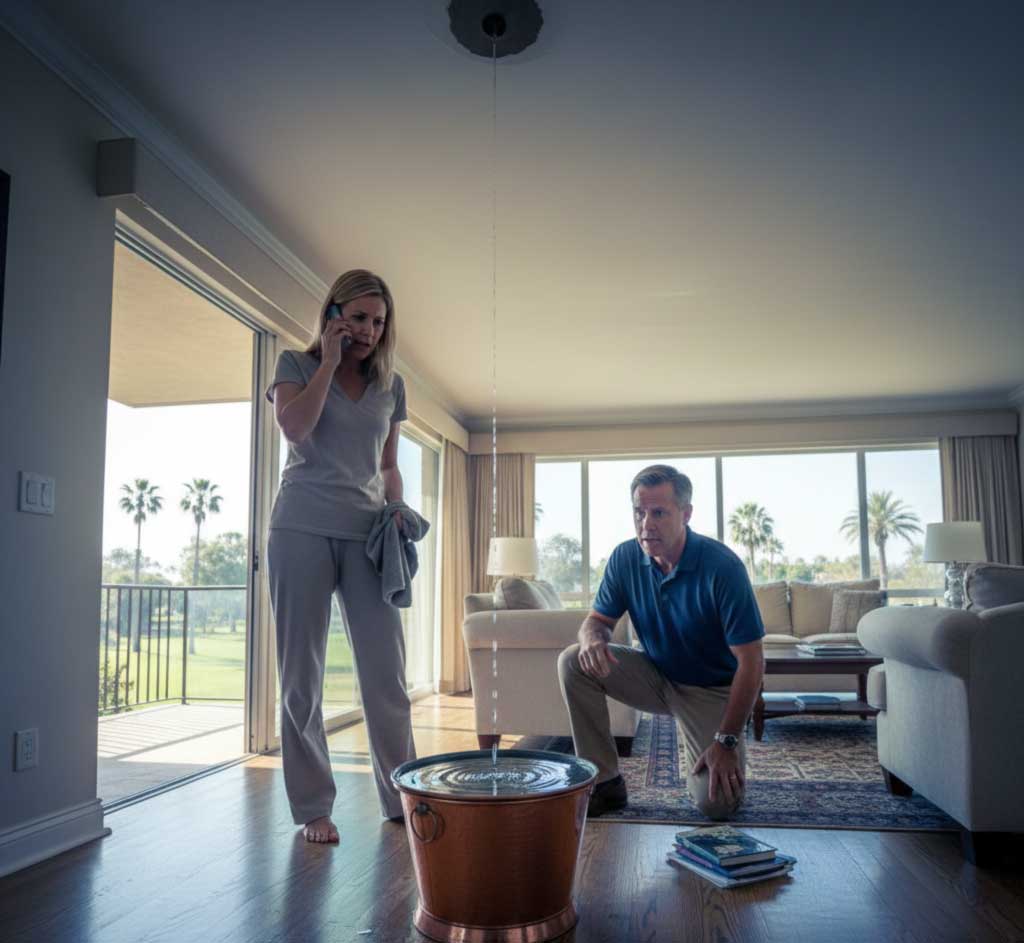
Water intrusions are among the most frequent and contentious issues facing homeowners in California HOAs. When water enters a unit, homeowners often assume the HOA is automatically responsible, especially if the water appears to have come from a roof, exterior wall, pipe, or another unit. [Note to the reader: Although some principles discussed here can apply in detached single-family homes, this Fact Sheet is most directly relevant to connected housing such as condominiums and townhomes, where units share roofs, walls, plumbing, and other building components.]
In reality, responsibility depends on where the water originated, what components failed, how the governing documents allocate maintenance duties, and whether anyone failed to act reasonably once the problem was discovered. Responsibility also turns on what happened before the intrusion. If the HOA ignored known defects, deferred maintenance, or repeated warnings about conditions that predictably lead to water intrusion, that pre-loss conduct can drive both responsibility and liability.
The Davis-Stirling Act draws critical distinctions between separate interests, common areas, and exclusive use common areas, and it supplies default rules when CC&Rs are silent. It also frames the practical reality that water damage disputes often involve two separate questions: (1) who must repair the component that failed, and (2) whether someone’s negligence caused avoidable damage before or after the intrusion occurred. Homeowners should understand both questions, because they determine whether the HOA must repair building components, whether the homeowner must rely on personal insurance, and whether either side faces exposure for failing to prevent preventable damage.
This Fact Sheet is the first of a three-part Water Intrusion Cluster. In the next Fact Sheets (“HOA Water Damage: What the HOA Pays, What You Pay, and Why” and “HOA Water Intrusion Terms Defined & Why “Rules” Can’t Override Civil Code 4775″), we will cover insurance and the “deductible dilemma” (including the HOA master policy versus the homeowner’s HO-6 policy), real property versus personal property losses, relocation costs, remediation standards, and what homeowners can do when the HOA delays or mishandles the claim.
You can also watch an episode of my podcast, HOA HELL, entitled “Will My HOA’s Insurance Cover Damage Inside my Condo?”
Key Points
Water intrusion disputes in HOAs turn on classification of the affected components, the point of origin, and the governing documents, and they often require separating repair responsibility from negligence-based liability. The following key points explain how to analyze responsibility when water enters a unit and what homeowners should do immediately to protect their rights.
- Responsibility starts with whether the affected area is a separate interest (owned by you), common area, or exclusive use common area. Separate interests generally include the interior of a unit, common areas typically include roofs, exterior walls, and shared plumbing, and exclusive use common areas often include items like balconies, patios, and certain exterior fixtures reserved for solely one unit’s use. The CC&Rs usually assign maintenance responsibility for each category, and those allocations control unless the Davis-Stirling Act supplies a different default rule. [See below for discussion of Civil Code 4775’s default rule.]
- The source of the water usually controls the analysis more than the location of the damage. Water that originates from a common area component, such as a roof failure or a common area pipe, raises different responsibility questions than water that originates from a neighbor’s bathtub overflow or unit plumbing. Identifying the point of origin is therefore one of the most important factual steps in any HOA water intrusion dispute.
- When CC&Rs are silent, Civil Code 4775 supplies default maintenance rules, but those rules differ for common areas and exclusive use common areas. Civil Code 4775 establishes the default rule in stating that unless your CC&Rs say otherwise, your HOA is responsible for maintaining, repairing, and replacing the common area, while you (the homeowner) is responsible for maintaining your separate interest. When it comes to exclusive use common areas, Civil Code 4775 does not treat “maintenance” the same as “repair and replacement.” By default, unless your CC&Rs say otherwise, Civil Code 4775 places maintenance of exclusive use common areas on the homeowner, while it places repair and replacement of those exclusive use common areas on the HOA. This distinction matters because many water intrusion disputes involve exclusive use components such as balconies, patios, doors, and windows, where owners and boards often argue about “maintenance” versus “repair and replacement” as if they mean the same thing, even though the statute treats them differently.
- Water intrusion disputes often involve two separate questions, and homeowners should not treat them as the same. The first question asks who must repair the component that failed under the CC&Rs and Civil Code 4775. The second question asks whether the HOA or homeowner acted negligently before or after the loss, which can determine liability for avoidable resulting damages.
- Your HOA is not automatically responsible for all resulting damage simply because water originated from a common area. Even when there is no dispute that a roof, exterior wall, or common area pipe caused the initial intrusion, responsibility for repairing the building component is a separate issue from responsibility for paying for damage inside the unit. As a general matter, damage to real property components the HOA is obligated to maintain, repair, or replace under the CC&Rs and Civil Code 4775 may fall on the HOA, while damage to a homeowner’s personal property, such as furniture, electronics, clothing, or contents, does not automatically become the HOA’s responsibility. Liability for personal property or interior finish damage typically turns on whether the HOA acted negligently, such as by failing to maintain the common area component before the loss or unreasonably delaying repairs after receiving notice, rather than on the mere fact that the water came from a common area. [Real property generally refers to the parts of a unit that are physically attached to the building, such as walls, ceilings, flooring, built-in cabinets, plumbing fixtures, and other permanently installed components. Personal property refers to movable items owned by the homeowner, such as furniture, electronics, clothing, rugs, artwork, and other contents that are not permanently affixed to the structure.]
- HO-6 policies. In many cases, damage to interior finishes or personal property is addressed through the homeowner’s HO-6 policy, even when the HOA repairs the common area source of the leak. The interplay between the HOA’s master policy, the homeowner’s HO-6 policy, and deductible allocation will be addressed in my next water-intrusion related Fact Sheet.
- In condos and most townhomes, studs-in versus finished surfaces disputes often reflect governing document allocations, not universal rules. Many HOAs in connected housing allocate responsibility by distinguishing between structural components and finished surfaces, but the governing documents control. You should review your CC&Rs carefully before accepting a blanket claim that the HOA always pays “studs-in” or that the homeowner always pays “everything inside.”
- No matter who’s ultimately responsible for repairs or damages, homeowners must promptly report water intrusion and take reasonable steps to mitigate further damage. Once a homeowner discovers water intrusion, they must notify the HOA immediately (in writing, of course) and take reasonable measures to prevent the damage from spreading. Failure to report and mitigate can increase damage and complicate responsibility, even when the HOA bears responsibility for the original failed component or damages to the real or personal property.
- Heavy rain does not automatically shift responsibility away from the HOA or toward the homeowner. An HOA that properly maintained roofs, drains, waterproofing, and known defects may have a different exposure profile than an HOA that ignored repeated intrusion complaints or deferred known maintenance. The facts determine whether the intrusion resulted from unavoidable weather or preventable conditions.
- Water intrusion that creates mold or moisture conditions raises health and safety issues that require prompt remediation. Mold growth is not just a cosmetic issue. When water intrusion leaves materials wet or saturated, professional drying and remediation may be required to prevent mold amplification and indoor air quality problems. Delay by either the HOA or the homeowner can significantly increase damage, cost, and potential liability. It can also threaten your health or the health of your loved ones and guests.
- Mold remediation may require temporary relocation when health or safety is implicated. If conditions inside a unit are unsafe due to mold, moisture, or remediation work, temporary relocation may be necessary while drying, demolition, or clearance testing occurs. Whether relocation costs fall on the HOA, the homeowner, or insurance often depends on the governing documents, insurance policies, and whether the HOA’s negligence caused or worsened the condition.
- Professional remediation and clearance standards matter. Mold remediation should follow recognized industry standards, including containment, removal of affected materials, and post-remediation clearance testing when appropriate. Treating mold as a routine maintenance issue or relying on unqualified (or unlicensed) vendors can expose both HOAs and homeowners to health hazards, prolonged damage, and future disputes.
- Early documentation and investigation preserve leverage. If you experience a water intrusion event, there are several critical steps you can take to protect your rights and your property, including:
- You should immediately document the water intrusion and preserve evidence. As soon as water enters your unit, homeowners should photograph and video the intrusion, affected areas, and visible sources, and document dates, times, weather conditions, and any prior complaints or warnings. Early documentation often determines whether you’ll be able to later assess who is responsible for any repairs or damages.
- You must promptly notify the HOA in writing and request investigation. Your notice should identify the location of the intrusion, describe visible damage, and request inspection of potential common area or exclusive use common area sources. Written notice creates a record and triggers your HOA’s duty to investigate and respond.
- You should take reasonable steps to mitigate further damage. This may include shutting off water, drying affected areas, or temporarily protecting finishes or contents. Failure to mitigate, regardless of the source or cause of the water intrusion, can increase damage to your property and could reduce recovery even when the HOA bears responsibility for the source/damage.
- You should request confirmation of component classification under the CC&Rs. Water intrusion disputes often hinge on whether the failed component is a common area, exclusive use common area, or separate interest. Homeowners should ask the HOA to identify how each relevant component is classified and who the CC&Rs assign responsibility to maintain, repair, and replace it.
- You should distinguish repair responsibility from damage liability early. Even when the HOA is responsible for repairing a failed component, responsibility for interior finishes or personal property damage often depends on whether the HOA acted negligently before or after the intrusion. Homeowners should not assume repair responsibility automatically includes damage reimbursement.
- You should determine, if you can, whether the HOA had prior notice of the condition. Prior complaints, maintenance requests, inspection reports, or known defects can be critical. If the HOA ignored known problems or deferred maintenance, that pre-loss conduct may support liability beyond simple repair obligations (i.e., the HOA may be responsible for damage or destruction of your personal property).
- You should request a timeline for repairs and remediation. Unreasonable delay after notice can convert a maintenance issue into a negligence issue. Homeowners should request written timelines and follow up when deadlines slip.
- You should avoid authorizing permanent repairs without coordination. Emergency (i.e., immediate) mitigation is appropriate, but permanent repairs should generally be coordinated with the HOA to avoid disputes over scope, responsibility, or reimbursement.
- You should loop your insurance carrier early without conceding responsibility. Even when the HOA may ultimately bear responsibility, early notice to your insurer protects your coverage rights and preserves options if disputes arise.
- You should escalate in writing if the HOA delays, denies, or minimizes the issue. Follow-up letters, requests for board consideration, and formal documentation of delays often become critical if the dispute later escalates to insurance, ADR, or litigation.
- You should consult with MBK Chapman when the dispute expands or stalls. Water intrusion cases often escalate quickly due to mold concerns, relocation issues, and insurance deadlines. Early legal guidance can prevent procedural mistakes that limit recovery later. The attorneys at MBK Chapman are experts in addressing water intrusion and related damages to homeowners’ properties.
These rules explain why HOA water intrusion disputes are fact-driven and why responsibility is rarely automatic. When homeowners identify the origin, confirm component classification, and act promptly, they put themselves in the strongest position to force a lawful response.
FAQs
Is the HOA always responsible when water enters my unit?
No. Even when there is no dispute that water originated from a common area component, responsibility often breaks into two separate questions: who must repair the component that failed, and who pays for the resulting damage inside the unit. The HOA may have to repair or replace a common area component under the CC&Rs and Civil Code 4775, while responsibility for damage to interior finishes or personal property may depend on negligence, insurance coverage, and how the governing documents allocate responsibility.
If the water came from a roof, exterior wall, or common area pipe, does the HOA have to pay for all my damage?
Not automatically. The HOA generally must address the failed common area component under the CC&Rs and Civil Code 4775, but that does not mean the HOA must pay for all resulting losses. Damage to real property components the HOA maintains may fall on the HOA, while damage to a homeowner’s personal property, such as furniture, electronics, clothing, and contents, does not automatically become the HOA’s responsibility. Liability for interior damages often turns on whether the HOA acted negligently before the loss, such as ignoring known defects, or after the loss, such as unreasonably delaying repairs after notice, which then resulted in new or further damages.
What if the water came from my neighbor’s unit?
When water originates from another unit, responsibility likely rests with that homeowner, their insurance, or the HOA depending on whether the source was your neighbor’s separate interest component or a common area component serving multiple units. The point of origin and component classification under the governing documents usually control the analysis.
What are exclusive use common areas and why do they matter?
Exclusive use common areas are areas reserved for one owner’s use, such as balconies or patios. When CC&Rs are silent, Civil Code 4775 distinguishes between maintenance, repair, and replacement for exclusive use common areas. By default (i.e., unless the CC&Rs say otherwise), the homeowner bears maintenance responsibility, while the HOA bears repair and replacement responsibility.
Do I have to report water intrusion immediately?
Yes. You should report water intrusion immediately and take reasonable steps to mitigate further damage. Delays often increase damage and can complicate responsibility, even when the HOA bears responsibility for the original failed component.
What should I do first if water enters my unit?
Document the intrusion, notify the HOA immediately in writing, take reasonable steps to mitigate further damage, and request an inspection to determine the source. If you suspect mold or unsafe conditions, you should also push for timely professional drying and remediation. Insurance and deductible allocation, including the HOA’s master policy and the homeowner’s HO-6 policy, are addressed in the next Fact Sheet related to water intrusion.
About MBK Chapman Fact Sheets
Homeowners searching for answers online will often come across articles that appear authoritative, but are actually written as search-engine marketing content rather than by an experienced HOA lawyer. These pieces tend to prioritize keyword density over clarity, accuracy, or legal context, which often leaves homeowners more confused than informed.
At MBK Chapman, our Fact Sheets are part of our HOA Law Library and are written by Michael Kushner, an HOA lawyer with decades of hands-on experience representing California homeowners. In fact, Michael Kushner is the HOA lawyer who pioneered the systems and strategies used by some of California’s most successful homeowner-side HOA law firms.
Each Fact Sheet is deliberately concise, statute-based, and designed as a quick-reference guide to help homeowners understand key HOA laws and enforcement rules at a glance.
AND DON’T FORGET TO TUNE INTO MY PODCAST, HOA HELL
YOU CAN ALSO ORDER MY GROUNDBREAKING BOOK
HOA HELL | California Homeowners’ Definitive Guide to Beating Bad HOAs
Amazon | Barnes & Noble
