
HOA HELL | CALIFORNIA HOMEOWNERS’ DEFINITIVE GUIDE TO BEATING BAD HOAs
OVERVIEW
For far too many California homeowners, the idea of living in an HOA starts with promise and ends with frustration. What begins as an effort to preserve property values too often turns into a system of unchecked power, an HOA board that fines without cause, hides records, plays favorites, or manipulates elections to stay in control. When that happens, homeowners discover a hard truth: no government agency will step in, no hotline will solve the problem, and the only path to accountability and fairness lies in knowing how to use the law to force the HOA to comply with the law. While your dispute with your HOA might seem like a fight between David and Goliath, never forget how that story ended. David won.
That is the purpose of HOA HELL. It was written for every California homeowner who has ever felt powerless against their HOA. This book provides a clear path forward, giving homeowners the knowledge and structure to take back control and enforce the law confidently and effectively. It’s a comprehensive, California-specific enforcement manual that translates the most misunderstood parts of the Davis-Stirling Act into clear, actionable steps that anyone can follow. This is not an over-simplified or watered-down book. It is a complete and nuanced explanation, a guide that shows how California law actually works, presented in plain English so that non-lawyers can understand and apply it with confidence.
Written by the attorney who pioneered homeowner-side HOA enforcement in California, HOA HELL brings clarity and precision to a subject that has long been buried in confusion. Each chapter builds a foundation of control. It begins with an explanation of your statutory rights, such as your entitlement to inspect association records, and then moves to the enforcement tools that give those rights meaning in the real world. You’ll learn how to recognize the red flags that something is wrong in your HOA. And, you’ll learn how to challenge unlawful fines through the due-process requirements, how to compel fair elections, how to hold boards to their fiduciary obligations, and how to use California’s pre-litigation dispute procedures to force compliance before problems escalate.
Every section of every chapter focuses on the same goal: helping homeowners recognize, confront, and stop misconduct. Each chapter builds practical skills that empower readers to take direct, informed, and decisive action. Whether the issue involves misuse of reserve funds, failure to maintain, architectural control abuses, arbitrary or abusive fines, election interference, or withheld documents, the book walks you through what to do and when to do it.
By the end, readers will understand not only what their rights are, but how to use them to force accountability. Every chapter delivers structure, clarity, and strategy, making HOA HELL the definitive California homeowner’s guide to fighting back against their HOA from HELL—and more importantly, how to WIN that fight.
WHAT MAKES HOA HELL THE DEFINITIVE GUIDE FOR CALIFORNIA HOMEOWNERS
HOA HELL is unlike any resource ever written for California homeowners. I wrote every page to further my goal of replacing homeowner confusion with control and to give readers a complete, real-world working system for holding their HOAs accountable under California law.
The book covers the most common and serious areas of conflict that California homeowners face with their HOAs, including financial disclosures, board elections, fines and disciplinary hearings, access to records, assessments and reserves, and architectural control. These are the issues that most often lead to abuse of power, selective enforcement, and costly disputes. I explain each topic through the lens of the Davis-Stirling Act’s statutory requirements and the procedures that bring those statutes to life, giving homeowners a practical roadmap for success. The focus is always on real steps that produce measurable, real-world results.
Written by the attorney who pioneered homeowner-side HOA enforcement in California, this book condenses decades of HOA-centric experience into a structure that homeowners can actually follow. It explains not just what the law says, but what to do with that information. The systems introduced here, such as document-demand protocols, the importance of an HOA’s financial condition and how to determine what that condition is, and ADR enforcement ladders, are the same systems that transformed how HOA cases are handled in the two other most influential law firms on the homeowner side in California. That’s because the shareholders who formed those firms used to work for me.
HOA HELL does not contain abstract concepts. Rather, I provide battle-tested, proven methods that have forced real HOA boards into compliance and won real results for homeowners. Every explanation in HOA HELL is complete and nuanced, yet written in a way that respects your intelligence. I don’t dumb down the law by leaving out important details. Instead, I explain the subtle nuances, but do so in a way that makes the law understandable.
Another defining feature of HOA HELL is its absolute focus on California. I wrote HOA HELL exclusively for Californians, and the entire book therefore draws every rule, remedy, and example from California law. The Davis-Stirling Act governs every common-interest development in this state, and its procedures differ significantly from those used elsewhere. Following out-of-state templates or guidelines can cause homeowners to miss deadlines, cite incorrect authorities, or waive rights without realizing it. This book removes that risk entirely by staying within California’s statutory framework and explaining precisely how to use it to the homeowner’s advantage.
Throughout the book, I show homeowners exactly how to apply these principles to real-world situations. Readers learn to recognize when a board violates the law, how to respond correctly and effectively, and how to escalate through the appropriate channels when compliance does not occur. Each lesson connects directly to California statutes and is reinforced by the same strategies my firm has used successfully for years. The book’s organization allows homeowners to move seamlessly from identifying a problem to implementing a solution.
Nothing in these pages is filler. Every section delivers legal clarity, practical instruction, and proven tools. HOA HELL stays focused on what matters: giving homeowners real legal leverage. It presents the law as it is, including what HOAs can and can’t do. It then shows you how to demand accountability, how to document abuse, and how to escalate properly when a board refuses to follow the law.
In short, this book stands apart because it gives homeowners what they have always needed but never had: a comprehensive, California-specific, and fully operational system for fighting back effectively and winning. HOA HELL is not commentary. It is a plan of action, and it works.
WHY ACCURACY MATTERS AND WHY GENERIC ADVICE CAN BE DANGEROUS
Accuracy is not a stylistic choice in this field. It determines whether a homeowner wins or loses. California’s Davis-Stirling Act is unique, detailed, and procedural. The rules that control how records must be produced, how architectural decisions must be made, or how elections must be run do not exist in the same form anywhere else. When advice tries to apply to multiple states, it inevitably becomes watered down, and that vagueness can cost homeowners their rights.
That is why I wrote this book exclusively for Californians. Every statute, procedure, and illustration comes from California law. I wrote it to give homeowners certainty, not generalizations, and to make sure they have the same level of clarity that we use at MBK CHAPMAN. For that reason, every example, strategy, and statutory reference in this book applies only to California. It explains the real-world consequences of the Davis-Stirling Act (and other applicable statutes) that define how HOAs must operate. The book does not generalize, and it does not borrow rules from other jurisdictions. It teaches homeowners to use the exact statutes that govern their HOAs and shows how those statutes connect to one another to create leverage.
Generic advice leaves homeowners vulnerable. Nationalized or multi-state materials can’t account for California’s unique laws or its enforcement procedures. Using them can lead homeowners to rely on deadlines that do not exist or rights that are not recognized here. HOA HELL eliminates those risks by anchoring every explanation solely to California law and showing precisely how to use it.
This focus on accuracy also means that every interpretation in this book has been tested in practice. I did not write from theory. I wrote from the thousands of California HOA disputes that my firm has handled firsthand, each of which confirmed the same truth: precision wins. Knowing which statute to cite, which notice period to use, or which document to request can make the difference between forcing compliance and being ignored.
Accuracy is power. When homeowners have precise, California-specific information, they gain leverage that most boards never expect them to have. HOA HELL gives them that leverage and shows them how to use it effectively.
INSIDE HOA HELL’S TOOLKIT: WHAT CALIFORNIA HOMEOWNERS WILL LEARN
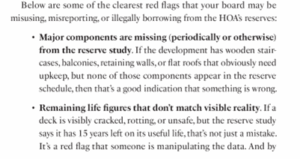
HOA HELL is a practical playbook, not a collection of commentary, anecdotal data, obvious observations, or advice so generic as to be basically worthless. Each chapter teaches homeowners exactly how to identify, confront, and resolve the problems that plague California HOAs. For example, throughout the book I include sections that teach homeowners what to look out for, what I refer to as the “red flags,” that could indicate a problem.
. . . .
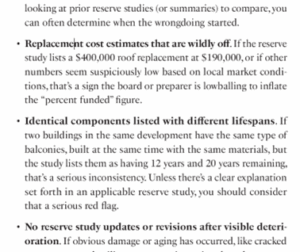
After the initial set-up chapters, where I map out the world of HOAs step-by-step, I dedicate entire chapters to the most common sources of HOA/homeowner conflict, from the fight to assure transparency, to disputes related to homeowner discipline and due process, architectural control, failure to maintain, and financial mismanagement. With respect to the latter, I include entire segments addressing such financial mismanagement through the lens of systemic mishandling of assessments and reserves.
Each of these topics connects to the next, creating a step-by-step system. A homeowner who first demands records under section 5200 can then use that information to challenge improper assessments or expose failures in reserve planning. A proper understanding of section 5855 hearings helps defeat selective enforcement. And knowing how to audit annual disclosures under section 5300 gives homeowners the evidence needed to demand transparency before problems escalate.
Everything in HOA HELL builds toward one purpose: to teach homeowners how to transform individual rights into a unified enforcement strategy. The book does not simply explain what the Davis-Stirling Act says. It shows readers, in detail, how to use it to protect their property, their finances, and their peace of mind.
THE SYSTEM THAT TRANSFORMS RIGHTS INTO LEVERAGE
Every homeowner in California has rights under the Davis-Stirling Act, but most don’t realize how powerful those rights can become when combined strategically. HOA HELL teaches a system that transforms those individual rights into a coordinated enforcement plan. I call this approach “stacking rights,” and it’s part of a system that I teach called “strategic persistence.” It’s the difference between knowing what the law says and knowing how to use it to force results.
Too many homeowners lose ground because they treat each dispute as isolated. They request documents without following up properly. They challenge fines without connecting those violations to larger patterns of misconduct. They complain about the board’s financial practices without linking those failures to breaches of statutory or fiduciary duty. HOA HELL teaches readers to view these issues as connected parts of a single strategy.
When homeowners follow the system I outline, they stop simply reacting and they start controlling the narrative. For example, a records demand under Civil Code section 5200 can reveal missing or altered financial disclosures that violate section 5300’s mandatory disclosures requirements. That information can then form the basis of a due-process challenge under section 5855 or strengthen an argument that the board is breaching its fiduciary obligations. The goal is not to create conflict, but to build lawful pressure that forces the board to take you more seriously and comply with its duties.
When homeowners learn my system of stacking rights to build leverage and then start using that system to confront their bad HOA boards, they will see something that they may have not been expecting to see at all: their boards, and the HOA-side attorneys who represent them, will be completely unprepared to counter them. HOAs expect homeowners to be ignorant and apathetic when it comes to HOA-management. HOA HELL turns that dynamic upside down.
This approach has already produced tangible results for thousands of homeowners across the state. Many have forced their HOAs to correct unlawful practices without ever going to court. Others have used the system to negotiate favorable settlements, to remove or replace abusive board members, or to stop fines and assessments that never should have been imposed.
REAL-WORLD RESULTS AND READER TAKEAWAYS
I developed the systems and strategies presented in HOA HELL on the back of decades representing homeowners in HOA disputes. Nothing in the book is theoretical. To drive that point home, throughout the book, I include real life examples that show how homeowners used these exact tools to fight back against their HOAs’ abuses.
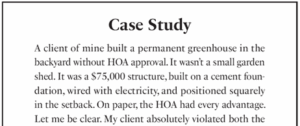
For example, in several of the chapters, readers will find boxed “case studies” that describe actual situations where homeowners confronted their HOAs and won. Each story highlights the problem, the relevant statutes, and the strategy that turned the outcome around. The goal is not to tell war stories, but to demonstrate that these methods work when applied carefully and consistently. Homeowners are shown what success looks like and how to replicate it.
And between chapters, HOA HELL features short gray-page inserts that provide quick lessons on discrete issues. These pages cover everything from how to recognize selective enforcement to how to read a reserve study correctly. They are easy to find, easy to understand, and immediately usable. Many readers flip to these inserts first because they distill complex topics into clear, step-by-step instructions.
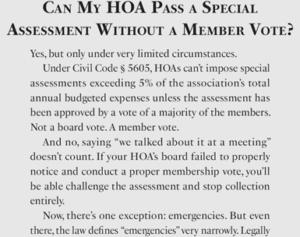
You get the idea. The goal of these examples and inserts is simple: to give homeowners the confidence to act. The law becomes far less intimidating when you can see exactly how others have applied it successfully.
By the time readers finish HOA HELL, they will have more than knowledge. They will have a working plan, complete with real examples, proven strategies, and the reasoning behind every move. The book’s design makes it easy to return to any chapter when a new issue arises. Each section stands alone as a practical reference, but together they form a powerful and unique system that empowers homeowners to win against HOAs that have operated unchecked for too long.
WHY THIS BOOK MATTERS RIGHT NOW
The need for HOA HELL could not be greater than it is today. California’s HOA landscape has reached a tipping point. Millions of homeowners face staggering special assessments, aging buildings, underfunded reserves, and boards that hide behind confusion and intimidation. The legal framework that governs these HOAs has grown increasingly complex, and yet, before HOA HELL, homeowners had not been given a clear guide that explains what those changes mean in practical terms and how to fix the problems. This book fills that gap.
The law itself is evolving faster than most people realize. Each new legislative session brings amendments that expand, restrict, or redefine homeowner rights. The recent passage of AB 130 is just one example. While the media focused on the new $100 cap on HOA fines, very few sources explained the rest of the bill or how it actually affects enforcement in practice. In HOA HELL, I break down those changes, clarify what they do and do not accomplish, and show homeowners what steps to take to protect themselves.
The cultural climate has changed as well. With the advent of AI platforms, homeowners are becoming more and more informed. At the same time, however, homeowners are being more and more misguided, often at the hands of those same AI platforms that suffer from a very real and currently prevalent problem of hallucinations.
Now more than ever, especially when increasingly faced with large special assessments or dismal reserve funds, homeowners are demanding transparency, accountability, and proof that their HOAs are managing their money responsibly. I wrote HOA HELL for this moment.
The book provides HOA members like you the structure, language, and strategy to demand accountability without relying on guesswork or emotion. Indeed, for so many years, I watched patterns repeat themselves: boards exceeding their authority, management companies shielding them from scrutiny, and homeowners paying the price. Until now, there has been no single, complete resource that teaches Californians how to recognize those abuses early and stop them effectively. HOA HELL provides that invaluable resource.
This book also matters because it shifts the conversation. Instead of focusing on frustration, it focuses on results. It doesn’t ask readers to vent their anger. Rather, it teaches them how to act with precision. Every chapter gives them tools that make sense in the real world. Homeowners can read a chapter, apply what they’ve learned the same day, and see measurable progress toward resolving their problems.
For the first time, California homeowners have a roadmap that combines legal accuracy with step-by-step implementation. That combination has never existed before. HOA HELL brings order to confusion, turns complexity into clarity, and gives homeowners the confidence to stand that much closer to equal footing with their boards.
CONCLUDING THOUGHT
California homeowners have lived for too long at the mercy of HOA boards that count on confusion, apathy, and fear to maintain control. HOA HELL ends that era. It gives homeowners the knowledge, structure, and confidence to fight back intelligently and win.
The strength of this book lies in its precision. HOA HELL converts complicated statutes into clear steps that any homeowner can follow. Every chapter builds power through strategy, not speculation. The systems that I present have been tested, refined, and proven to work in real disputes across the state. The result is a definitive guide that teaches homeowners how to transform frustration into leverage, and leverage into success.
The time to act is now. Each day that passes without knowledge is another day a bad HOA can misuse its authority. HOA HELL provides the roadmap to stop that cycle. It replaces uncertainty with clarity and gives homeowners what they have always deserved: control over their own communities and peace inside their own homes.
For California homeowners ready to reclaim both, HOA HELL is the key.
At the time of this article’s release, HOA HELL is available for preorder on Amazon (Kindle) and on barnesandnoble.com (hardcover/softcover).
Q&As
What made you decide to write this book?
I intended to write HOA HELL years ago, and actually started writing it in 2018. But I got sidetracked with other projects, and then COVID happened, and then….Well, life got in the way.
But then, earlier this year, I read a recently published “homeowner-side” HOA book written by a former employee of mine who now runs his own firm, and who has styled himself as a “thought leader” and “pioneer” in this area of the law. I was deeply disappointed. Not only did it appear to me to be largely filled with meaningless platitudes, generic, recycled talking points, and trite superficial suggestions masquerading as actual useful information, but it betrayed a shockingly superficial understanding of the Davis-Stirling Act. In some parts of the book, what the author didn’t say could easily be misunderstood, resulting in negative consequences for the unwary homeowner. And even worse, the book contained some complete misstatements of the law (i.e., the statements were just wrong). I discuss a couple of the more serious errors in my response to Q3 below. Anyway, my disappointment in that book gave me the push to finally write the book that I should’ve finished in early 2019: an easy-to-read, statute-based roadmap that actually teaches Californians how to fight back and win against bad HOAs.
I also wrote HOA HELL because California homeowners have lived for too long without a useful, real-world manual on how to deal with really bad HOAs. I’ve spent nearly thirty years representing homeowners in this state, and I’ve seen the same story repeat itself: good people suffering under the yoke of abusive or corrupt HOAs not because the law fails them, but because no one ever explained how to use it.
HOA HELL takes the proven systems I developed over decades and turns them into a complete, plain-English, guide that any Californian can follow immediately.
Why did you feel other HOA books weren’t good enough?
Well, I really only found one book dedicated to homeowner-side HOA law that, at least in part, focused on California HOAs, and that was the book written by my former employee. I don’t think that book is of any real use to anyone. As if an attorney venturing into amateur psychology by describing board “personality types” by labeling someone a “meddler” or “tyrant” could help a homeowner actually deal with such board members, or for that matter, with a conflict about adding an ADU, force the release of records, or stopping systemic financial mismanagement. It can’t. The fact that this other book also wants to appeal to HOA residents in both Florida and California presents, in my opinion, a lack of focus by the author. By his own admission, despite the fact that Florida and California have vastly different HOA laws, he wrote the book as a “general guide” on going after bad HOAs no matter where they were located.
I wrote HOA HELL to give homeowners what, in my opinion, no other book has ever done: a structured, enforceable plan based entirely on California law. This book shows readers exactly what to do, what to cite, and when to act. It takes the most common major areas of HOA conflict (e.g., records, elections, fines, reserves/finances, maintenance, and architectural control), and shares a plain-English, easy-to-follow system.
When homeowners read this book, they don’t walk away feeling informed. They’ll walk away actually being informed, and even better, they’ll walk away knowing what to do with that information. And that’s a game changer.
What are the most dangerous legal errors you spotted in your former employee’s book?
Among the most damaging mistakes that I see are the ones that completely misstate California law. And that’s dangerous because laypeople will have no idea that they were told something that’s just WRONG. I’ll give just three examples:
- Claiming that “generally,” a director had to be both an owner and a resident of the HOA.
- Residency has absolutely nothing to do with an owner’s eligibility to serve on the board of an HOA. Ownership does. Under the Davis-Stirling Act, the only baseline requirement is membership, and “member” means a person who holds a recorded ownership interest in a separate interest within the development. If you hold title, you are a “member.” If you do not, you are not.
- Regardless of what an HOA’s governing documents might say, the Davis-Stirling Act (and specifically, for example, Civil Code § 5105) allows only narrow, explicitly stated disqualifications (e.g., assessment delinquency, if a conviction would prevent the HOA from maintaining a fidelity bond, etc.). The only residency-related limitation isn’t a bar to service, but more of a delay of service. If an HOA’s bylaws or election rules explicitly say so, an HOA may require an owner to have owned for at least 1-year before serving on the board. But that’s the extent of it.
- So, this statement by the author is just plain wrong. And yet, a layperson would have no idea that he or she was just given completely wrong information.
- Saying that once a homeowner sends a mediation demand to an HOA board, mediation is mandatory.
- If I understood what the author was trying to say, and I think I did, then my problem lies in his lack of nuance and his superficial treatment of the law. And it’s that lack of nuance that results in the author’s saying something that is absolutely WRONG. Under Civil Code § 5930, the requirement to offer alternative dispute resolution (ADR) (or for the other party, like an HOA, to accept it) applies only to an “enforcement action” filed in superior court, and only to enforcement actions where: (i) the plaintiff is seeking only declaratory, injunctive, or writ relief; or (ii) where the plaintiff is seeking one or more of those three types of relief in conjunction with monetary damages less than $12,500 (which represents the current jurisdictional limit of the small claims court). The author of the other book, mentions nothing about the enforcement action requirement, or the monetary damages limitation that actually takes most HOA cases out of the ADR requirement contained in Civil Code § 5930. By glossing over that critical fact (and in so doing, completely misstating the law), this author could cost a layperson a good deal of money for no reason.
- Misrepresenting a party’s right to attorney’s fees.
- In that very same section where this author made the mistake referenced above, he made another glaring misstatement of the law. The author of the other book claimed that if the HOA in the case highlighted above were to refuse to mediate upon a demand by the homeowner, the HOA might (he used the word “may”) waive its right to get their fees if the HOA were to win at trial.
- This is the type of error I would expect to see from someone who has only a superficial understanding of the Davis-Stirling Act. To understand the nature of this author’s misunderstanding and misstatement of a very important law, you have to first know that Civil Code § 5975 states that the prevailing party in an enforcement action is entitled to that party’s attorney’s fees. [That fee shifting statute is very important because without it, most homeowners would be seriously disincentivized to sue their HOAs even in the face of serious wrongdoing. Why would a family spend six figures and get nothing back?]
- There is another statute, however, and it’s that other statute that the author has clearly misread or misunderstood, and that other statute is Civil Code § 5960. Civil Code § 5960 states that in an enforcement action in which the prevailing party is entitled to attorney’s fees (under Civ. Code, § 5975), if the prevailing party refused to participate in a demand for ADR (in the author’s book, he used the word “mediation”), then the court may “consider” the reasonableness of that refusal in “determining the amount of the [attorney’s fees] award.” This illustrates the issue with the other author’s response.
- Nowhere does the statute say that the court is empowered to disregard § 5975 by refusing the prevailing party’s fees altogether. Reduce them? Sure. But eliminate them? The statute does not authorize that, and if the Legislature intended to give that power to a judge, it would’ve said so. That author’s failure to provide any nuance to his generalized statement results in his communicating a complete misstatement of the law. And this one could have serious economic consequences for a homeowner who has no way of knowing better.
How can homeowners tell whether a law firm or lawyer is credible?
Look at the facts, not the marketing. Real authority comes from trial experience, quality of work-product, legal fluency, and leadership that has been tested in court. Here are a few tips on finding the right HOA lawyer:
- Named partner’s personal trial experience is a must. Ask whether the named partner has personally tried cases in jury or bench trials as lead counsel. A law firm that claims to be a litigation leader but whose founder has never personally conducted at least one jury and bench trial is selling image, not substance.
- Confirm the firm’s focus. Your lawyer should represent homeowners only, not split time defending HOAs. The mindset and strategies are completely different.
- Before hiring any HOA law firm, take time to read what its attorneys actually post online. Start with the articles published on the firm’s website. Are they thoughtful, organized, and easy to follow, or do they look like rushed marketing pieces stuffed with keywords and riddled with grammatical and spelling errors? Sloppy or generic writing often signals that the firm outsources its “thought leadership” to non-lawyers or uses automated content rather than genuine analysis from experienced attorneys. Remember that a lawyer’s published work usually reflects their best effort. If the material under their name lacks depth, accuracy, or polish, that’s a preview of what you can expect if they handle your case. Poor grammar, weak organization, and recycled phrasing are not harmless. Those things demonstrate a lack of discipline and understanding. A firm willing to post that level of work publicly will likely show the same carelessness when representing you. In short, evaluate writing the same way you’d evaluate legal skill. Clear, precise, and well-reasoned writing is the hallmark of a serious attorney. Disorganized or error-filled “content” is a warning sign to look elsewhere.
- Be careful about putting too much faith in Google or Yelp reviews. Aside from the fact that there are precious few controls preventing people from putting up completely unfair reviews, it’s easy to fake the system and create completely fake reviews. I know that one of the largest so-called homeowner-side firms in California was caught creating fake Yelp and Google accounts, buying multiple devices to post fabricated reviews, and threatening to sue homeowners who left honest feedback. When one reviewer refused to back down, that firm sued. The reviewer filed an anti-SLAPP motion, won, and the court ordered the firm to pay the homeowner’s attorney’s fees. Yelp even added a public warning stating that the firm had engaged in “Questionable Legal Threats” and “may have tried to abuse the legal system in an effort to stifle free speech.” In short, a lot of stellar reviews actually tells you very little about a firm.
What will readers be able to do after finishing this book?
They will know how to act with confidence and structure. After finishing HOA HELL, readers will know how to do a variety of important things. For example, they’ll be able to:
- Draft airtight records demands that boards cannot ignore.
- Audit financial disclosures and reserves to detect manipulation before a special assessment appears.
- Prepare for disciplinary hearings and identify procedural defects that invalidate fines.
- Protect the integrity of elections and challenge unlawful candidate disqualifications.
- Use these rights together to build leverage against abusive HOA boards.
In short, after reading HOA HELL, readers finish empowered, organized, and ready to win.
Why should homeowners buy this book now instead of waiting until a dispute arises?
Because once a board acts, deadlines begin. Every day of delay costs leverage. Homeowners who read HOA HELL before conflict begins know how to spot the red flags that signal serious problems early, how to document them correctly, and how to respond before timelines expire or the problems become too serious.
This book eliminates panic and replaces it with preparation. It lets homeowners control the dispute from the start instead of reacting to it later.
What is the single biggest advantage homeowners gain from this book?
Leverage and knowledge. The Davis-Stirling Act gives homeowners enormous power, but only if they understand how to organize it. HOA HELL shows how to combine records, timelines, elections, and hearings into a unified enforcement plan that boards cannot ignore.
Leverage is what shifts power. This book teaches how to build it, layer by layer, until compliance becomes the board’s only option.