
Overview
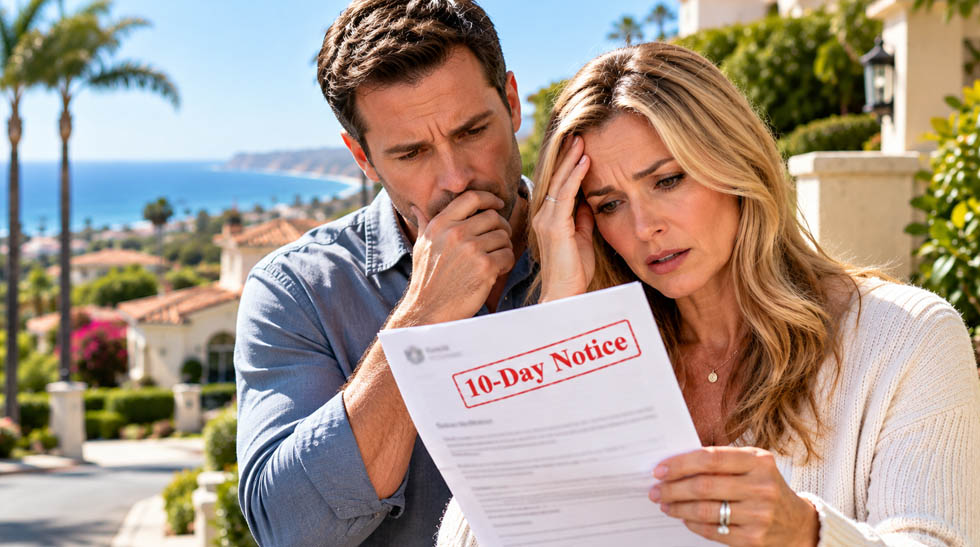
California HOAs can’t fine homeowners or suspend their privileges just because a manager or the HOA sent a letter or a director called out a purported violation of the governing documents. The Davis-Stirling Act requires HOAs to give homeowners written notice and a chance to defend themselves at a hearing before the HOA board imposes any discipline. If an HOA skips any step the Davis-Stirling Act requires, the fine or suspension never takes legal effect.
The hearing process starts well before the hearing itself. The Davis-Stirling Act sets the minimum number of days before the hearing that HOAs must deliver the notice, which gives homeowners time to prepare a defense. That notice also has to tell homeowners what the HOA claims they did. Before the hearing, homeowners get a chance to fix the violation and avoid discipline altogether.
When the hearing takes place, HOA boards have to run it fairly, both in the procedures they follow and in the decisions they reach. Homeowners get a genuine opportunity to defend themselves, to see and answer the evidence against them, and to have their cases decided by directors who have no personal stake in the outcome. Once the HOA board makes its decision, the Davis-Stirling Act dictates what the HOA board must do next and where homeowners can turn when they disagree.
This Fact Sheet explains each stage of the violation hearing process in California HOAs, from the notice to the HOA board’s written decision. It covers what the notice must contain and how homeowners can fix a violation, or commit to fixing it, before the hearing. It explains what rights homeowners have at the hearing, what happens when homeowners and their HOA boards reach an agreement, and the options homeowners have when the HOA board rules against them.
Key Points
Civil Code 5855 sets the hearing process that California HOAs must follow before they fine homeowners, suspend their privileges, or impose any other discipline, and Civil Code 5850 limits the fines HOAs can impose. The points below walk homeowners through the disciplinary process, from their rights before a hearing, to the hearing itself, to what happens after it. At each stage, they explain what the law requires, where a lot of bad HOAs cut corners, and what homeowners should do to protect themselves.
- California HOAs can’t discipline homeowners without first giving them a fair hearing. Civil Code 5855 requires HOA boards to notify homeowners in writing and hold a hearing before they impose discipline for violating the governing documents. That discipline includes both monetary fines and suspensions of privileges like pool, gym, or clubhouse access. Civil Code 5855 also states that no disciplinary action may legally be imposed against a homeowner unless the HOA board meets every requirement that the statute imposes. If, for example, an HOA board skips the notice, the hearing, the written decision, or any other required step, the discipline has no legal effect, and any fine or suspension arising out of such a hearing would be completely illegal. Courts judge the fairness of HOA discipline under two standards, procedural due process and substantive due process, and HOAs have to satisfy both. [To find out which privileges HOAs can suspend and which ones they can never touch, read my Fact Sheet, “Can My California HOA Suspend My Pool, Gym, and Other Privileges?”]
- Procedural due process requires HOAs to use fair procedures to decide whether a violation occurred and what penalty to impose. Civil Code 5850 establishes the first procedural safeguard by requiring HOAs that fine homeowners to adopt a schedule of fines and distribute it to every homeowner in the annual policy statement. HOAs can’t impose a fine larger than the amount in the schedule in effect when the violation occurred, and if no fine schedule exists, the HOA can’t impose any fines. Civil Code 5855 then sets the procedures for the hearing itself. It requires HOAs to: (i) give homeowners at least 10 days’ written notice of the hearing; (ii) describe the alleged violation in that notice; (iii) let homeowners attend the hearing and address the HOA board; and (iv) deliver a written decision within 14 days after the HOA board imposes discipline. [I think that the “address the board at the meeting” language found in Civil Code 5855 implies that homeowners have the procedural due process rights to present evidence, call witnesses, and see and respond to the evidence the HOA uses against them.]
- Substantive due process requires HOA boards to reach fair decisions, not arbitrary or capricious ones. Civil Code 5850 requires every fine to be reasonable. One of the ways courts test the reasonableness standard is by asking whether the discipline bore a rational relationship to the HOA’s legitimate operations, and whether the HOA board imposed the discipline fairly and without discrimination. That’s why selective enforcement is such a strong basis to challenge HOA discipline. If a homeowner can prove that the HOA fined them for having a basketball hoop (even if against the rules) while ignoring other homeowners’ basketball hoops, the discipline imposed will almost certainly be deemed arbitrary and capricious, and thus fail the substantive due process test.
- The hearing notice has to meet specific requirements. Civil Code 5855 requires HOAs to deliver written notice at least 10 days before the HOA board meets to consider discipline (i.e., at least 10 days before the hearing). HOAs must deliver the hearing notice either in person or by individual delivery via the method homeowners have designated with the HOA. If homeowners never designated one, the HOA must send the notice by first-class, registered, certified, or express mail, or by overnight delivery, to the address on the HOA’s books. The notice must state the date, time, and place of the hearing, the nature of the alleged violation, and that homeowners have the right to attend and address the board. [Civil Code 5855 doesn’t expressly require the notice to identify the provision of the governing documents that homeowners allegedly violated, but a notice can’t describe the nature of a violation without identifying the rule that the homeowner purportedly violated. Indeed, there’s no reasonable way for a homeowner to defend against a charge if the homeowner doesn’t know which rule he or she supposedly violated.]
- Homeowners have the right to fix the violation before the hearing and avoid discipline entirely. Civil Code 5855, as amended by AB 130, gives homeowners the opportunity to cure the violation before the hearing. If homeowners cure it in time, or provide a financial commitment to cure it when the fix takes longer than the notice period allows, the HOA board can’t impose any discipline at all, not even a reduced fine. [Neither the Legislature nor the courts have answered whether HOA boards can still fine homeowners who cured a violation that the HOA board says has an adverse health or safety impact. Unfortunately, that isn’t a theoretical problem because bad HOAs have already begun making that argument.] [To learn more about how the cure rule works and how bad HOAs try to get around it, read my Fact Sheet, “Can My California HOA Fine Me for a Violation I Fixed Before the Hearing?”]
- Homeowners need to be able to prove that they completely cured before the hearing. Civil Code 5855 doesn’t define “cure,” but a cure has to eliminate the violation before the hearing. Promising to fix it, or leaving the job half finished, doesn’t count. Homeowners should document the cure with dated photographs, contractor completion records, or receipts, and send the HOA written confirmation of the cure before the hearing. Taking those steps will go a long way to defeating attempts by HOAs to manufacture a dispute over whether the cure was good enough, such as by objecting to details the original notice never mentioned. [Because Civil Code 5855 doesn’t define “cure,” however, disputes over whether homeowners did enough will stay unsettled until the courts address the issue.]
- When the fix takes longer than the notice period allows, a financial commitment to cure also bars discipline. Civil Code 5855 also lets homeowners avoid discipline by providing a financial commitment to cure, but only when curing the violation would take longer than the time between the notice and the hearing. If homeowners could fix the violation over a weekend, they can’t offer a commitment in place of the cure itself. When the option applies, such as with work that needs a permit, a licensed contractor, or weeks of construction, homeowners should provide something concrete. Good examples include a signed contractor agreement, a deposit receipt, a permit application, or a written proposal with a completion date. [Civil Code 5855 doesn’t define what counts as a valid financial commitment, and no court has drawn that line yet, so homeowners should make their commitments as specific and verifiable as possible.]
- Homeowners have the right to a private hearing. Civil Code 5855 entitles homeowners to a disciplinary hearing in executive session, which means neighbors and other members can’t attend or hear the evidence and arguments. Civil Code 5855 also requires the HOA’s directors themselves to conduct the hearing and decide the discipline. Due process also requires any director with a personal stake in the outcome, such as a director who filed the complaint, to step aside from both the hearing and the vote. [Although 99% of HOAs hold disciplinary hearings in executive session as a matter of course, technically speaking, Civil Code 5855 requires executive session only when homeowners request it.]
- Homeowners can defend themselves at the hearing in person or in writing. Civil Code 5855 gives homeowners the right to attend the hearing and address the HOA’s directors. Appearing in person means attending live or by video call (such as Zoom). There, homeowners can argue their defense, present photographs and documents, call witnesses, and respond to the evidence the HOA presents against them. Although not addressed in the statute, most HOAs permit homeowners who don’t wish to attend their hearings “live” to submit their defenses in writing.
- Homeowners don’t have a right to bring an attorney to the hearing. Civil Code 5855 gives homeowners the right to attend the hearing and address the HOA, but quite surprisingly, it says nothing about legal representation. This means that HOAs can lawfully refuse homeowners’ requests to bring a lawyer to represent them at a disciplinary hearing. That refusal doesn’t stop homeowners from working with an attorney before the hearing to prepare a written defense, organize their evidence, and plan what to say. Nor does that fact prevent homeowners from requesting permission, either directly or through their attorneys, to be represented at the hearing. [While some HOAs deny homeowners’ requests to bring attorneys, most don’t because quite frankly it just looks bad. The worst HOAs deny homeowners that right and then have their own attorneys at the hearing. That imbalance stands out because both Civil Code 5910 and Civil Code 5915 guarantee homeowners the right to an attorney during the internal dispute resolution process (IDR).]
- If homeowners and their HOAs resolve the dispute at the hearing, the HOA has to put the agreement in writing. Civil Code 5855 requires the HOA to draft a written resolution whenever an HOA and a homeowner come to an agreement after a hearing. Once both sides sign it, the resolution binds the HOA, and the parties can enforce it in court, as long as its terms don’t conflict with the law or the governing documents. Homeowners shouldn’t leave the hearing with only a verbal promise, such as an agreement to waive a fine or extend a deadline to fix the violation. They should insist on a signed resolution that spells out exactly what each side agreed to do and by when.
- HOAs must deliver their disciplinary decisions to homeowners in writing within 14 days. Civil Code 5855 requires HOAs to notify homeowners in writing of any discipline they impose within 14 days after they act. If the HOA misses that deadline, the discipline cannot legally be imposed. [If there’s any question in a homeowner’s mind regarding the timeliness of the notice of decision, the homeowner should keep a copy of the envelope, email, or other record showing when the decision arrived.]
- AB 130 capped most HOA fines at $100 per violation. Subject to a limited health and safety exception, Civil Code 5850, as amended by AB 130, prohibits HOA fines of more than $100 per violation. Civil Code 5850 now also bars HOAs from charging late fees or interest on fines. There is still a massive unknown associated with what qualifies as “per violation.” [Neither AB 130 nor Civil Code 5850 defines what counts as a single violation. The statute doesn’t say whether a condition that continues for weeks counts as one violation or a new violation every day. It also doesn’t say whether HOAs can escalate fines for repeat violations or stack several fines on the same conduct. Until the courts answer those questions, bad HOAs will use the gap to push total fines well past $100.][If you’d like to explore more about this problem with AB 130, read my Fact Sheet, “California HOA Fines After AB 130: $100 Limit, Repeat Violations, and Predictions Coming True.”]
- The $100 cap doesn’t apply to violations that threaten health or safety. Civil Code 5850 lets HOAs impose the higher amount stated in their fine schedules when a violation may result in an adverse health or safety impact on the common area or on another homeowner’s property. Before imposing that higher fine, the HOA’s directors must make a written finding at an open meeting that identifies the specific health or safety impact. [Civil Code 5850 doesn’t define an adverse health or safety impact, and no court has drawn that line yet. To learn more about this AB 130-related gap, read my Fact Sheet, “What Qualifies as a Health and Safety Violation Under California’s $100 HOA Fine Cap?”]
- If homeowners disagree with the HOA’s decision, they can request internal dispute resolution (IDR). Civil Code 5855 gives homeowners the right to request IDR under Civil Code 5910 whenever they and the HOA don’t reach an agreement at the hearing. Homeowners must make that request in writing. Once they do, Civil Code 5910 requires the HOA to participate, and it bars the HOA from charging homeowners a fee to take part. Any written resolution that both sides sign through IDR binds the HOA, and homeowners can enforce it in court. Homeowners should send their IDR requests promptly, identify the decision they’re challenging, and state the outcome they want. [To learn how to get ready for IDR and what to expect once you’re there, read my Fact Sheet, “How to Prepare for IDR With Your California HOA and What to Expect When You Get There.”]
- If your HOA has threatened to fine you, suspend your privileges, or has already disciplined you without a fair hearing, call the HOA attorneys at MBK Chapman. The HOA attorneys at MBK Chapman know every notice, cure, and hearing protection the Davis-Stirling Act guarantees homeowners, and they know how to force bad HOAs to honor each one. Whether you need help preparing your defense before a hearing, challenging a fine that came out of a defective process, or making your HOA respect a cure or financial commitment, call MBK Chapman today.
The Davis-Stirling Act doesn’t let HOAs fine homeowners or suspend their privileges on a director’s or manager’s mere say-so. Every step, from the notice to the written decision, is mandatory, and if an HOA skips even one, it can’t legally impose the discipline. Document your cure, demand to see the evidence against you, and get every agreement in writing. Bad HOAs count on homeowners showing up to these hearings unprepared, so don’t give them that advantage.
FAQs
Can my California HOA fine me without a hearing?
No. Civil Code 5855 requires your HOA to give you written notice and hold a hearing before it fines you or suspends your privileges. The notice has to reach you at least 10 days before the hearing. It must state the date, time, and place of the hearing, the nature of the alleged violation, and that you have the right to attend and address the HOA’s directors. If your HOA skips the notice, the hearing, the 14-day written decision, or any other step Civil Code 5855 requires, it can’t legally impose the fine.
How much can my California HOA fine me for a violation?
Civil Code 5850 caps each fine at the lesser of the amount in your HOA’s fine schedule or $100 per violation, and it bars HOAs from charging late fees or interest on fines. If your HOA never adopted and distributed a fine schedule in its annual policy statement, it can’t fine you at all. The only exception to the $100 cap covers violations that may result in an adverse health or safety impact on the common area or on another homeowner’s property, and only after the HOA’s directors make a written finding at an open meeting identifying that impact. Neither AB 130 nor Civil Code 5850 defines what counts as a single violation, so it’s still unsettled whether HOAs can treat an ongoing condition as multiple violations or escalate fines for repeat violations.
Can my HOA still fine me if I fix the violation before the hearing?
No. Civil Code 5855 bars your HOA from imposing any discipline if you cure the violation before the hearing. If the fix would take longer than the time between the notice and the hearing, a financial commitment to cure, such as a signed contractor agreement or a permit application, also bars discipline. Document the cure with dated photographs, receipts, or contractor completion records, and send your HOA written confirmation of the cure before the hearing so it can’t manufacture a dispute over whether you did enough.
Can I bring a lawyer to my HOA violation hearing?
Not as a matter of right. Civil Code 5855 gives you the right to attend the hearing and address the HOA’s directors, but it says nothing about legal representation, so your HOA can lawfully refuse your request to bring an attorney. You can still ask for permission, either directly or through your attorney, and most HOAs don’t refuse. Even if your HOA says no, you can work with an attorney before the hearing to prepare a written defense, organize your evidence, and plan what to say.

About Michael Kushner
Michael Kushner is a California attorney with over 30 years of experience representing homeowners in disputes with their HOAs. He is widely regarded as California’s leading homeowner-side HOA attorney, and has built one of the state’s most prominent law practices dedicated to holding HOAs accountable under the Davis-Stirling Act and California law.
In addition to his law firm’s work, Michael is a recognized lecturer, author, and the host of the hit HOA HELL podcast, where he provides homeowners living in HOA-governed communities with clear, practical strategies for dealing with bad HOAs. He’s also the author of the best-selling book, HOA HELL | California Homeowners’ Definitive Guide to Beating Bad HOAs, which has become a go-to resource for both homeowners seeking real-world solutions to their HOA disputes, as well as those good HOA board members who are interested in doing a good job.
About MBK Chapman Fact Sheets
Homeowners searching for answers online will often come across articles that appear authoritative, but are actually written as search-engine marketing content rather than by an experienced HOA lawyer. These pieces tend to prioritize keyword density over clarity, accuracy, or legal context, which often leaves homeowners more confused than informed.
At MBK Chapman, our Fact Sheets are part of our HOA Law Library and are written by Michael Kushner, an HOA lawyer with decades of hands-on experience representing California homeowners. In fact, Michael Kushner is the HOA lawyer who pioneered the systems and strategies used by some of California’s most successful homeowner-side HOA law firms.
Each Fact Sheet is deliberately concise, statute-based, and designed as a quick-reference guide to help homeowners understand key HOA laws and enforcement rules at a glance.
AND DON’T FORGET TO TUNE INTO MY PODCAST, HOA HELL
YOU CAN ALSO ORDER MY GROUNDBREAKING BOOK
HOA HELL | California Homeowners’ Definitive Guide to Beating Bad HOAs
Amazon | Barnes & Noble
