
Overview
Parking disputes are one of the most common sources of conflict between homeowners and their HOAs, and the reason for that isn’t too much of a mystery. Parking rules affect everyday life inside an HOA community. Homeowners deal with those rules every day when they pull into their driveways, park in their garages, allow guests to visit, or leave their vehicles on the street. Because an HOA’s parking rules directly affect convenience, access to property, and even the types of vehicles that members can park on their own properties, it’s no wonder that even small restrictions can quickly become a source of friction between homeowners and HOA boards. These conflicts have also arisen because for a long time, bad HOAs have regulated parking beyond the limits imposed by their governing documents or the Davis-Stirling Act, and those are the cases that get attention in the news, social media, and the courts.
As it so happens, California HOAs possess substantial rule-making authority to regulate all manner of issues, including parking, within their communities. When such rule-making authority is present in an HOA’s CC&Rs, bylaws, or articles, HOAs are well within their rights to impose rules on the membership provided that the rules don’t violate the Davis-Stirling Act or conflict with a provision of a higher-ranked document (such as the CC&Rs). [If you’d like to watch a podcast episode I discussed the difference between your HOA’s governing documents, tune into “How Are CC&Rs, Bylaws, Rules, and Architectural Guidelines Different From Each Other?”]
This Fact Sheet explains how parking rules typically work in California HOAs and how those rules interact with the Davis-Stirling Act and the governing documents that control each community. It also provides real world examples of parking and vehicle restrictions that HOA boards have historically been able to enforce, along with examples of restrictions that frequently fail when challenged. In the next Fact Sheet, “Can a California HOA Tow Your Car or Ban Street Parking?,” I will discuss when HOAs can tow vehicles and regulate street parking inside the HOA. [For a deeper dive into this topic, see my article “The Battle Over Parking: HOAs v. Homeowners.” You might also enjoy an episode of my podcast, HOA HELL, titled “HOA Parking Rules EXPLAINED: Fines, Towing, and Your Legal Rights.”]
Key Points
Parking rules inside California HOAs are governed by a combination of the Davis-Stirling Act and the rulemaking authority granted in the community’s governing documents. The key question in most disputes is not whether an HOA can regulate parking, but how far that authority extends and where the legal limits begin.
- Most HOAs in California are empowered to regulate resident and guest parking throughout the community. Civil Code 4350 permits an HOA to adopt operating rules governing the use of property within the community provided that the CC&Rs, bylaws, or articles of incorporation authorize such rulemaking and the rule satisfies 4350’s reasonableness requirements. [In other words, a parking rule that contradicts the CC&Rs, for example, or otherwise exceeds the HOA’s rulemaking authority will not be enforceable.] Because the vast majority of California HOA governing documents expressly grant boards the power to adopt rules regulating the use of property within the community, for purposes of this Fact Sheet, I’m going to assume that your HOA has such authority.
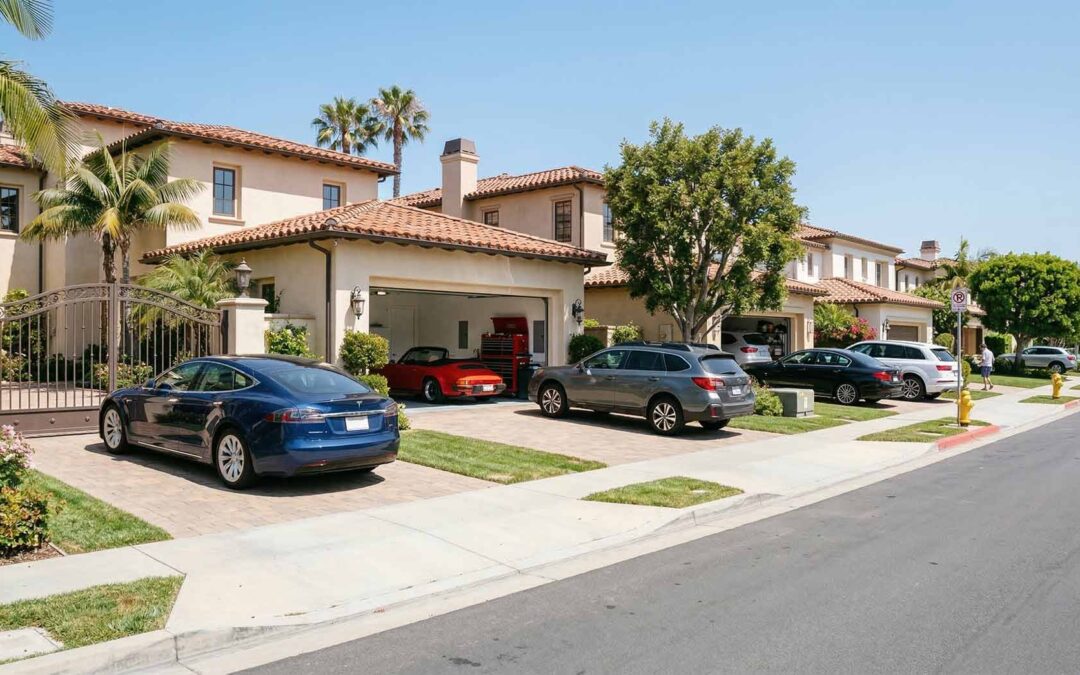
- HOA boards may require homeowners to use garages for vehicle parking before using driveways or other parking areas within the community. These rules are common in communities where parking availability is limited or where the HOA seeks to prevent garages from being used primarily for storage. When properly adopted and applied consistently, courts have upheld such rules as reasonable extensions of HOA power.
- HOAs may restrict the types of vehicles that may be parked within the community. HOAs may adopt reasonable restrictions on certain categories of vehicles that affect the appearance or functionality of the community. These restrictions commonly apply to recreational vehicles, trailers, boats, oversized vehicles, and commercial vehicles. HOAs often define commercial vehicles based on size, weight, or equipment, or based on visible advertising on the vehicle. In many HOAs, vehicles displaying business signage or advertising are treated as commercial vehicles even if the vehicle would otherwise qualify as a permitted vehicle.
- HOAs may define commercial vehicles broadly so long as the definition is reasonable and applied consistently. In practice, many HOAs treat vehicles with ladder racks, work equipment, oversized dimensions, or visible company logos as commercial vehicles. Some HOAs also treat vehicles displaying removable magnetic business signage as commercial vehicles when parked within the community. Courts have consistently upheld an HOA’s right to enforce such rules.
- HOAs may no longer issue blanket bans on pickup trucks. There was a time when pick up trucks were primarily used for commercial purposes and few families used them as everyday vehicles. That has changed, however. So, while many older governing documents still contain the old “no truck” provisions, California law has evolved to recognize pickup trucks as standard passenger vehicles. An HOA may, therefore, still regulate trucks based on reasonable objective criteria, such as weight (e.g., over 3/4 ton), size, the presence of dual rear wheels (“duallies”), or commercial equipment, but they can no longer ban a vehicle simply because it is a pickup truck used for personal transportation.
- HOA boards may regulate guest parking within the community. Many California HOAs designate portions of the common area for guest parking and adopt rules governing how those spaces may be used. These rules are typically designed to ensure that guest parking remains available for visitors rather than being used by residents as overflow parking, and they’re almost always deemed enforceable. For example:
- Common guest parking rules include restrictions on homeowner use of guest spaces. Many HOAs prohibit residents from parking in guest-designated spaces so that those spaces remain available for visitors.
- HOA boards may impose time limits on guest parking in common areas. Some HOAs limit guest parking to a specific number of hours or days to prevent long term parking in areas intended for temporary use.
- HOA boards may require guest vehicles to be registered with the HOA or management company. In communities with limited parking availability, HOAs sometimes require homeowners to notify management when a guest will be parking overnight.
- HOA boards may require guest vehicles to display temporary parking permits. Some HOAs issue temporary parking permits that allow guest vehicles to park within designated areas for a limited time.
- HOAs may adopt rules intended to prevent long term vehicle storage within the community. HOAs frequently adopt rules requiring vehicles parked in driveways or common areas to remain registered and operable. These rules are intended to prevent abandoned or unused vehicles from occupying parking spaces that are intended for active use.
- HOAs must allow for the temporary “loading and unloading” of recreational vehicles and boats. While boards can generally prohibit the long-term storage of RVs and trailers in driveways or common areas, they cannot block a homeowner’s right of “egress and ingress.” This typically means homeowners are entitled to a reasonable window (often 24 hours) to keep the vehicle at their property for the purpose of packing, cleaning, or preparing for a trip without facing an immediate fine or tow.
- HOA boards may prohibit the use of common areas for vehicle storage unless the governing documents authorize such use. Because common areas are owned collectively by the HOA membership, HOA boards have a duty to manage those areas for the benefit of all members. For that reason, many HOAs prohibit the storage of vehicles, trailers, or equipment in common areas that are intended to function as parking areas.
- HOA boards cannot immobilize vehicles using wheel clamps, boots, or similar devices. The California Attorney General issued a formal opinion that concluded that devices designed to immobilize vehicles (e.g., wheel clamps, boots, etc.) may violate Vehicle Code 10852, which prohibits tampering with a vehicle without the owner’s consent. Consequently, it’s very likely illegal for an HOA to make use of such devices for any reason, including to enforce the community’s parking rules.
- The Davis-Stirling Act protects your right to install an EV charging station. Under Civil Code 4745, any provision in a governing document that effectively prohibits or unreasonably restricts the installation or use of an EV charging station in a homeowner’s designated parking space is void and unenforceable. While the HOA can impose reasonable aesthetic requirements and require the homeowner to pay for electricity and insurance, they cannot use “parking rules” as a tool to prevent you from going electric. [If you’d like to read a short article about EV charging in HOA communities, read “Navigating the Tensions Between HOAs and Homeowners Amid the Rise of Electric Vehicles.” Or if you prefer, I have an HOA HELL podcast “short” dedicated to that issue called “You Have the Right to Install an EV Charging Station in Your Assigned Parking Spot.”]
- Call MBK Chapman if your HOA is violating the law. If your HOA is enforcing parking restrictions that appear unreasonable or unsupported by the governing documents, call the HOA attorneys at MBK Chapman and we’ll set your HOA straight. The HOA lawyers at MBK Chapman are considered by many industry insiders to be the most experienced homeowner-side HOA attorneys in California.
Parking rules can serve legitimate purposes within HOA communities. At the same time, those rules must remain grounded in the authority granted by the governing documents and the requirements of the Davis-Stirling Act. When HOA boards attempt to regulate parking beyond those limits, homeowners can and should push back.
FAQs
Can my HOA regulate parking in my own driveway or garage?
If the CC&Rs, bylaws, or articles of incorporation authorize the HOA to adopt rules regulating the use of property within the community, then yes. Civil Code 4350 allows the HOA to adopt reasonable operating rules affecting the use and misuse of garages, driveways, and other parking areas throughout the HOA.
Can my HOA require me to park my cars in my garage before I’m allowed to park on my own driveway?
Yes. Many HOAs adopt rules requiring homeowners to park vehicles inside their garages before using driveways or other parking areas. These rules are commonly adopted in communities with limited parking availability or where the HOA seeks to prevent garages from being used primarily for storage. And some HOAs pass such rules because they’ve determined that multiple cars parked in the street or on a driveway isn’t a good look for the community. All of those have been upheld by California courts as reasonable in terms of HOA power.
Can my HOA restrict commercial vehicles or oversized vehicles?
Yes, if the restriction is reasonable and authorized by the governing documents. Many HOAs regulate recreational vehicles, trailers, boats, oversized vehicles, and commercial vehicles for a variety of reasons. HOAs often define commercial vehicles based on size, equipment, or visible business advertising.
Can my HOA require my guests to register their vehicles or use parking permits?
Yes. Many HOAs regulate guest parking to ensure that visitor spaces remain available for guests and aren’t being used primary by residents as overflow parking. Common rules include requiring guest vehicles to be registered with management, limiting the amount of time a guest vehicle may remain parked in common areas, or requiring temporary guest parking permits.
Can my HOA ban all types of pickup trucks?
No. Older governing documents sometimes contain provisions banning trucks entirely. California law has evolved years ago to recognize pickup trucks as common passenger vehicles, so HOAs cannot prohibit them solely because they are pickup trucks. HOAs may still regulate pickup trucks based on objective factors such as weight, size, commercial equipment, or dual rear wheels, however.
Can my HOA put a boot or wheel clamp on my vehicle?
Very likely not. Although it doesn’t have the force of law, the California Attorney General previously issued a formal opinion concluding that immobilizing devices such as boots or wheel clamps likely violate Vehicle Code 10852, which prohibits tampering with a vehicle without the owner’s consent. Because of that, it is very likely illegal for an HOA to immobilize a vehicle as a method of enforcing parking rules.
About MBK Chapman Fact Sheets
Homeowners searching for answers online will often come across articles that appear authoritative, but are actually written as search-engine marketing content rather than by an experienced HOA lawyer. These pieces tend to prioritize keyword density over clarity, accuracy, or legal context, which often leaves homeowners more confused than informed.
At MBK Chapman, our Fact Sheets are part of our HOA Law Library and are written by Michael Kushner, an HOA lawyer with decades of hands-on experience representing California homeowners. In fact, Michael Kushner is the HOA lawyer who pioneered the systems and strategies used by some of California’s most successful homeowner-side HOA law firms.
Each Fact Sheet is deliberately concise, statute-based, and designed as a quick-reference guide to help homeowners understand key HOA laws and enforcement rules at a glance.
AND DON’T FORGET TO TUNE INTO MY PODCAST, HOA HELL
YOU CAN ALSO ORDER MY GROUNDBREAKING BOOK
HOA HELL | California Homeowners’ Definitive Guide to Beating Bad HOAs
Amazon | Barnes & Noble
