
HOW TO CHALLENGE SELECTIVE ENFORCEMENT BY YOUR CALIFORNIA HOA
OVERVIEW
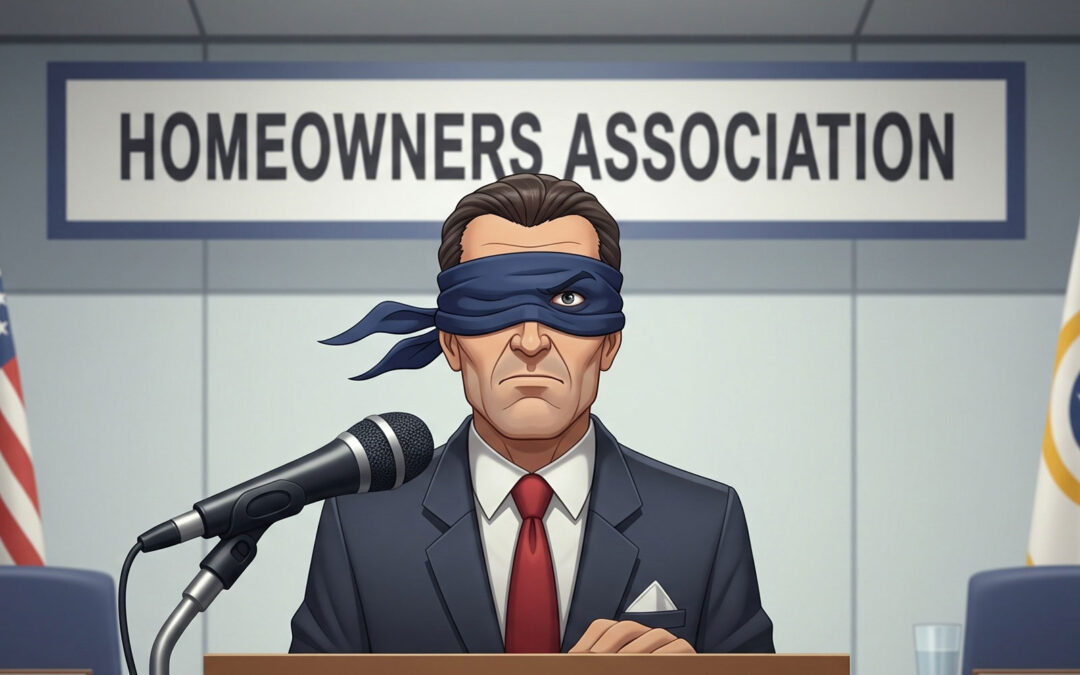
Selective enforcement is one of the most common and infuriating problems homeowners face in California HOAs. It happens when the board applies the rules unevenly, e.g., penalizing one homeowner while letting others slide for the exact same violation. On the surface, it may feel like favoritism, politics, or even personal grudges. And it is exactly that. But it’s also much more than that. It’s a legal vulnerability that homeowners can turn into leverage to fight back.
California law does not allow HOAs to enforce their governing documents arbitrarily or in a way that singles out certain members. Rules must be applied fairly, consistently, and in good faith. When boards cross that line, homeowners gain a powerful defense against fines, penalties, and denials. More than that, if handled correctly, homeowners can turn an HOA’s selective enforcement into a powerful legal weapon that can shift leverage back to the membership.
This article explains what selective enforcement looks like and why it violates the core principles of fairness and due process. More importantly, this article explains how you can turn the board’s selective enforcement into a strategy aimed at forcing your board to back down and start applying rules evenly and fairly. If your HOA is singling you out, you should make them stop. This article will arm you with the tools to do just that.
For a quick-reference on this topic, see my Fact Sheet: “Selective Enforcement in California HOAs: What It Is And Why It’s Illegal.”
WHAT SELECTIVE ENFORCEMENT LOOKS LIKE IN CALIFORNIA HOAs
Selective enforcement occurs when a board applies HOA rules or standards inconsistently amongst its membership. It can take the form of uneven discipline, e.g., fining one homeowner for a violation while ignoring the same condition at another property, but it also shows up in architectural control, where one homeowner’s plans are denied while another homeowner’s nearly identical plans are approved. In fact, selective enforcement can happen with rule enforcement, architectural decisions, amenity privileges, or even access to association resources. What makes it “selective” is not the rule itself, but the way the board chooses to enforce it.
Common examples of selective enforcement include things like:
- You are ordered to remove hedges or trees while others with the same landscaping are left alone.
- Your balcony improvement is denied even though multiple nearby homes received approvals for materially similar work.
- You receive a violation for leaving trash cans out overnight while neighbors do the same without consequence.
- The board fines you for parking in your driveway while ignoring the fact that board members’ own families do the same thing.
- The board penalizes you for repainting with an unapproved shade, while other homes with similar colors are ignored.
- You’re fined for putting up a basketball hoop (which is against the rules), but other homes with the same equipment remain untouched.
- The association denies your patio cover, while approving nearly identical ones for neighbors two doors down.
- The HOA singles out your dog for being a barking/noise nuisance while overlooking barking dogs owned by directors or their allies.
- The board restricts your pool or gym access for a violation, while allowing other residents with similar issues to continue using amenities.
Selective enforcement doesn’t always look dramatic at first glance. It often shows up in these day-to-day situations where the difference isn’t the rule itself, but who the board decides to apply it against. That’s what makes it not just unfair, but unlawful.
WHY SELECTIVE ENFORCEMENT IS ILLEGAL IN CALIFORNIA HOAs
California law does not allow HOAs to apply restrictions arbitrarily or in a way that singles out certain members while favoring others. In fact, Civil Code section 4350 requires HOAs to implement its rules fairly, consistently, reasonably, and in good faith. When bad HOA boards violate the law by selectively enforcing rules, they are violating the basic principles of fairness and due process embedded in California law, including the Davis-Stirling Act.
Selective enforcement is illegal because:
- It undermines uniform rule enforcement. The law presumes recorded covenants and adopted rules are valid, but that presumption is easy to defeat if you can show that your HOA does not enforce its rules evenly across the community.
- It produces arbitrary and capricious results. Boards cannot enforce rules on a whim or as a weapon against certain homeowners.
- It violates fundamental concepts of fairness and due process. Homeowners are entitled to procedures that are fair and uniformly applied, not stacked against certain individuals.
Although section 4350 doesn’t define the terms “arbitrary” or “capricious,” the Davis-Stirling Act uses them in related contexts, e.g., in Civil Code section 4765, which requires architectural decisions to be made in good faith and not arbitrarily or capriciously. I raise that point here because despite those words not appearing in Civil Code section 4350, California courts have extended those principles (as contained in Civ. Code, § 4765) to HOA enforcement generally. [In plain English, “arbitrary” means decisions based on personal whim or favoritism rather than facts, while “capricious” means decisions that are unpredictable, inconsistent, or without rational basis.] Both words capture the same core idea that when boards stray from rules and standards to pursue their own preferences, they step outside the protections of the law.
When an HOA board engages in selective enforcement, therefore, it is not merely being unfair, it is violating California law. And that unlawful behavior can become the foundation of your defense, whether against fines, penalties, or denials of architectural approval.
WHY HOAs WEAPONIZE SELECTIVE ENFORCEMENT
Selective enforcement is rarely, if ever, an accident. Rather, it’s almost always a deliberate demonstration and abuse of power. Bad HOA boards weaponize rules to protect allies, punish opponents, and keep homeowners off balance. By applying restrictions unevenly, they turn what should be neutral community standards into tools for politics and personal agendas.
The motivations are simple and timeless—power, ego, and retaliation. Directors protect their friends, target their critics, and shield themselves from rules they enforce on others. Selective enforcement is the board’s way of reminding the community who’s in charge. Or that’s true until homeowners push back and expose the double standard.
This type of conduct doesn’t just erode trust. It undermines the legal foundation of the board’s actions. Once documented, selective enforcement shows that decisions weren’t made neutrally or in good faith. They were made to serve personal interests, and that’s exactly when the law steps in.
GATHERING PROOF AND BUILDING YOUR SELECTIVE ENFORCEMENT STRATEGY
More often than not, if you’ve been the target of selective enforcement, you were probably aware of it (if not certainly, then at least vaguely). Suspicion alone, however, isn’t enough. To successfully fight against selective enforcement, you need clear evidence showing that the board is enforcing (or using) rules against you differently from other members. The goal is to document patterns of unequal treatment that demonstrate favoritism, retaliation, or abuse of authority.
The first step is comparison. If your board fined you for a rule violation or denied your project, look around the community. Has anyone else been allowed to get away with the same rule infraction or construct a similar improvement? Photograph the pergola two doors down, the landscaping across the street, or the garage door down the block. Tie those examples directly to your case. The sequencing matters. If you’ve been cited, don’t stop with your own situation. Document similar violations throughout the community. Each additional example strengthens your argument that the board isn’t enforcing its rules fairly or consistently.
Next, add records to what you can see with your own eyes. Homeowners in California have the right to inspect association records (Civ. Code § 5200), including board and committee minutes. These documents can reveal which architectural applications were approved, which were denied, and whether directors or their allies were treated differently. If those records don’t exist, or if they expose inconsistent treatment, that absence itself becomes a pressure point that you can capitalize on.
If applicable, layer in “process.” If the board denied your application or fined you without giving you a fair hearing, or if they failed to provide you with a written explanation detailing the basis for, say, their denial of your architectural plans (as Civ. Code, § 4765(a)(4) requires your HOA to do), that due process violation becomes another piece of proof. By combining comparisons, records, and process failures, you can build a case that is far stronger than simply saying, “It feels unfair.”
The key is how you build your response. Start with visual comparisons that show unequal treatment. Reinforce those examples with association records that expose inconsistent decisions. Then add process failures, like the board denying you a fair hearing or failing to explain its decision. When you stack these elements together, you transform selective enforcement from a board’s abuse of power into a homeowner’s strongest proof.
LEVERAGING YOUR HOA’s SELECTIVE ENFORCEMENT AGAINST THEM
Selective enforcement starts as a bad HOA board’s abuse of power. But when documented correctly, it becomes one of the most effective defenses homeowners can use to protect their property and stop abusive boards in their tracks. When you’ve documented selective enforcement, the next step is using it to shift risk back onto the board.
The more you can show a pattern of unfair treatment, the weaker the board’s legal position becomes. Boards know that if they press forward and lose, they risk not only having their decision overturned but also being ordered to pay your attorney’s fees under Civil Code section 5975. That financial exposure often forces them to back down. This translates directly into granting your approvals, dismissing fines, or settling rather than gambling on defending a double standard in court.
A client of mine built a permanent greenhouse in the backyard without HOA approval. It wasn’t a small garden shed. It was a $75,000 structure, built on a cement foundation, wired with electricity, and positioned squarely in the setback. On paper, the HOA had every advantage. Let me be clear. My client absolutely violated both the CC&Rs and the Architectural Guidelines when he built the greenhouse. Not only did he build it within a prohibited setback, but he built it without seeking prior HOA approval. The HOA’s attorney sent a formal demand threatening litigation if my client didn’t tear down and remove the greenhouse.
My client did not want to tear it down. He had invested heavily, and the greenhouse was built to last. More importantly, we knew that the only reason it was an issue was because the President of the HOA did not like my client.
So instead of conceding, I built leverage. I flew a drone over the community and documented how dozens of other properties, including those of board members, had pergolas, sheds, play structures, and BBQs inside their setbacks. Some were even more obvious violations than my client’s greenhouse, yet the board had apparently ignored all of them. This was not a modest neighborhood. These were multimillion-dollar homes. Enforcing the rules consistently would have required demolishing backyard improvements worth millions more in aggregate.
In my demand letter, I forced the board to face that reality. In addition to presenting 11 pages of pictures demonstrating dozens of other properties with violating structures, I also called out the hypocrisy driving the dispute. I wrote:
“The HOA President herself maintains unapproved structures within her setback, yet she is leading the charge to force my client to remove his greenhouse. This is selective enforcement at its most blatant.”
At that point, the HOA had no good options. If they chose litigation, they risked losing on selective enforcement grounds and being ordered to pay my client’s attorney’s fees. If they enforced consistently, they would have enraged the entire community.
The board folded. The settlement let my client keep the greenhouse. In return, my client granted a concession to plant two or three small trees along the property line to block the greenhouse’s limited street visibility. My client kept a $75,000 structure that should have been demolished had the rules been evenly enforced. What looked like a hopeless violation became an unqualified win because I turned the HOA’s own hypocrisy into leverage.
The lesson is simple. When you expose selective enforcement, you turn the board’s misconduct into your advantage. What begins as a violation notice or demand letter can end with the board retreating, settling, or granting approval rather than risking exposure to the rest of the HOA, or even worse, a courtroom loss.
CONCLUDING THOUGHT
HOAs don’t get to apply rules one way to some, and another way to others. The Davis-Stirling Act requires that restrictions be applied fairly, consistently, and in good faith. When boards ignore that obligation, they cross the line from legitimate authority into illegality.
The fix is straightforward. Show the double standard, tie it to your matter, and force your board to provide you with equal treatment. Photograph comparable conditions, secure board and architectural committee minutes and other association records available under Civil Code section 5200, and demand a withdrawal of the fine, the grant the approval, or a halt to the board’s negative action against you.
And if your efforts at doing that aren’t working, that’s when you call us at MBK Chapman. We’ll set your HOA straight.