
Overview
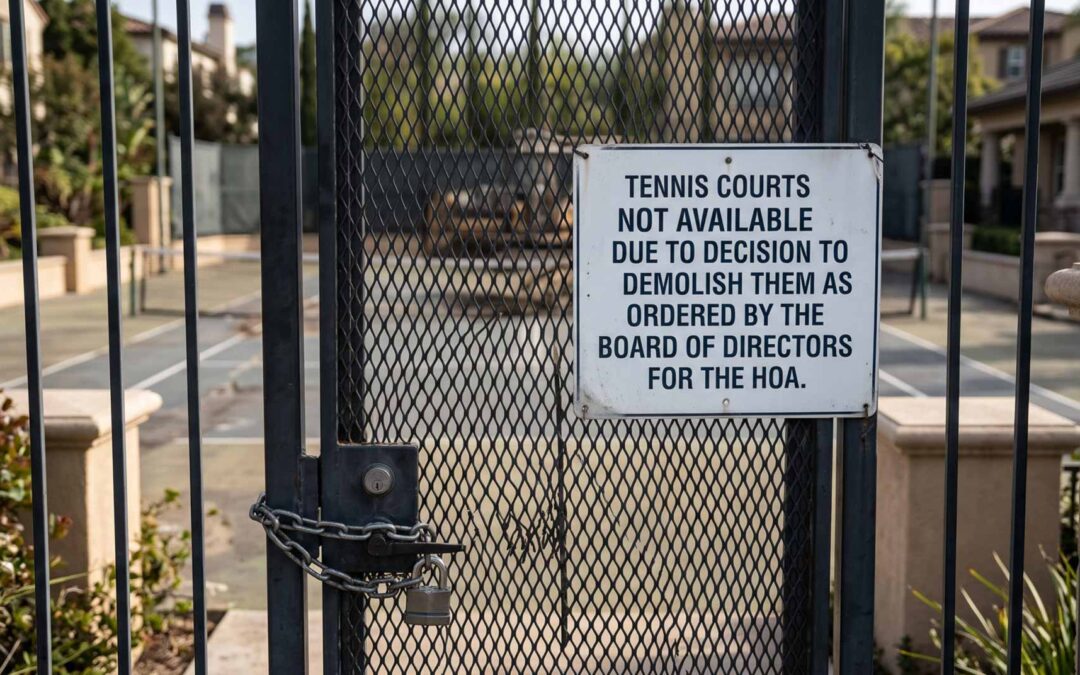
Pools, clubhouses, golf courses, tennis courts, and equestrian facilities are often the most expensive components California HOAs maintain. As they age, the cost of keeping them open can drive up regular assessments, trigger special assessments, and drain the reserves HOAs need for roofs, paving, and other major components. That financial pressure has grown as many California HOAs absorb steep new costs from balcony repairs in condominium buildings, wildfires and other natural disasters, and rapidly rising insurance premiums. As a result, more HOAs are deciding whether to keep funding their amenities, scale them back, or close them altogether.
Whether an HOA can close an amenity depends first on its CC&Rs. Civil Code 4775 makes the HOA responsible for repairing, replacing, and maintaining the common area unless the CC&Rs provide otherwise. In some communities, particularly golf, tennis, and equestrian communities, the CC&Rs go further and require the HOA to provide specific amenities. Those HOAs have no authority to stop repairing, maintaining, or replacing those amenities no matter how much financial pressure they face. Indeed, Civil Code 5600 requires HOAs to levy assessments sufficient to perform their obligations under their CC&Rs, and only an amendment to the CC&Rs can remove those obligations. Other CC&Rs don’t go that far but might require a membership vote before the HOA eliminates or materially alters an amenity. Where the CC&Rs say nothing, the HOA’s board likely has authority to make the decision on its own, but it still has to make that decision openly, and it can’t let the amenity deteriorate as a way of closing it (rather than doing it openly).
Within whatever authority the CC&Rs allow, fiduciary duty governs how the HOA makes that decision. The HOA’s fiduciary duty runs to the membership as a whole and to the corporate entity the directors serve. Corporations Code 7231 requires an HOA’s directors to act in good faith, in what they believe is the HOA’s best interest, and with the care an ordinarily prudent person would use, including reasonable inquiry (that is, investigating before acting). Once an amenity starts draining the community’s finances, that duty requires the HOA to look at the numbers and weigh the alternatives its CC&Rs permit, such as repairing the amenity, scaling it back, repurposing it, or closing it.
This Fact Sheet explains how the CC&Rs determine whether an HOA can close an amenity, what an HOA’s fiduciary duty requires before it decides an amenity’s future, and what the Davis-Stirling Act requires an HOA to disclose when it decides not to repair or replace a major component. It also explains how homeowners can respond when their HOA closes an amenity it has no authority to close or lets an amenity’s costs keep climbing without ever making a decision.
Key Points
An HOA’s decision about the future of an expensive amenity involves two separate questions. The first is whether the HOA has authority to close or cut back the amenity at all, and the CC&Rs answer that question. The second is how the HOA has to make the decision once it has that authority, which the Corporations Code and the Davis-Stirling Act control. HOAs have to investigate the costs and the alternatives, make their decisions at open board meetings, and disclose any decision not to repair or replace a major component in the annual budget report. When an HOA exceeds its authority or skips those requirements, homeowners have grounds to challenge the decision, or the HOA’s failure to make one.
- The CC&Rs determine whether an HOA has the power to close an amenity. Civil Code 4775 makes the HOA responsible for repairing, replacing, and maintaining the common area unless the CC&Rs provide otherwise, and pools, clubhouses, golf courses, tennis courts, and equestrian facilities are typically part of the common area. The CC&Rs can expand that duty for a particular amenity, restrict how the HOA can change it, or say nothing about it at all, and each of those possibilities leads to a different answer. To find out which one applies, homeowners should look for CC&R provisions that describe the community’s recreational facilities, define the HOA’s maintenance obligations, set out the HOA’s authority over the common area, or require a membership vote before the HOA alters or removes common area improvements.
- If the CC&Rs require the HOA to provide an amenity, eliminating the amenity requires an amendment to the CC&Rs. Some CC&Rs, especially in golf, tennis, and equestrian communities, require their HOAs to operate, maintain, repair, or replace those amenities. Those provisions make keeping the amenities an obligation, not a choice, and those HOAs have no authority to stop funding or maintaining them, even when balcony repairs, disaster losses, or rising insurance premiums strain their budgets. Civil Code 5600 requires HOAs to levy regular and special assessments sufficient to perform their obligations under their CC&Rs. If meeting those obligations requires a regular assessment increase of more than 20%, or special assessments totaling more than 5% of an HOA’s budgeted gross expenses for the year, Civil Code 5605 requires the HOA to get approval from a majority of a quorum of its members. The only way to remove the obligation itself is for the members to amend their CC&Rs, and Civil Code 5100 requires that vote to take place by secret ballot.
- When their CC&Rs require a membership vote before eliminating amenities, HOAs can’t close those amenities without that vote. Other CC&Rs don’t require their HOAs to provide specific amenities, but they do require a vote of the membership before those HOAs eliminate, remove, or materially alter common area improvements. Some communities with extensive tennis or equestrian facilities, for example, have CC&Rs that require a membership vote before their HOAs convert those facilities to another use. In those HOAs, a permanent closure or repurposing requires the vote. Whether a partial change, such as closing some but not all of the community’s tennis courts, also requires a vote depends on how the CC&Rs describe the changes that trigger it. [To learn more about when HOAs can repurpose recreational facilities, read my Fact Sheet, “Can a California HOA Convert Tennis Courts Into Pickleball Courts?”]
- When their CC&Rs say nothing about an amenity, HOAs likely have authority to close it without a membership vote. Most CC&Rs give HOAs broad authority to manage, maintain, and operate the common area, and in the absence of explicit language like that described above, that authority likely includes the power to scale back or repurpose recreational amenities, and in many cases, to close them. That authority becomes less certain, however, when HOAs eliminate amenities entirely instead of modifying them. Homeowners can legitimately argue that closing the community’s only pool, or all of its tennis courts, eliminates a longstanding amenity, especially where the community marketed that amenity as a major feature or homeowners bought their homes because of it.
- HOAs have to investigate an amenity’s costs and alternatives before deciding its future. Corporations Code 7231 requires HOA directors to act in good faith, in what they believe is the HOA’s best interest, and with the care, including reasonable inquiry, that an ordinarily prudent person in a like position would use. Reasonable inquiry means gathering the information a prudent decision requires, such as current repair and replacement bids, the amenity’s operating costs, its remaining useful life and replacement cost in the reserve study, and how much the community uses it. Rising costs from balcony repairs, disaster losses, and insurance premiums give HOAs good reason to revisit expensive amenities, but those pressures don’t lower the standard of care that applies when they do. HOA directors can rely on reports from reserve specialists, contractors, accountants, and other professionals, but Corporations Code 7231 protects that reliance only when the directors act in good faith and have no knowledge that would make the reliance unwarranted. When HOAs make informed, good-faith decisions, the Business Judgment Rule generally protects those decisions from second-guessing, but it never protects a decision the CC&Rs don’t authorize. When HOAs skip the inquiry, they lose that protection. [For a closer look at when HOAs lose the protection of the Business Judgment Rule, read my Fact Sheet, “When the Business Judgment Rule Does Not Protect an HOA Board.”]
- HOAs can’t let amenities fall apart instead of deciding their future. Civil Code 4775 makes HOAs responsible for repairing, replacing, and maintaining the common area unless their CC&Rs provide otherwise, and that duty doesn’t pause while HOAs put off decisions about expensive amenities. Letting a pool, clubhouse, or tennis court deteriorate until no one can use it closes the amenity as effectively as a formal decision would, but without the investigation, the open vote, or the disclosure the law requires. Instead, the Davis-Stirling Act requires HOAs to make that decision in the open. Civil Code 5300 requires HOAs to state in their annual budget reports, which they must distribute 30 to 90 days before the end of each fiscal year, whether they’ve decided to defer or not undertake the repair or replacement of any major component with a remaining life of 30 years or less, and to justify any such decision. Pool surfaces and equipment, clubhouse roofs, and court surfaces commonly appear in reserve studies as major components, so a decision to stop repairing or replacing them belongs in that statement. [If you’d like to know more about those required annual written disclosures, read my Fact Sheet, “What Documents Does My California HOA Have to Send Me Every Year?”]
- Reserve studies show when HOAs have stopped planning to repair or replace an amenity. In most HOAs, Civil Code 5550 requires a visual inspection of the major components at least once every three years as part of a reserve study, and it requires HOAs to review that study every year. The reserve funding plan in the study has to cover every major component with a remaining life of 30 years or less, except components the HOA has decided it won’t repair or replace. When pool equipment, tennis court resurfacing, equestrian arena fencing, or a golf course’s irrigation system disappears from an HOA’s reserve funding plan, the HOA has made a decision about that amenity, whether or not it ever announced its intentions. Civil Code 5300 requires HOAs to include a summary of the reserve funding plan in their annual budget reports and to give the full plan to any homeowner who asks for it. Comparing the current plan with earlier ones, and checking whether the annual budget report disclosed and justified the change, gives homeowners a direct way to find out what their HOA has decided. If the CC&Rs require the HOA to provide the amenity, the HOA has no authority to drop that amenity’s components from the plan at all.
- HOAs have to make amenity decisions at properly noticed open board meetings. Civil Code 4910 prohibits HOAs from taking action on any item of business outside a board meeting, so directors can’t decide an amenity’s future through email exchanges or private conversations. Civil Code 4920 requires HOAs to give notice of each board meeting, including its agenda, at least four days in advance, and Civil Code 4930 bars HOAs from discussing or acting on items that aren’t on that agenda, except in the limited circumstances that statute allows. Civil Code 4935 limits executive session to the specific subjects set forth in that statute (none of which involve the disposition of HOA amenities), so HOAs can’t move the decision to close their amenities behind closed doors. [To learn more about homeowners’ rights at board meetings, read my Fact Sheet, “California HOA Open Meeting Act: Homeowner Rights and Board Obligations.”]
- If your HOA mishandled a decision about a pool, golf course, tennis courts, equestrian facilities, or other amenity, call the HOA attorneys at MBK Chapman. Whether your HOA closed an amenity its CC&Rs required it to provide, eliminated one without a required membership vote, or let one deteriorate without ever affirmatively deciding its future, the HOA attorneys at MBK Chapman know how to use your CC&Rs and your HOA’s own budget reports, reserve studies, and minutes to hold it to its obligations.
Rising costs from balcony repairs, natural disasters, and insurance premiums will keep pushing many cash strapped California HOAs to reconsider their most expensive amenities. How far an HOA can go in response depends on its CC&Rs, which can require it to keep an amenity, require a membership vote before it eliminates one, or leave the decision to the board. Where the decision belongs to the board, its reserve studies, annual budget reports, and board meeting minutes show whether it made that decision the way the law requires.
FAQs
Can my California HOA close the pool or other amenities?
It depends on your CC&Rs. Unless the CC&Rs provide otherwise, Civil Code 4775 makes your HOA responsible for repairing, replacing, and maintaining the common area. If the CC&Rs require your HOA to provide a specific amenity, such as golf, tennis, or equestrian facilities, your HOA can’t close them unless the members amend the CC&Rs. If the CC&Rs require a membership vote before your HOA eliminates or materially alters an amenity, your HOA needs that vote. If the CC&Rs say nothing, your HOA’s board likely has authority to close the amenity on its own, although that authority becomes less certain when the HOA eliminates an amenity entirely instead of modifying it.
Can my HOA stop maintaining an amenity because it costs too much?
Not by letting it deteriorate. Unless the CC&Rs provide otherwise, Civil Code 4775 requires your HOA to repair, replace, and maintain the common area, and rising costs from things like balcony repairs, natural disasters, and insurance premiums don’t suspend that duty. If your CC&Rs require the HOA to provide the amenity, Civil Code 5600 requires the HOA to levy assessments sufficient to keep providing it. If the HOA does have authority to stop repairing or replacing the amenity, it has to make that decision at an open board meeting and disclose and justify it in the annual budget report, as Civil Code 5300 requires.
Does my HOA have a fiduciary duty to consider closing an amenity that’s draining the budget?
Your HOA has a duty to investigate and weigh the alternatives its CC&Rs permit, and closing the amenity is one of those alternatives only when the CC&Rs allow it. Corporations Code 7231 requires HOA directors to act in good faith, in what they believe is the HOA’s best interest, and with the care an ordinarily prudent person would use, including reasonable inquiry. Once an amenity starts draining the HOA’s finances, that duty requires the HOA to gather the facts, such as repair bids, operating costs, reserve study figures, and usage, before deciding whether to repair, scale back, repurpose, or close it. The Business Judgment Rule generally protects informed, good-faith decisions, but it doesn’t protect directors who skip the inquiry or act beyond the authority their CC&Rs give them.
How can I find out whether my HOA has decided not to repair or replace an amenity?
Check your HOA’s annual budget reports and reserve studies. Civil Code 5300 requires the annual budget report to state whether the HOA has decided to defer or not undertake the repair or replacement of any major component with a remaining life of 30 years or less, and to justify that decision. The reserve funding plan required by Civil Code 5550 covers those major components except the ones the HOA has decided it won’t repair or replace, so when an amenity’s components, such as pool equipment or tennis court resurfacing, disappear from the plan, the HOA has made a decision about that amenity. Your HOA has to give you the full reserve funding plan if you ask for it.

About Michael Kushner
Michael Kushner is a California attorney with over 30 years of experience representing homeowners in disputes with their HOAs. He is widely regarded as California’s leading homeowner-side HOA attorney, and has built one of the state’s most prominent law practices dedicated to holding HOAs accountable under the Davis-Stirling Act and California law.
In addition to his law firm’s work, Michael is a recognized lecturer, author, and the host of the hit HOA HELL podcast, where he provides homeowners living in HOA-governed communities with clear, practical strategies for dealing with bad HOAs. He’s also the author of the best-selling book, HOA HELL | California Homeowners’ Definitive Guide to Beating Bad HOAs, which has become a go-to resource for both homeowners seeking real-world solutions to their HOA disputes, as well as those good HOA board members who are interested in doing a good job.
About MBK Chapman Fact Sheets
Homeowners searching for answers online will often come across articles that appear authoritative, but are actually written as search-engine marketing content rather than by an experienced HOA lawyer. These pieces tend to prioritize keyword density over clarity, accuracy, or legal context, which often leaves homeowners more confused than informed.
At MBK Chapman, our Fact Sheets are part of our HOA Law Library and are written by Michael Kushner, an HOA lawyer with decades of hands-on experience representing California homeowners. In fact, Michael Kushner is the HOA lawyer who pioneered the systems and strategies used by some of California’s most successful homeowner-side HOA law firms.
Each Fact Sheet is deliberately concise, statute-based, and designed as a quick-reference guide to help homeowners understand key HOA laws and enforcement rules at a glance.
AND DON’T FORGET TO TUNE INTO MY PODCAST, HOA HELL
YOU CAN ALSO ORDER MY GROUNDBREAKING BOOK
HOA HELL | California Homeowners’ Definitive Guide to Beating Bad HOAs
Amazon | Barnes & Noble
