
Overview
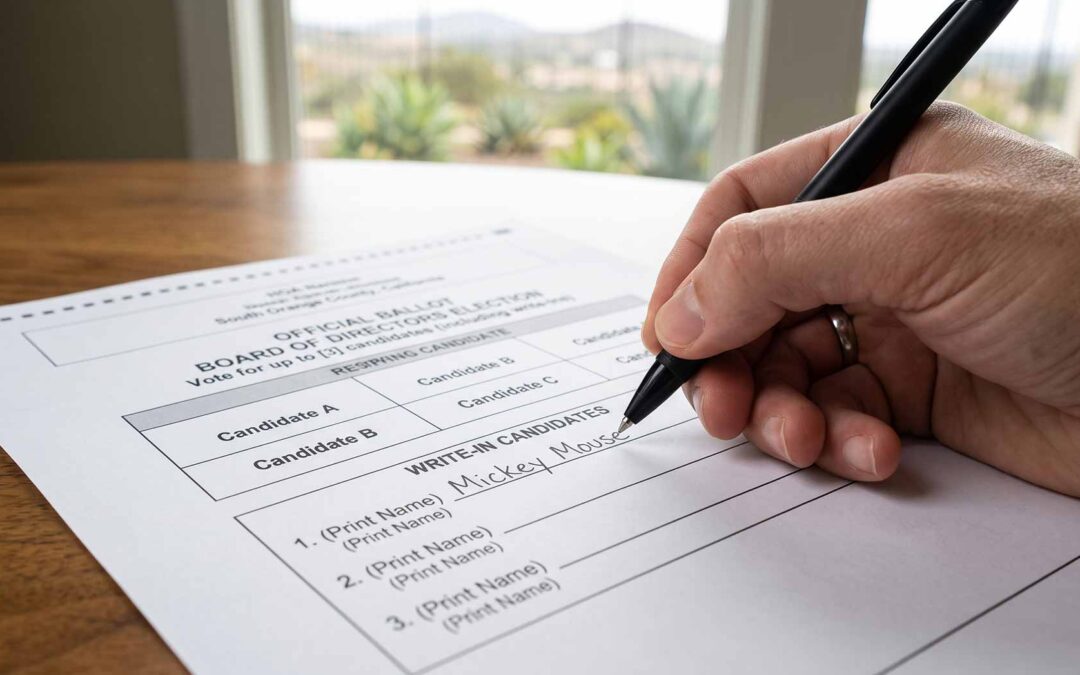
I’ve received several questions recently from homeowners about write-in candidates in California HOA elections. One homeowner wrote to tell me that his HOA had just announced its election results, and that a woman who wrote her own name in took a board seat with a single vote. Nothing in the HOA’s documents mentioned write-ins, the ballot had no space for one, and the inspector of elections counted the vote anyway. Enough homeowners are asking about this that I decided that it was time for a Fact Sheet on the subject.
Write-in candidates aren’t automatically allowed in California HOA elections. The Davis-Stirling Act permits HOAs to allow write-ins through their election operating rules, but HOAs aren’t required to do so. So when it comes to whether write-in candidates are legal or not, the answer turns on a single question. Do the HOA’s election rules affirmatively permit write-in candidates? If not, then an inspector of elections has no basis to count a write-in vote, and the HOA can’t legally seat that candidate on the board.
This Fact Sheet explains when an HOA can legally consider write-in candidates, why the candidate-related notice laws don’t apply to write-ins, and what homeowners can do when their HOAs illegally allow a write-in candidate to take a seat on the board.
[If you’d like to learn more about HOA election rules in general, read my Fact Sheet “California HOA Election Rules and Homeowner Rights.”]
Key Points
Every California HOA has to adopt election operating rules. If an HOA’s election rules do not explicitly permit write-in candidates, then that HOA can’t count write-in votes. The points below cover where an HOA’s authority to permit write-in candidates comes from, why the candidate-related notice rules don’t even apply to write-in candidates, and how homeowners can challenge an election where a write-in candidate was counted when the HOA’s election rules didn’t authorize that process.
- Write-in candidates can only be elected if the HOA’s election rules affirmatively permit them. A write-in candidate is someone whose name never appeared on the ballot, so members have to write that name onto the ballot by hand. This can occur at any time up to and including the time of the election. Civil Code 5105 requires every California HOA to adopt election operating rules, and those rules have to cover candidate qualifications, nomination procedures, voting power, the voting period, and how the HOA selects its inspector of elections. Civil Code 5105 allows HOAs to “permit write-in candidates for ballots.” That’s permission, not a requirement, so HOAs that want write-ins have to say so in their election rules. If you want to know whether write-in candidates are permitted in your HOA’s elections, look for that right in the election rules. If it’s not there (i.e., if your election rules are silent on the matter), then your HOA can’t consider write-in candidates at all. [A lot of bad HOAs deal with homeowner challenges to write-in candidates by saying something like “nothing in the rules prohibits us from allowing write-in candidates to run.” Homeowners should reject that response. Civil Code 5105 requires the rules to permit write-ins. In other words, silence isn’t permission.]
- HOAs can’t amend their election rules within 90 days of an election. Civil Code 5105 states that election operating rules shall not be amended less than 90 days before an election. So HOAs that realize mid-campaign that their rules don’t cover write-ins, or that scramble after members complain about a counted write-in, can’t adopt a rule and apply it to that election. Civil Code 5105 also requires HOAs to adopt election rules through the operating rule procedures in Civil Code 4340 (including the 28-day notice requirement). In practice, this means that HOAs who want to add a write-in provision to their election rules should start at least 118 days before the election. [HOAs running electronic elections face a further limit because Civil Code 5105 makes the write-in permission subject to the electronic voting provisions, and an electronic voting rule has to prohibit nominations from the floor.]
- In HOAs that permit write-in candidates, the candidate-related notice requirements don’t apply. Civil Code 5115 requires HOAs to give members general notice of every candidate name that will appear on the ballot at least 30 days before ballots go out, and to give general notice of the nomination procedure and deadline at least 30 days before that deadline. Homeowners who see a write-in candidate get elected but whose name never showed up in any HOA notice might jump to the conclusion that their HOA violated the 30-day rule. But, in HOAs whose election rules permit write-ins, the fact that nobody saw the name before election night means nothing. By definition, a write-in candidate could never have been announced in advance.
- Write-in candidates still have to meet every other qualification the law and the election rules impose. While HOAs that permit write-in candidates to be elected to the board can disregard the candidate-related deadlines imposed by the Davis-Stirling Act, the other election requirements still apply. For example, Civil Code 5105 requires HOAs to disqualify anyone who wasn’t a member when the nomination happened, and to disqualify anyone who already served the maximum number of terms the HOA allows. Civil Code 5105 also lets HOAs disqualify candidates through their bylaws or election rules for being behind on regular or special assessments, for co-owning a separate interest with a sitting or nominated director, for belonging to the HOA less than one year, and for criminal convictions that would cost the HOA the insurance Civil Code 5806 requires. None of that changes because someone got onto the ballot by hand, so a write-in who fails any of those tests can’t hold the seat even where the election rules permit write-ins. [If you’d like some more information about who’s qualified to serve on an HOA’s board of directors, read my Fact Sheet “Can I Serve on the Board of a California 55+ HOA If I’m Under 55?”]
- Homeowners who conclude that their HOAs counted write-in votes without authority should move quickly. Election materials carry a one-year retention period, and the deadline to file suit runs from the day the inspector of elections announces the results.
- Start with a written request for the election rules and the election materials. Civil Code 5200 makes election materials association records that members can inspect, and Civil Code 5125 requires the inspector of elections or a designee to keep them for at least one year after the election. Request the election operating rules, the returned ballots, the signed voter envelopes, the voter list, the candidate registration list, and the tally sheet.
- Demand that your HOA (or inspector of elections) identify the rule that authorized the write-in candidate. Put your HOA (or inspector) on notice that the inspector counted write-in votes, name the seat and the candidate, and require it to point to the specific election rule permitting write-in candidates. Smart HOAs who realize that they may have made a mistake will vacate the seat and hold a new election rather than defend a result they won’t be able to justify legally.
- File within one year if the HOA digs in. Civil Code 5145 lets members bring a civil action for declaratory or equitable relief within one year of the date the inspector of elections notifies the board and the membership of the results, or within one year of when the cause of action accrues, whichever is later. Once members show by a preponderance of the evidence that the HOA didn’t follow the election procedures or its own election rules, courts void the results unless the HOA proves that the non-compliance didn’t affect the outcome. Members who prevail recover reasonable attorneys’ fees and court costs, and courts can impose a civil penalty of up to $500 for each violation. Civil Code 5145 also stops a prevailing HOA from recovering its costs (but never fees) unless the court finds the action frivolous, unreasonable, or without foundation. This fee-shifting provision provides a strong incentive for homeowners who want to hold their HOAs accountable.
- If your HOA seated a write-in candidate its election rules never authorized, call the HOA attorneys at MBK Chapman. The HOA attorneys at MBK Chapman are widely considered the best homeowner-side HOA attorneys in California, and we’ve spent decades forcing HOAs to hand over their election records, void improper results, and run their elections the way the Davis-Stirling Act requires. If your HOA has violated those laws, call us.
Whether your HOA can seat a write-in candidate comes down to what its election rules say. Ask for the election rules, ask for the candidate registration list, and ask your HOA to name the rule it relied on. If it can’t, you have one year to challenge the election results.
FAQs
Are write-in candidates allowed in California HOA elections?
Only if the HOA’s election operating rules affirmatively permit them. If your HOA’s election rules say nothing about write-ins, your HOA can’t count write-in candidates, and an HOA can’t rely on the absence of a prohibition because silence isn’t permission.
My HOA counted a write-in vote for someone whose name was never in any election notice. Is that a violation?
Not by itself. Civil Code 5115 requires HOAs to give members general notice of every candidate name that will appear on the ballot at least 30 days before ballots go out. For obvious reasons, that requirement only covers names printed on the ballot. A write-in candidate couldn’t possibly be printed on the ballot. So in HOAs whose election rules permit write-ins, the missing name proves nothing.
Can my HOA change its election rules to allow write-ins after the election starts?
Not in most cases. Civil Code 5105 prohibits HOAs from amending their election rules less than 90 days before an election. Civil Code 4360 separately requires the HOA board to give members notice of a proposed rule change at least 28 days before making it. This means that HOAs who want to add a write-in candidate provision to their election rules need to send that notice no later than 118 days before the election for the new rule to govern that election.
How do I challenge an election where my HOA counted write-in candidates that it wasn’t authorized to count?
Civil Code 5145 gives members one year to file a civil action for declaratory or equitable relief, measured from the date the inspector of elections announces the results or the date the cause of action accrues, whichever is later. Once you show the HOA didn’t follow the election procedures or its own election rules, the court voids the results unless the HOA proves the violation didn’t affect the outcome. Members who prevail recover reasonable attorneys’ fees and court costs, and the court can impose a civil penalty of up to $500 for each violation.

About Michael Kushner
Michael Kushner is a California attorney with over 30 years of experience representing homeowners in disputes with their HOAs. He is widely regarded as California’s leading homeowner-side HOA attorney, and has built one of the state’s most prominent law practices dedicated to holding HOAs accountable under the Davis-Stirling Act and California law.
In addition to his law firm’s work, Michael is a recognized lecturer, author, and the host of the hit HOA HELL podcast, where he provides homeowners living in HOA-governed communities with clear, practical strategies for dealing with bad HOAs. He’s also the author of the best-selling book, HOA HELL | California Homeowners’ Definitive Guide to Beating Bad HOAs, which has become a go-to resource for both homeowners seeking real-world solutions to their HOA disputes, as well as those good HOA board members who are interested in doing a good job.
About MBK Chapman Fact Sheets
Homeowners searching for answers online will often come across articles that appear authoritative, but are actually written as search-engine marketing content rather than by an experienced HOA lawyer. These pieces tend to prioritize keyword density over clarity, accuracy, or legal context, which often leaves homeowners more confused than informed.
At MBK Chapman, our Fact Sheets are part of our HOA Law Library and are written by Michael Kushner, an HOA lawyer with decades of hands-on experience representing California homeowners. In fact, Michael Kushner is the HOA lawyer who pioneered the systems and strategies used by some of California’s most successful homeowner-side HOA law firms.
Each Fact Sheet is deliberately concise, statute-based, and designed as a quick-reference guide to help homeowners understand key HOA laws and enforcement rules at a glance.
AND DON’T FORGET TO TUNE INTO MY PODCAST, HOA HELL
YOU CAN ALSO ORDER MY GROUNDBREAKING BOOK
HOA HELL | California Homeowners’ Definitive Guide to Beating Bad HOAs
Amazon | Barnes & Noble
