
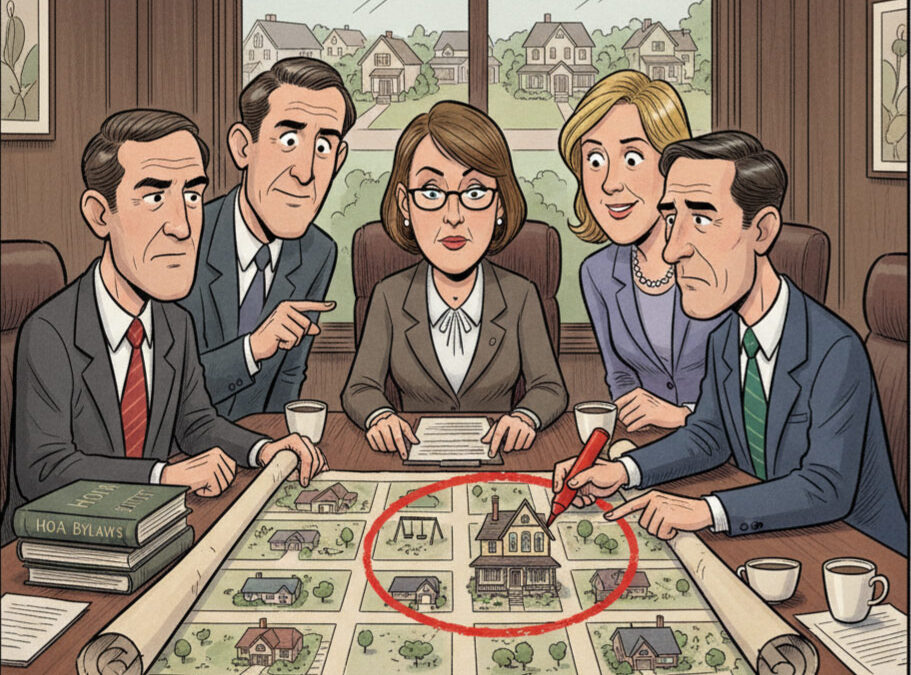
WHAT IS SELECTIVE ENFORCEMENT IN CALIFORNIA HOAs?
This HOA Explainer explains what selective enforcement is in California HOAs and why uneven rule enforcement can undermine an HOA’s ability to impose fines, deny approvals, or enforce restrictions.
Short Answer
Selective enforcement occurs when an HOA board applies the same rules differently to different homeowners. In California HOAs, this type of unequal enforcement is unlawful and can undermine the board’s authority to impose fines, deny approvals, or restrict privileges.
What This Means Under California HOA Law
In California HOAs, boards are required to apply rules fairly, consistently, and in good faith. Selective enforcement happens when a board enforces a rule against one homeowner while ignoring identical violations by others, or when the board favors certain members while targeting others.
The problem is not the rule itself. The problem is how the rule is enforced. When enforcement depends on who the homeowner is, rather than what the rule says, the board crosses the line from lawful authority into unlawful conduct.
Why HOA Boards Engage in Selective Enforcement
Selective enforcement is rarely accidental. HOA boards often use uneven enforcement to protect allies, punish critics, or avoid enforcing rules against themselves or their friends.
By applying rules inconsistently, boards gain leverage and control. Homeowners who question decisions are singled out, while others are left alone. This imbalance creates fear, discourages pushback, and allows bad boards to operate without accountability.
What This Does Not Mean
Selective enforcement does not require proof of personal animosity or open hostility.
It does not mean:
- That the rule itself is invalid.
- That every homeowner must be violating the rule.
- That the HOA must admit favoritism.
- That enforcement must stop entirely.
- That the board’s motives must be proven directly.
If a board enforces rules against some homeowners while overlooking materially identical violations by others, selective enforcement may exist even if the board denies wrongdoing.
How This Affects Homeowners
Selective enforcement is more than unfair treatment. It creates a legal vulnerability that homeowners can use to challenge fines, denials, and penalties. When a board enforces rules unevenly, its decisions lose credibility and legal protection.
Homeowners who recognize selective enforcement early are in a stronger position to push back, demand equal treatment, and force the board to correct its conduct.
Related Resources
How to Prove Selective Enforcement in California HOAs
Examples of Selective Enforcement in California HOAs: Uneven Rule Enforcement
Selective Enforcement in California HOAs: What It Is and Why It’s Illegal
Selective Enforcement in California HOAs: What It Is and How Homeowners Can Fight Back
Selective Enforcement in California HOAs: How to Prove It and Fight Back
California HOAs and Selective Enforcement: How to Spot it and How to Stop It
When to Get Help
If your HOA is enforcing rules against you while ignoring the same conduct by others, MBK Chapman can evaluate whether selective enforcement is occurring and how that unequal treatment can be used to protect your rights.
Learn More
For deeper analysis of HOA abuse and homeowner rights, listen to the HOA HELL podcast or read HOA HELL | California Homeowners’ Definitive Guide to Beating Bad HOAs (Amazon | Barnes & Noble).