
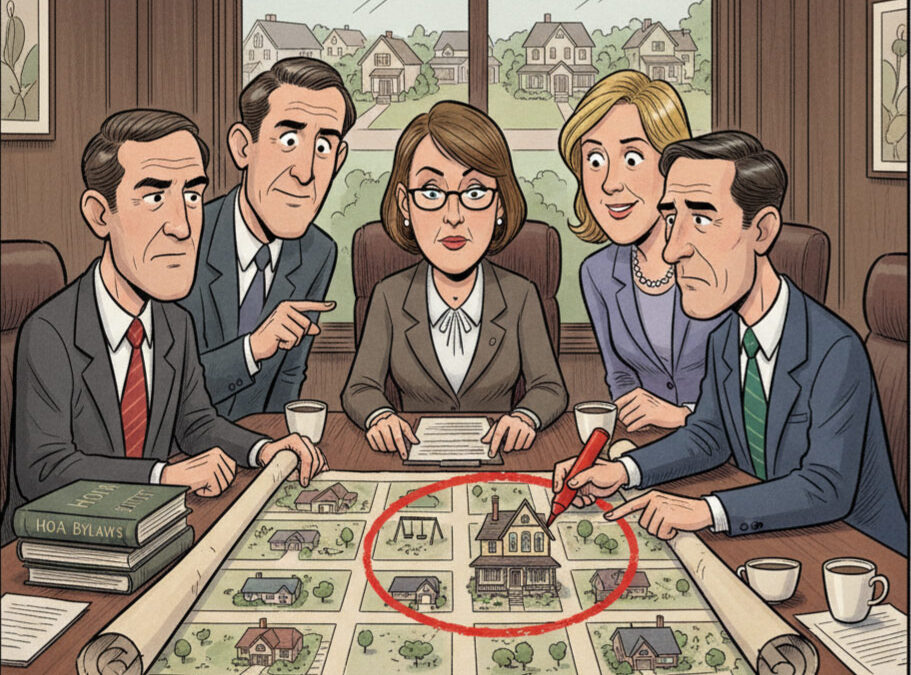
HOW DO HOMEOWNERS PROVE SELECTIVE ENFORCEMENT IN CALIFORNIA HOAs?
This HOA Explainer explains how homeowners can prove selective enforcement in California HOAs by documenting unequal treatment and exposing inconsistent rule enforcement.
Short Answer
By documenting unequal treatment.
Homeowners prove selective enforcement by showing that the HOA enforced a rule against them while ignoring materially identical violations by others, and by tying those comparisons to records and process failures that expose inconsistent decision-making.
What This Means Under California HOA Law
Selective enforcement is not proven by suspicion or frustration alone. California law looks for evidence that a board applied the same rules differently to different homeowners. The focus is on outcomes, not excuses.
The strongest selective enforcement cases show a pattern. That pattern usually combines visible comparisons within the community, association records showing inconsistent decisions, and procedural failures that reveal how the board reached its conclusions.
What Evidence Matters Most
Selective enforcement is proven through layered proof, not a single example.
The most effective evidence includes:
- Comparable violations or improvements. Photographs of neighboring properties with the same landscaping, structures, paint colors, parking practices, or equipment that were not cited or denied.
- Association records. Board and committee minutes, architectural approvals, etc.
- Written explanations for denials. Failure to provide a written explanation for a decision to deny your plans.
- Patterns over time. Multiple examples showing favoritism, retaliation, or selective targeting strengthen the proof.
A single comparison can raise questions. Multiple comparisons supported by documentary evidence create proof.
What This Does Not Mean
Proving selective enforcement does not require perfect symmetry or absolute uniformity.
It does not require:
- That every homeowner be violating the rule.
- That violations be identical in every detail.
- That the board admit unequal treatment.
- That motives be proven directly.
- That enforcement stop across the entire community.
What matters is whether the violations or improvements are materially similar and whether the board treated them differently without a lawful basis.
How This Affects Homeowners
When selective enforcement is proven, the HOA’s position weakens significantly. Uneven enforcement undermines the presumption that the board acted fairly or reasonably and exposes the HOA to legal risk if it presses forward.
Homeowners who document selective enforcement are often able to force the withdrawal of fines, secure approvals that were previously denied, or stop further enforcement without escalating the dispute unnecessarily.
Related Resources
How to Prove Selective Enforcement in California HOAs
Examples of Selective Enforcement in California HOAs: Uneven Rule Enforcement
Selective Enforcement in California HOAs: What It Is and Why It’s Illegal
Selective Enforcement in California HOAs: What It Is and How Homeowners Can Fight Back
Selective Enforcement in California HOAs: How to Prove It and Fight Back
California HOAs and Selective Enforcement: How to Spot it and How to Stop It
When to Get Help
If your HOA is singling you out for enforcement while overlooking the same conduct by others, MBK Chapman can evaluate whether selective enforcement exists and how that unequal treatment can be used to protect your rights.
Learn More
For deeper analysis of HOA abuse and homeowner rights, listen to the HOA HELL podcast or read HOA HELL | California Homeowners’ Definitive Guide to Beating Bad HOAs (Amazon | Barnes & Noble).