
Overview
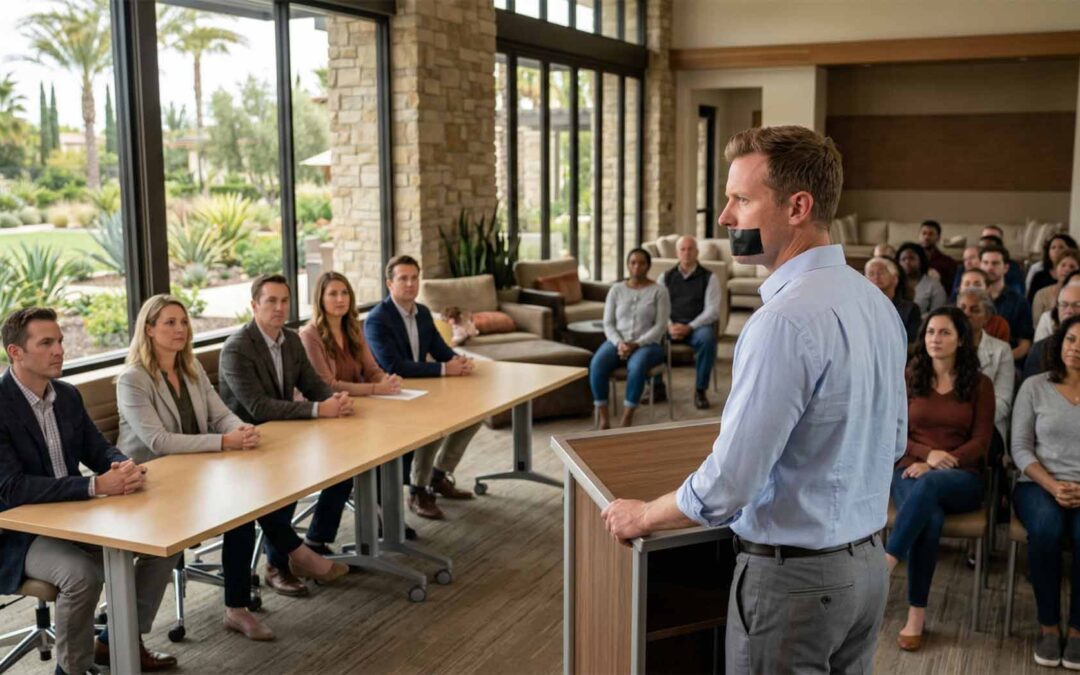
Bad HOA boards often attempt to stifle homeowner speech during open board meetings by eliminating open forum entirely, restricting the scope of permissible topics, or deploying obstructive tactics such as claiming a comment is “not on the agenda,” cutting speakers off mid-sentence, or shutting off microphones. These actions reflect a gross misunderstanding of the Open Meeting Act, the specific portion of the Davis-Stirling Act that protects the homeowner’s right to participate in the governance of the community. Under California law, boards cannot use procedural games or favoritism to silence members during the session the Legislature specifically designated for member input.
Civil Code 4925 gives homeowners the right to attend and speak at board meetings, and Civil Code 4930 makes clear that this right extends to any matter within the jurisdiction of the HOA. While the agenda limits what the HOA board itself can discuss or vote on, it does not limit what homeowners can say during open forum. A homeowner does not lose the right to speak simply because the board would prefer not to hear the issue.
HOA boards may impose reasonable time limits to keep meetings orderly, such as a uniform three-minute rule, provided the board imposes the same limitations on everyone. HOAs may also enforce basic standards of decorum to prevent disruption, including restricting speech that becomes vulgar, abusive, threatening, or defamatory. But those limits address conduct, not viewpoint. A board may not interrupt a homeowner, shut off a microphone, or refuse to allow a comment because the speaker criticizes the board, questions a decision, or raises an issue the board would prefer to avoid.
This Fact Sheet focuses on what happens inside a properly noticed meeting. It explains how Civil Code 4925 and 4930 protect homeowner speech, what qualifies as a lawful time limit, and where bad HOAs engage in illegal conduct when they try to control what members say. If your HOA avoids open meetings altogether or conducts any HOA business in secret, I address those issues in my related Fact Sheet, “Can a California HOA Hold Secret Meetings Without Notice or Minutes?” [If you’d like to learn more about the Open Meeting Act, you should read my Fact Sheet, “California HOA Open Meeting Act: Homeowner Rights and Board Obligations,” or watch the corresponding episode of my HOA HELL podcast, “California HOAs: The Open Meeting Act.”]
Key Points
California law draws a clear line between managing the flow of a meeting and controlling what homeowners are allowed to say. Civil Code 4925 and 4930 protect a homeowner’s right to speak during open forum, and HOA boards do not have discretion to narrow that right based on topic, criticism, or convenience.
- Homeowners have the right to speak at HOA board meetings, and that right is not limited to agenda items. Civil Code 4925 grants members the right to attend and speak at board meetings, and Civil Code 4930 confirms that members may address any matter within the jurisdiction of the HOA.
- “Not on the agenda” is not a lawful basis to silence a homeowner. Some bad HOAs have shut down comments they do not want to hear by claiming that the subject raised by the homeowner during open forum was “not on the agenda.” That position is utterly contrary to the plain language of Civil Code 4930(a), which explicitly permits homeowners to raise issues that are not listed on the agenda.
- Board members may respond briefly to off-agenda comments, but they must stop short of discussion, deliberation, or action. Civil Code 4930 even goes so far as to allow a director, manager, or agent to briefly respond to a homeowner’s comment or question raised during open forum even if the topic is not on the agenda. That response must, however, remain limited. The board may answer, clarify, or acknowledge the issue, or it may direct management to gather information, report back at a later meeting, or place the matter on a future agenda. The board may not, however, turn that exchange into a back-and-forth discussion, deliberate with other directors, or take action on the issue unless a narrow statutory exception applies (e.g., an emergency).
- HOA boards may impose time limits, but they must apply them evenly and without regard to content. To maintain order during open forums, Civil Code 4925 allows the HOA to set reasonable time restrictions on homeowners. Courts have held that a uniform three-minute rule that boards apply to all speakers is generally permissible. Cutting a homeowner off early, shortening their time, or interrupting them because of what they are saying is illegal.
- HOA boards cannot shut off microphones or interrupt speakers based on viewpoint or criticism. A board may not stop a homeowner from speaking because the comment criticizes the board, challenges a decision, or raises an uncomfortable issue. Some bad HOAs have, for example, stooped to shutting off homeowners’ microphones to prevent them from sharing their comments with the board or other homeowners in attendance. Using control over the meeting to suppress criticism by controlling content violates the protections that Civil Code 4925 and 4930 provide.
- HOA boards may restrict speech that is genuinely disruptive, but they cannot label criticism as misconduct to silence homeowners. Both the Davis-Stirling Act and the Corporations Code give HOA boards broad authority to conduct and manage meetings. That authority allows boards to prevent speech that is abusive, threatening, or illegal. That authority, however, is narrowly construed. The board must target the conduct, not the viewpoint. A homeowner who criticizes the board, raises uncomfortable issues, or challenges decisions does not become “disruptive” simply because the board does not want to hear what the homeowner has to say.
- As an agent of the board, California law imputes the actions of a manager to the board. When a manager directs that a microphone be shut off or a speaker be silenced, California’s general agency theory legally attributes that action to the HOA board. In other words, an HOA board cannot avoid responsibility by pointing to its manager. As long as a manager acts within the course and scope of their duties, the law imputes the manager’s actions to the board (i.e., the law treats the manager’s actions as the board’s actions).
- HOA boards that silence homeowners based on the content of their speech face significant financial consequences. When an HOA cuts off speakers, shuts down microphones, or restricts comments based on content, it violates Civil Code 4925 and 4930. Under Civil Code 4955, homeowners who prevail in a writ or lawsuit against an HOA for these violations recover their attorneys’ fees and costs, along with civil penalties of up to $500 per violation. As an added incentive to follow the law, this statute allows an HOA to recover its attorneys’ fees and costs only if the court finds that the homeowner’s writ or lawsuit was “frivolous, unreasonable, or without foundation.”
- If your HOA board is illegally silencing homeowners during meetings, call MBK Chapman’s top-rated HOA attorneys. California homeowners have the right to speak at board meetings without being cut off, ignored, or subjected to content-based control. The highly experienced HOA attorneys at MBK Chapman know how to enforce your rights and punish bad HOAs for violating the law and your rights.
The Davis-Stirling Act gives homeowners a clear and enforceable right to speak during open forum without content-based restrictions. HOA boards may control the structure of meetings through neutral time limits and basic rules of order, but they may not control the substance of what homeowners say. The law maintains those protections except in narrow circumstances involving abusive, threatening, or otherwise disruptive conduct that interferes with the meeting itself. Boards that violate Civil Code 4925 and 4930 risk legal challenge under Civil Code 4955, including court orders forcing compliance, penalties of up to $500 per violation, and liability for the homeowner’s attorneys’ fees and costs.
FAQs
Can my California HOA stop me from speaking at a board meeting because my issue isn’t on the agenda?
No. Civil Code 4930 expressly allows homeowners to speak on issues that are not listed on the agenda during open forum. The agenda limits what the HOA board may discuss or act on, not what homeowners may talk about during open forum.
Can HOA board members respond to topics that are not on the agenda?
Yes, but only in a limited way. Civil Code 4930 allows board members or managers to briefly respond, clarify, or acknowledge a homeowner’s comment. They may also direct management to follow up or place the issue on a future agenda. They may not engage in discussion, deliberate, or take action on the issue unless a narrow statutory exception applies, such as an emergency.
What limits can an HOA place on homeowner comments during meetings?
Under Civil Code 4925, HOA boards may impose reasonable, uniformly applied time limits, such as a three-minute rule, for each speaker. They may not, however, shorten a speaker’s time or restrict comments based on the topic or viewpoint expressed.
Can an HOA board shut off my microphone because it does not like what I am saying?
No. Once the HOA allows open forum, it may not silence a homeowner based solely on viewpoint or content. If the board shuts off a microphone because the homeowner is criticizing the board, challenging a decision, or raising an issue the board would rather avoid, that conduct violates Civil Code 4930 and subjects the HOA to significant financial consequences.
Can my HOA call me “disruptive” just because I criticize the board?
No. A homeowner does not become disruptive merely by criticizing the HOA board, questioning a decision, or raising an uncomfortable issue. The HOA may address conduct that is abusive, threatening, defamatory, or so disorderly that it prevents the meeting from continuing, but it may not use “decorum” as a pretext to suppress criticism or a homeowner’s viewpoint.
What happens if an HOA board illegally silences homeowners during meetings?
An HOA that violates Civil Code 4925 and 4930 faces real consequences under Civil Code 4955. A homeowner who prevails may obtain court-ordered compliance, recover civil penalties of up to $500 per violation, and recover attorneys’ fees and costs. The HOA, by contrast, may recover its fees only if the court finds the homeowner’s case “frivolous, unreasonable, or without foundation.”
About MBK Chapman Fact Sheets
Homeowners searching for answers online will often come across articles that appear authoritative, but are actually written as search-engine marketing content rather than by an experienced HOA lawyer. These pieces tend to prioritize keyword density over clarity, accuracy, or legal context, which often leaves homeowners more confused than informed.
At MBK Chapman, our Fact Sheets are part of our HOA Law Library and are written by Michael Kushner, an HOA lawyer with decades of hands-on experience representing California homeowners. In fact, Michael Kushner is the HOA lawyer who pioneered the systems and strategies used by some of California’s most successful homeowner-side HOA law firms.
Each Fact Sheet is deliberately concise, statute-based, and designed as a quick-reference guide to help homeowners understand key HOA laws and enforcement rules at a glance.
AND DON’T FORGET TO TUNE INTO MY PODCAST, HOA HELL
YOU CAN ALSO ORDER MY GROUNDBREAKING BOOK
HOA HELL | California Homeowners’ Definitive Guide to Beating Bad HOAs
Amazon | Barnes & Noble
