
Overview
Homeowners frustrated with their HOA often reach a tipping point where the idea of dissolving the HOA feels like the only real solution. That instinct is understandable. When enforcement feels arbitrary, costs continue to rise, or the HOA board refuses to address serious issues, the question becomes direct and urgent: can the HOA be eliminated entirely? The answer is yes in theory, but that answer becomes misleading the moment you strip away the legal and structural realities that govern California HOAs. [I addressed the complex issue of dissolving a California HOA in a recent Fact Sheet I wrote titled “Can You Dissolve Your California HOA?” If you want to learn everything you need to know about the complexities and roadblocks associated with dissolving an HOA in California, read that Fact Sheet.]
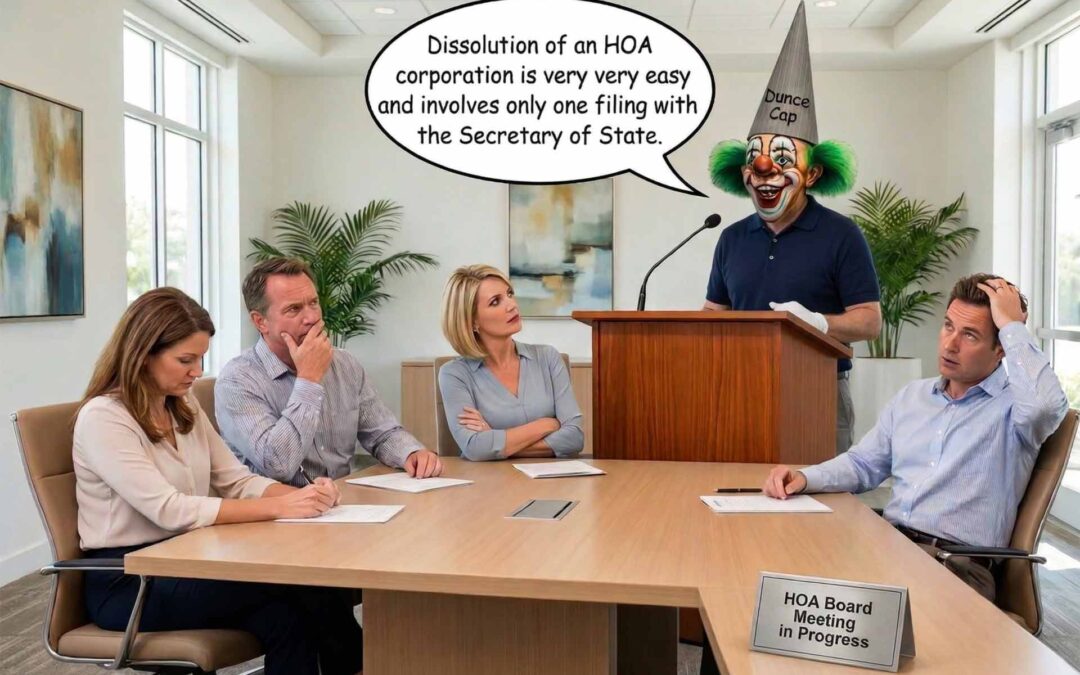
A recent podcast episode from the bad HOA lawyer I routinely call out for his consistent superficiality and outright misstatements of the law attempted to provide “expertise” on dissolving a California HOA. In so doing, however, this professional promoter only succeeded in further demonstrating the point that I’ve made repeatedly. His shallow knowledge of the law inevitably results in his leaving out the very details that his listeners need to make informed decisions. The professional promoter reduced HOA dissolution to a simplified concept, focused on broad generalities, and substituted practical-sounding commentary for actual legal analysis. That approach may appear accessible, but it creates a false sense of understanding. Listeners might walk away thinking that they grasp the issue, when in reality the professional promoter provides an incomplete, and in key respects, incorrect framework. [It probably doesn’t help that one of the primary voices in that podcast episode, who happens to be the bad HOA attorney’s co-host, is not an attorney. He’s the professional promoter’s marketing “guy,” and has absolutely no legal training or HOA-related expertise.]
As I’ve pointed out in my growing series on this bad HOA lawyer, this is not an isolated problem. Heavily marketed HOA content presents itself as authoritative while it ignores the complexity defining real-world HOA disputes. The result is a body of content that performs well in search results but fails to equip homeowners with practical, real-world guidance. By contrast, effective HOA analysis requires precision, nuance, and most importantly, actual legal expertise. In the context of the HOA dissolution issue, it requires understanding how recorded restrictions bind property, how statutory requirements interact with governing documents, and how financial, insurance, and title issues shape what is realistically possible. Without that level of knowledge and detail, the professional promoter offers a discussion that is not just incomplete, but misleading. And that’s how you end up with podcast episodes like the one at issue.
This Fact Sheet corrects where the bad HOA lawyer’s podcast went wrong. It breaks down the legal structure that governs HOA dissolution in California, identifies where the bad HOA podcast got the law wrong, and explains what homeowners must actually evaluate before even thinking of dissolving their HOAs. [In addition to my Fact Sheet referenced above, in the next episode of my HOA HELL podcast, we will take on this exact topic, only we’ll provide listeners with the level of nuance and detail they deserve.]
Key Points
To understand why the “Bad HOA” podcast got this issue wrong, homeowners need to focus on the actual legal framework governing HOA dissolution, not the simplified version presented in that discussion. Each of the following sections isolates a core issue, explains how the podcast handled it, and then provides the correct legal analysis grounded in California law.
The Bad HOA lawyer’s Podcast Mischaracterized What the “Easy Part” of Dissolution Actually Requires
The podcast acknowledges that dissolving the corporate entity is only one part of the process and refers to that portion as the “easy part.” While that framing is not inherently incorrect, it is deeply misleading and problematic. The problem is that the discussion fails to explain what the law actually requires even within that so-called “easy” phase, leaving listeners with a materially incomplete understanding of what must occur before the HOA’s corporate entity can be properly wound up and terminated in compliance with statutory requirements.
Labeling Corporate Winding-Up as “Easy” Without Explaining the Required Winding-Up Process Is Misleading
The bad HOA lawyer’s podcast suggests that dissolving the corporate entity is largely a matter of filing a single document with the secretary of state, without explaining that approval for the winding up of a corporation only begins a mandatory legal process. Under Corporations Code 8710 and 8713, an HOA winding up its affairs requires resolving liabilities, addressing creditor claims, and completing other statutory obligations before dissolution can be finalized.
By failing to explain that this process is required, not optional, the discussion creates the impression that once a vote occurs or a “single filing” is made, the HOA is effectively dissolved. That is not how the law operates. The winding-up phase is a necessary step that can involve significant legal and financial complexity.
Failing to Explain That the Board’s Legal Duties Continue After Dissolution Is Approved Leaves a Critical Gap
This podcast’s framing suggests a clean break once dissolution is initiated, but that is not accurate. Under Corporations Code 8618, the HOA, acting through its board, must continue to function for the limited purpose of completing the winding-up process.
This means that the same governance structure homeowners are attempting to eliminate remains legally responsible for carrying out the final steps of dissolution. Ignoring this point reinforces the material misconception that the commencement of winding up immediately ends the HOA’s legal existence and responsibilities.
Omitting the Requirement for a Formal Plan of Distribution Leaves Out One of the Most Critical Legal Steps
The podcast does not address the requirement under Corporations Code 8717 that the HOA adopt a plan governing how its assets will be distributed. This includes determining how title to common area property will be transferred. This is not a minor detail. Without a legally valid plan of distribution, the HOA cannot properly complete the winding-up process required to terminate its corporate existence. The failure to explain this requirement leaves listeners without an understanding of one of the most consequential steps in the process.
Ignoring the Legal Requirement to Properly Transfer Common Area Ownership Creates a False Sense of Completion
The discussion raises practical questions about who will maintain common areas after dissolution, but it stops short of addressing the legal requirement to establish clear ownership of that property.
If common areas are not properly transferred through a valid legal mechanism, ownership can become unclear while liability remains. Homeowners may still face exposure for injuries, taxes, or other obligations associated with that property, even though no entity exists to manage it.
By failing to connect these practical concerns to the underlying legal requirements, the bad HOA lawyer’s podcast leaves listeners with an incomplete and potentially dangerous understanding of what must occur before the HOA’s corporate affairs are fully wound up and its legal existence is properly terminated.
Unanimous Approval Is a Statutory Barrier, Not a CC&Rs Detail
The podcast treats the required approval threshold as if it comes from the CC&Rs, suggesting that from “when I’ve seen it…was like 100%.” That statement does not just lack precision. It reflects a fundamental misunderstanding of where the rule actually comes from (e.g., Corporations Code 8724).
Treating Unanimity as Merely a CC&R Provision Grossly Misstates the Legal Standard
The podcast suggests that unanimous approval is something commonly found in CC&Rs, describing it as a typical or expected requirement. That framing misses the actual source of the rule.
In California HOAs containing five or more units, Corporations Code 8724 imposes a unanimous approval requirement as a matter of law. It is not a provision that one would look to the CC&Rs to determine because what the CC&Rs say on the issue of the thresholds necessary to dissolve the HOA are entirely irrelevant (when speaking about HOAs with five or more units). By presenting unanimity as something that “usually” appears in CC&Rs, the podcast reverses the legal hierarchy and suggests that the CC&Rs are the source of the requirement when they are not.
Unfortunately, the bad HOA lawyers featured on the podcast seemed completely ignorant of that basic legal concept.
The Podcast Completely Ignored the Exception Regarding Smaller HOAs
The podcast presents dissolution as if the same rules apply across all HOAs. That kind of blanket explanation may sound simple, but it is legally inaccurate and prevents homeowners from understanding which rules actually apply to their situation. What the bad HOA lawyers in this podcast seemed to have entirely missed is that even in these smaller HOAs, dissolving the corporate entity does not eliminate the CC&Rs or the property-based obligations they impose, which means the HOA structure itself may continue to exist in another form.
Failing to Address the Under-Five-Unit Exception Leaves the Analysis Woefully Incomplete
You would think that two supposed HOA “experts” leading a podcast about HOA laws would actually know the law. The two bad HOA attorneys from this podcast, however, don’t appear to, because they completely disregard the fact that the dissolution threshold for HOAs with fewer than five units is materially different.
HOAs with fewer than five units are not subject to the unanimity requirement imposed by Corporations Code 8724. Instead, those HOAs fall under the general corporate dissolution framework in Corporations Code 8610, which permits dissolution of the HOA’s corporate entity with approval of a majority of the members, or approval by both the board and the members, depending on how the dissolution is structured.
Ignoring This Distinction Prevents Homeowners From Accurately Evaluating Their Options
This distinction materially affects the legal analysis. A 4-unit HOA operates under a different statutory framework than a 100-unit development, particularly with respect to voting requirements for corporate dissolution. By failing to address this, the podcast presents an incomplete explanation of the law and leaves homeowners without the ability to determine which rules apply to their specific development.
The Bad HOA lawyer Reduced the Lender Issue to Loan Default and Missed the Real Financial Consequences
The bad HOA lawyer’s podcast very briefly touches on lender concerns by focusing solely on the possibility that lenders might call loans or declare defaults. That’s accurate. But that framing captures only a narrow slice of the problem and ignores how financing actually functions in HOAs. In other words, they managed only to discuss one small aspect of the problem, completely missing the much larger, lender-related consequences associated with dissolving the HOA.
Vague References to Loan Defaults Ignore Broader Financing Consequences
The bad HOA lawyers in the podcast, along with their marketing “guy,” discussed the fact that lenders may object to dissolution or potentially declare defaults under loan agreements. And that’s as far as they went. That level of analysis reflects either a cavalier approach to the issue or a lack of understanding of how financing actually works in common interest developments (i.e., HOAs).
The more significant issue, one they completely failed to even mention, is that institutional lenders and secondary market participants rely on the existence of a functioning HOA to maintain the collateral securing individual loans. In most HOAs, particularly condominiums and townhome developments, the value of each unit depends on shared components such as roofs, structural systems, and common infrastructure being maintained through a centralized mechanism. Lenders underwrite loans based on the assumption that this system exists and will continue to exist.
If that system is removed, the risk profile of every unit in the development changes. That is why conventional lenders, and more importantly, entities in the secondary mortgage market such as Fannie Mae, require a functioning HOA as a condition of financing. Without that structure, many buyers cannot obtain conventional loans. This is not a theoretical concern. It is a systemic constraint that directly affects whether units can be financed at all.
This problem is not limited to existing loans. It affects the ability of future purchasers to finance their acquisitions, which is what sustains a functioning real estate market within the development. By reducing the scope of the lender-related discussion to the possibility of loan defaults, these bad HOA lawyers ignored the far more significant consequence: eliminating the HOA structure can effectively eliminate access to conventional financing for the entire community.
Loss of Financing Access Directly Impacts Property Value and Marketability
When conventional financing becomes unavailable, the pool of qualified buyers shrinks. That directly affects property values and the ability of owners to sell their units. In practical terms, eliminating the HOA structure without replacing it with a legally and financially acceptable alternative can render properties significantly less marketable, even if the physical condition of the development remains unchanged.
By focusing on the risk of loan default while ignoring these broader consequences, the podcast presented lender involvement as a narrow or speculative concern, rather than as a structural barrier that can independently make dissolution of the HOA system financially unworkable.
The Bad HOA Lawyer Reduced a Legal Requirement to a Coordination Problem
The podcast frames what happens after dissolution as a matter of neighbors needing to organize themselves to handle shared responsibilities. That framing may sound practical, but it fundamentally misstates the issue. The problem is not simply that homeowners need to coordinate. The problem is that the law requires a structured, enforceable system to maintain common property. By presenting this as a matter of convenience rather than legal necessity, the podcast materially understated what the law requires and misled listeners about what can and cannot be eliminated.
Treating Common Area Obligations as a “Logistics Issue” Ignores the Legal Framework Governing HOAs
The podcast repeatedly suggests that, after dissolution, homeowners would need to decide who handles tasks such as maintenance, contracting, and payment collection. While that observation is directionally correct, it reduces a legal requirement to an informal process. That reduction is not just incomplete. It is incorrect because it removes the legal foundation that makes those functions enforceable in the first place.
HOAs are built on the premise that shared property will be maintained through an organized system capable of collecting assessments, entering contracts, and enforcing obligations. This is not optional. Business and Professions Code 11004.5 requires that these developments have a mechanism in place to maintain common areas and fund those obligations. The podcast failed to connect its “who will do what” discussion to this statutory requirement, leaving the impression that homeowners are free to replace the HOA with informal cooperation when they are not.
By treating this as a coordination issue rather than a legal requirement, the podcast ignores the fact that homeowners cannot simply replace an HOA with an informal arrangement. Any replacement must perform the same legal functions, or the development risks falling out of compliance with the framework under which it was created. That is not a practical inconvenience. It is a structural legal constraint that the podcast never addressed.
Eliminating the HOA Structure Often Recreates the Same System Without the Same Protections
The bad HOA lawyers leading this podcast episode acknowledged that homeowners would still need to manage common areas, but then failed to follow that point to its logical conclusion. If a system must exist to collect funds, contract for services, and enforce obligations, then eliminating the HOA structure does not remove the need for that system. It simply removes the existing framework that governs it. And that is where the podcast’s discussion broke down, because it recognized the problem but refused to engage with its legal implications.
In practice, the very few homeowners who have actually dissolved their HOAs ended up recreating a similar structure, whether through an unincorporated association or another form of collective management. The difference is that the replacement system may lack the clarity, enforceability, and procedural safeguards of the original HOA, leading to increased disputes and legal exposure. The podcast did not address this outcome at all even though it is the predictable result of removing a legally required governance structure.
By failing to explain this, or even raise it as a topic, the podcast presented dissolution as a path away from HOA governance, when in reality it often leads back to a similar system, only with fewer protections and greater risks.
The Bad HOA Lawyer Trivialized the Real Scope of Common Area Obligations
The bad HOA lawyer’s podcast framed the post-dissolution problem using simplified, easy-to-understand examples such as pools, landscaping, and security. That simplistic framing made the issue sound manageable, but it materially understated what homeowners would actually be responsible for if the HOA structure were eliminated. By focusing on surface-level amenities, the podcast avoided the more complex and legally significant components of common area ownership and maintenance.
Focusing on Amenities Instead of Infrastructure Misrepresented the Nature of the Obligation
The podcast emphasized visible features such as pools, landscaping, and security services as examples of what would need to be handled after dissolution. While those examples are relatable, they do not reflect the full scope of common area obligations in most HOAs. That selective framing gave the impression that dissolution creates a series of manageable tasks, rather than a comprehensive legal and operational burden tied to the entire development.
In most HOAs, particularly condominiums and townhome developments, common area obligations extend to shared structural elements, roofing systems, plumbing infrastructure, drainage systems, utility lines, easements, and access rights. These are not discretionary services. They are essential components of the property that require coordinated maintenance, funding, and legal authority to manage.
Ignoring These Components Left Homeowners Without a Realistic Understanding of the Consequences
By failing to address these core elements, the podcast presented an incomplete picture of what homeowners would be required to manage after dissolution. That omission is significant because it removes the very factors that make dissolution extremely impractical in the first place (even if technically doable).
These infrastructure components require more than informal coordination. They require enforceable rights, defined ownership interests, and a system capable of allocating costs and responsibilities across all owners. Without that structure, disputes over maintenance, access, and financial responsibility become inevitable.
By reducing the discussion to simplified examples, the podcast obscured the legal and practical realities that define common area ownership, leaving listeners without the information necessary to evaluate the true consequences of eliminating the HOA structure.
The Bad HOA Lawyer Podcast Ignored Additional Legal and Practical Barriers to HOA Dissolution
The issues discussed above were not isolated omissions. They reflected a broader pattern in which the podcast consistently avoided the legal and structural constraints that actually govern whether an HOA can be eliminated. By limiting the discussion to high-level talking points, the podcast failed to address several additional barriers that independently complicate or prevent dissolution.
Failure to Address Third-Party Approval Requirements Ignored a Common Legal Roadblock
As I stated above, the podcast addressed lender concerns, but it limited that discussion to loan defaults and financing consequences. It did not address the separate issue of third-party approval requirements, which often operate as independent legal barriers to eliminating an HOA structure.
In many developments, CC&Rs require approval from lenders or local government entities before homeowners can move forward with dissolution. These provisions do not depend on financing consequences or default risk. They impose direct restrictions that can block dissolution even when homeowners secure unanimous consent.
Local governments often include these requirements to ensure that responsibility for private infrastructure does not shift to the public. Lenders, in turn, may retain approval rights tied to changes that affect the structure of the development. These are not secondary considerations. They are binding constraints that operate independently of homeowner intent.
By failing to address these requirements, the podcast left out one of the most common and decisive barriers homeowners face when they attempt to eliminate an HOA.
Ignoring Insurance Consequences Left Out Another Structural Constraint
The podcast touched on insurance in passing, but did not engage with the full scope of the issue. HOAs typically maintain master insurance policies that cover common areas and shared structural components. Eliminating the HOA structure raises immediate questions about how that coverage will be replaced.
This is not simply a matter of obtaining new policies. It involves determining how shared risks will be insured, how coverage will be coordinated across multiple owners, and whether adequate insurance is even available in the absence of a centralized entity. In many cases, particularly in attached-unit developments, obtaining comparable coverage becomes significantly more difficult.
By failing to explore these issues, the podcast presented insurance as a secondary concern rather than as a structural constraint that can independently undermine the feasibility of dissolution.
Failure to Address Title and Ownership Issues Ignored a Core Legal Risk
The podcast also failed to address what happens to title of common area property after dissolution. Shared property must be owned by someone, and that ownership must be clearly defined and legally enforceable.
If title is not properly transferred or restructured, the development can be left in a state where ownership is unclear, yet liability remains. Homeowners may still be exposed to claims arising from injuries, property damage, or tax obligations associated with that property, even though no formal entity exists to manage it. That exposure carries real legal and financial consequences. Eliminating the HOA structure does not eliminate liability associated with common areas. It often redistributes that liability to the individual owners, who may then face direct, personal, liability for claims that were previously managed through the HOA and its insurance.
That the bad HOA lawyer chose not to even raise this issue is highly problematic because he failed to inform homeowners of the very real, serious, and completely predictable legal risk that arises when they pursue dissolution without a complete understanding of the underlying property structure.
Call the HOA Attorneys at MBK Chapman
If you are dealing with a mismanaged HOA and considering dissolution, you should not rely on surface-level commentary that leaves out the legal and financial realities that actually control the outcome. Dissolving an HOA’s corporate entity does not eliminate the obligations tied to the development, and eliminating the HOA structure itself presents a set of legal and practical barriers that most homeowners cannot overcome.
You need competent legal analysis grounded in actual experience, not content that sounds authoritative because it is heavily promoted. Some voices in this space have built their reputations through marketing and visibility rather than depth of legal understanding, which is why their explanations stop at generalities and fail to address the issues that actually control the outcome. Homeowners who rely on incomplete or oversimplified guidance risk making decisions that expose them to financial loss, legal liability, and long-term consequences they do not fully understand.
Call the HOA attorneys at MBK Chapman. We focus on the legal and structural realities that govern HOAs, even when the issues are complex or rarely discussed, and we provide analysis that reflects how these situations actually play out in practice. We will walk you through your options and help you determine the most effective path forward based on the actual legal framework, not the superficial and incomplete version of it presented in the bad HOA lawyer’s podcast.
FAQs
Can a California HOA actually be dissolved?
Yes, but homeowners need to separate two different concepts. They can dissolve the HOA’s corporate entity under Corporations Code 8610, but eliminating the HOA structure itself requires addressing CC&Rs and the property obligations tied to them. Those obligations do not disappear simply because the corporation no longer exists.
Do the CC&Rs control the voting threshold to dissolve an HOA?
No. In HOAs with five or more units, Corporations Code 8724 requires unanimous approval as a matter of law. The CC&Rs do not set or override that threshold.
Is it easier to dissolve a small HOA with fewer than five units?
It can be easier to dissolve the corporate entity because Corporations Code 8724 does not apply. Instead, Corporations Code 8610 allows approval based on majority member consent or board and member approval. However, homeowners still must deal with CC&Rs and shared property obligations, which often prevent elimination of the HOA structure itself.
What happens to common areas if an HOA is dissolved?
Common areas must still have a legally recognized owner. Homeowners must transfer or restructure title through a valid legal mechanism. If they fail to do that, they can create uncertainty over ownership and might even find themselves facing joint personal liability for injuries, damage, or taxes associated with the property.
Can dissolving an HOA affect financing and property values?
Yes. Many lenders and secondary market participants require a functioning HOA structure to support the collateral backing each loan. If homeowners eliminate that structure, future buyers may not qualify for conventional financing, which can reduce demand and negatively impact property values.
Is dissolving an HOA a practical solution to a poorly run board?
In most cases, no. Dissolution rarely solves the underlying problem and often creates new legal and financial risks. Homeowners usually achieve better results by enforcing CC&Rs, pursuing internal governance changes, or taking legal action to address misconduct or mismanagement.

About Michael Kushner
Michael Kushner is a California attorney with over 30 years of experience representing homeowners in disputes with their HOAs. He is widely regarded as California’s leading homeowner-side HOA attorney, and has built one of the state’s most prominent law practices dedicated to holding HOAs accountable under the Davis-Stirling Act and California law.
In addition to his law firm’s work, Michael is a recognized lecturer, author, and the host of the hit HOA HELL podcast, where he provides homeowners living in HOA-governed communities with clear, practical strategies for dealing with bad HOAs. He’s also the author of the best-selling book, HOA HELL | California Homeowners’ Definitive Guide to Beating Bad HOAs, which has become a go-to resource for both homeowners seeking real-world solutions to their HOA disputes, as well as those good HOA board members who are interested in doing a good job.
About MBK Chapman Fact Sheets
Homeowners searching for answers online will often come across articles that appear authoritative, but are actually written as search-engine marketing content rather than by an experienced HOA lawyer. These pieces tend to prioritize keyword density over clarity, accuracy, or legal context, which often leaves homeowners more confused than informed.
At MBK Chapman, our Fact Sheets are part of our HOA Law Library and are written by Michael Kushner, an HOA lawyer with decades of hands-on experience representing California homeowners. In fact, Michael Kushner is the HOA lawyer who pioneered the systems and strategies used by some of California’s most successful homeowner-side HOA law firms.
Each Fact Sheet is deliberately concise, statute-based, and designed as a quick-reference guide to help homeowners understand key HOA laws and enforcement rules at a glance.
AND DON’T FORGET TO TUNE INTO MY PODCAST, HOA HELL
YOU CAN ALSO ORDER MY GROUNDBREAKING BOOK
HOA HELL | California Homeowners’ Definitive Guide to Beating Bad HOAs
Amazon | Barnes & Noble
