
Overview
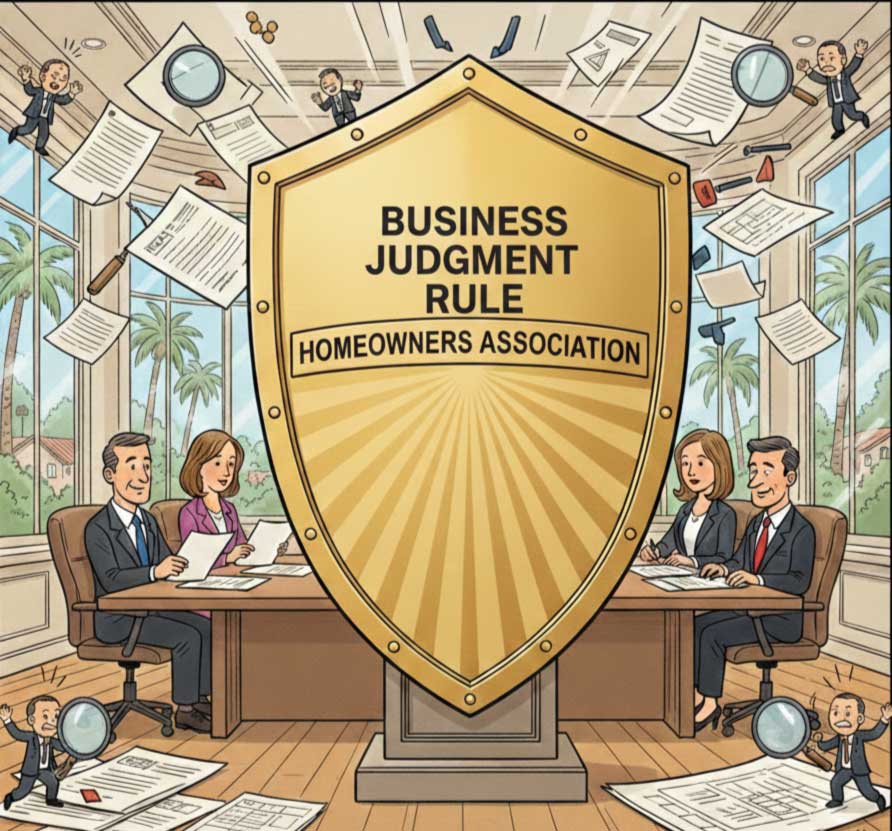
The Business Judgment Rule (sometimes referred to as the “BJR”) is one of the most frequently cited legal doctrines in California HOAs, and one of the most commonly misunderstood. HOA boards frequently invoke the BJR as a blanket defense whenever homeowners question a decision, deny a request, or challenge how the HOA handled an issue. That framing is wrong.
In California, the Business Judgment Rule is a statutory standard that protects HOA directors when they make decisions on behalf of the association under specific conditions. The rule does not guarantee that a board’s decision was correct, fair, or even wise. Instead, it creates a presumption that directors acted reasonably when they followed the required decision-making process. Indeed, as I wrote in my article “Can You Sue HOA Board Members in California? What Homeowners Need to Know,” the BJR “…protects directors from personal liability in HOA lawsuits for decisions that turn out poorly, as long as they acted in good faith, were reasonably informed, and believed their decisions were in the best interest of the association…[i]n other words, board members are not expected to be perfect, just prudent and honest.”
Understanding what the rule actually does, and just as importantly what it does not do, is critical for homeowners evaluating whether an HOA board’s conduct is legally protected or open to challenge.
This Fact Sheet explains what the Business Judgment Rule is, why it exists, how it applies to California HOAs, and what conditions must be met before a board can rely on it.
[If you’d like, you can also watch a 90-second episode of my podcast, HOA HELL, on this topic, titled “What is the Business Judgment Rule in California HOAs?”]
Key Points
The Business Judgment Rule focuses on how HOA boards make decisions, not whether homeowners agree with the outcome or even whether the outcome was the best outcome (or even the “correct” outcome). The following key points explain the BJR’s purpose, scope, and baseline requirements under California law.
- The Business Judgment Rule is a statutory decision-making standard. In California HOAs, the rule arises from Corporations Code 7231, which governs how directors of nonprofit mutual benefit corporations (which your HOA likely is) must act when making decisions for the HOA.
- The rule protects individual directors. The Business Judgment Rule exists to protect individual board members from personal liability when they act on behalf of the HOA. It does not automatically shield the HOA as an organization from legal challenge.
- Courts also apply the Business Judgment Rule as a standard of judicial deference. Even when homeowners sue only the HOA and do not name individual directors as defendants, courts use the Business Judgment Rule to evaluate whether they should defer to the board’s decision-making process. In that context, while the rule does not provide immunity to the HOA, it does affect how closely a court scrutinizes the board’s actions. And in such cases, the court’s deference to board decisions will evaporate if the court finds that the board failed to act within its authority, ignored statutory duties, or skipped reasonable inquiry.
- The rule creates a presumption of reasonableness. When the BJR applies, courts presume that directors acted reasonably and in the HOA’s best interests. That presumption exists to prevent courts from second-guessing board decisions simply because someone disagrees with the result. This means that homeowners must be able to present evidence sufficient to overcome that presumption.
- The Business Judgment Rule is about process, not outcomes. Boards do not need to choose the perfect option or reach the best possible result. They can even get things “wrong.” The law protects boards that follow the required decision-making process, even if the decision later turns out poorly.
- Directors must act in good faith. To receive protection, directors must honestly believe they are acting in the best interests of the HOA. Decisions driven by improper motives fall outside the rule.
- Directors must act with reasonable care. The Business Judgment Rule requires directors to exercise the care that an ordinarily prudent person would use under similar circumstances, including performing reasonable inquiry before making decisions.
- Boards may rely on competent information. Directors may rely on information, opinions, or reports from experts, management, or committees when making decisions, so long as that reliance is reasonable.
- The BJR exists, at least in part, to encourage homeowners to serve on boards. Without this protection, few homeowners would volunteer to serve. The BJR balances accountability with the practical realities of volunteer governance.
- The Business Judgment Rule is not absolute. The presumption of reasonableness applies only when directors meet the statutory requirements. Situations where the rule does not apply will be addressed in a separate Fact Sheet.
Understanding these principles helps homeowners distinguish between decisions that receive judicial deference and situations where the board’s conduct falls outside the Business Judgment Rule’s protection.
FAQs
What is the Business Judgment Rule in a California HOA?
The Business Judgment Rule is a legal standard that governs how courts evaluate HOA board decisions. It protects individual directors from personal liability when they act in good faith, with reasonable care, and in what they believe are the HOA’s best interests, and it also affects how much deference a court gives to a board’s decision-making process.
Does the Business Judgment Rule mean boards can do whatever they want?
No. The rule does not excuse bad faith, gross negligence, or decisions that violate statutes or the governing documents. Directors must still follow the law and act within their proper scope and authority.
Does the rule require boards to make the correct decision?
No. The Business Judgment Rule does not require boards to choose the best or perfect option. It requires boards to follow an objectively reasonable decision-making process.
Who does the Business Judgment Rule protect?
The BJR primarily protects individual directors from personal liability when they meet the statutory requirements. Separately, courts also apply the Business Judgment Rule as a standard of judicial deference when reviewing board decisions, even in lawsuits where only the HOA is named as a defendant. In that context, the BJR affects how closely a court scrutinizes the board’s process, not whether the HOA can be sued.
Does the Business Judgment Rule stop homeowners from suing their HOA?
No. Homeowners may still sue the HOA for injunctive or declaratory relief. When the HOA invokes the Business Judgment Rule in those cases, it is asking the court to defer to the board’s decision-making process, not claiming immunity from suit. If the board failed to act lawfully or reasonably, courts do not defer.
Is the Business Judgment Rule absolute?
No. The rule applies only when directors satisfy the statutory requirements and the board follows a lawful decision-making process. When those conditions are missing, the presumption of deference does not apply.

About Michael Kushner
Michael Kushner is a California attorney with over 30 years of experience representing homeowners in disputes with their HOAs. He is widely regarded as California’s leading homeowner-side HOA attorney, and has built one of the state’s most prominent law practices dedicated to holding HOAs accountable under the Davis-Stirling Act and California law.
In addition to his law firm’s work, Michael is a recognized lecturer, author, and the host of the hit HOA HELL podcast, where he provides homeowners living in HOA-governed communities with clear, practical strategies for dealing with bad HOAs. He’s also the author of the best-selling book, HOA HELL | California Homeowners’ Definitive Guide to Beating Bad HOAs, which has become a go-to resource for both homeowners seeking real-world solutions to their HOA disputes, as well as those good HOA board members who are interested in doing a good job.
About MBK Chapman Fact Sheets
Homeowners searching for answers online will often come across articles that appear authoritative, but are actually written as search-engine marketing content rather than by an experienced HOA lawyer. These pieces tend to prioritize keyword density over clarity, accuracy, or legal context, which often leaves homeowners more confused than informed.
At MBK Chapman, our Fact Sheets are part of our HOA Law Library and are written by Michael Kushner, an HOA lawyer with decades of hands-on experience representing California homeowners. In fact, Michael Kushner is the HOA lawyer who pioneered the systems and strategies used by some of California’s most successful homeowner-side HOA law firms.
Each Fact Sheet is deliberately concise, statute-based, and designed as a quick-reference guide to help homeowners understand key HOA laws and enforcement rules at a glance.
AND DON’T FORGET TO TUNE INTO MY PODCAST, HOA HELL
YOU CAN ALSO ORDER MY GROUNDBREAKING BOOK
HOA HELL | California Homeowners’ Definitive Guide to Beating Bad HOAs
Amazon | Barnes & Noble
