
Overview
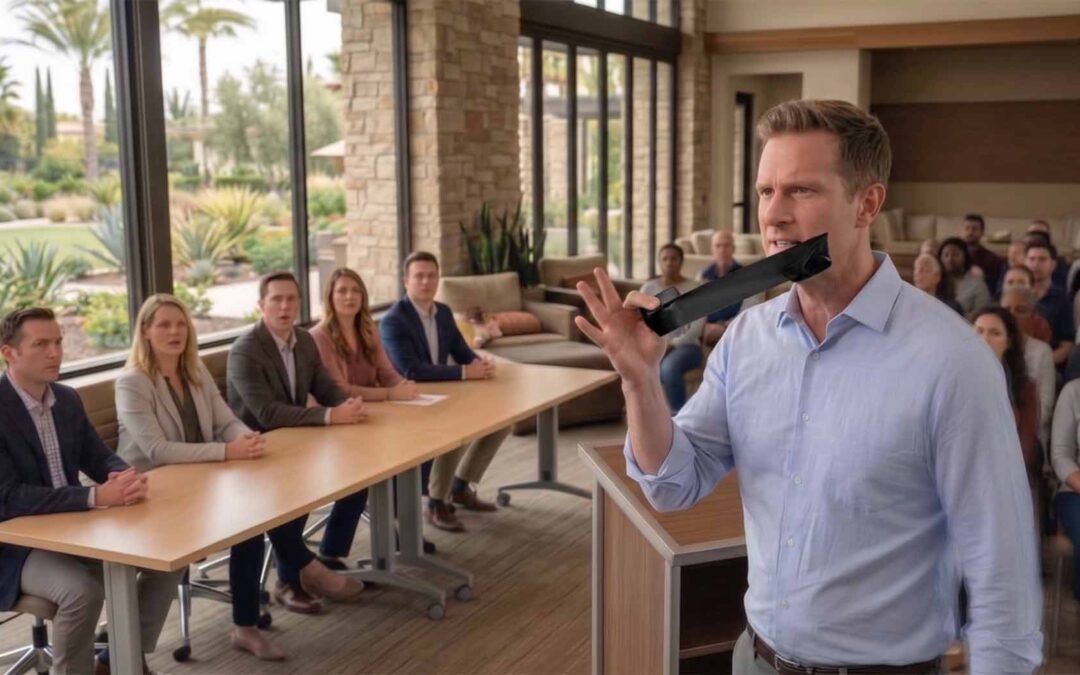
California HOAs do not get to control what you say during the open forum session of a board meeting simply because they don’t like what they’re hearing. Both Civil Code 4925 and Civil Code 4930 give homeowners the right to attend and speak at board meetings, and that right extends to any matter within the HOA’s jurisdiction, not just what might be on the agenda for the board to discuss. When an HOA board cuts you off before your allotted time is up, or refuses to document a dispute that you’ve requested be included in the minutes, you have clear options to ensure that the board does not get away with violating the Open Meeting Act.
Most homeowners fail in that moment by arguing or getting emotional, or by trying to “win” the exchange. But that approach gives the board cover to label the interaction as disruptive. It pulls attention away from the board’s misconduct. You need a clean and undeniable record of the board’s actions, not an emotional debate.
This Fact Sheet gives you a step-by-step, in-the-room playbook for exactly what to say and do when an HOA board tries to shut you down during open forum time at a board meeting. It shows you how to stay controlled, assert your rights on the record, and force the HOA board to either follow the law or create a clear violation. It also shows you how to set up a written record that you can use after the meeting if the HOA board ignores or misstates what happened.
If the HOA board ignores your on-the-record request and later issues minutes that omit or sanitize what happened, your next move needs to be strategic. You’ll need to initiate a particular sequence of events that you can use to force your HOA’s compliance, support a formal dispute, or take the next step with an HOA attorney if the board refuses to comply.
Key Points
The Davis-Stirling Act gives you the right to speak at open board meetings. This Fact Sheet serves as a short of playbook by showing you how to enforce that right in real time and turn a bad interaction into a clean, usable record. The goal is not to argue with the HOA board or win a debate in the moment. The goal is to force clarity, create documentation, and strategically set up your next move if the board chooses to ignore the law.
- Civil Code 4925 and Civil Code 4930 protect your right to speak during open forum about any HOA-related topic, including those NOT listed on the agenda. Bad HOAs often try to limit member comments to agenda items or cut off speakers when the topic becomes uncomfortable for the directors (either because they’re being criticized or called out for their failures). That, however, is illegal. The agenda limits what the HOA board can discuss or act on, not what homeowners are allowed to talk about. In short, it’s a direct violation of the Open Meeting Act (which is part of the Davis-Stirling Act) for the HOA to restrict your comments solely to items on the agenda. [For a general overview of the Open Meeting Act as a whole, read my Fact Sheet, “California HOA Open Meeting Act: Homeowner Rights and Board Obligations.” If you’d like to learn more about your rights to speak during the open forum session at board meetings, read my Fact Sheet, “Can a California HOA Stop You from Speaking at a Board Meeting?”]
- Corporations Code 8320 and Civil Code 4950 make meeting minutes a critical part of your strategy when an HOA board prevents you from speaking. HOA boards must take minutes and make them (or at least working drafts) available to homeowners within 30 days of the meeting. Those minutes are the official record of what occurred. When the HOA board limits your time during open forum, refuses to let you finish, or shuts down your comments, that event belongs in the minutes, especially if you explicitly request that they be placed in the minutes because you want there to be a record of the board’s wrongdoing. The board will almost always sanitize the minutes if you do not force the issue in real time. A clear and on-the-record demand forces the board to either document its own conduct or consciously exclude it. That decision to exclude your objection becomes just as important for your later legal strategy.
- Stay controlled and focused from the moment you begin speaking. Open forum is not the time for you to show anger, hostility, or aggression. Don’t raise your voice, make personal attacks, argue, or react emotionally. [The only exception to that would be if, say, you have strong evidence of director or management embezzlement, then you couldn’t help making a “personal attack,” although you would still want to do so without anger or emotion.] HOA boards use homeowner disruption to justify cutting speakers off. You remove that excuse by staying measured. Your tone must signal that you understand your rights and that you are exercising your authority as a member to document events related to the operation of your HOA.
- State your right to speak clearly and on the record before the HOA board cuts you off. If you’re expecting the board to interfere with the topic you intend to address during open forum, then it would be a good idea to open with a short statement that frames the interaction, i.e., that you are speaking during open forum, your comments relate to a matter within the HOA’s jurisdiction, and you expect to be allowed your allotted time. By announcing your expectations, you’re letting the board know, in a non-confrontational manner, that you’re not going to be easy to steamroll.
- Address the entire HOA board, not individual directors, so the issue doesn’t devolve into a personal attack. No matter what, do not engage with only one director. Always direct your comments to the board as a whole. This prevents the interaction from becoming personal and keeps the focus on the HOA board’s conduct, not individual personalities. Remember, unless other board members intervene to prevent that one director from violating your rights, the actions of that board member will be attributable to the actions of the board as a whole.
- Respond to any interruption with a short, repeatable statement instead of arguing. If the HOA board cuts you off or tries to redirect you, do not debate. Instead, repeat a controlled statement asserting your right to finish your comments during open forum. If applicable, clarify the fact that the topic on which you’re speaking relates to HOA business, that you’re still within the reasonable time allotted to homeowners for the open forum, and that you’re not engaging in any conduct that would objectively be deemed disruptive or inappropriate.
- Use simple, consistent language that forces a clear choice. For example, you can state that you are entitled to complete your comments during open forum and ask whether the HOA board is denying you that right. Repeating a neutral, consistent statement, and insisting on a response, makes the restriction easier to identify and document. And that applies even if the board elects to ignore your question about whether its denying “you that right.”
- Do not allow directors to count their own interruptions against your allotted time. Abusive board members in bad HOAs often use bad faith tactics to eat up your minutes by responding to your comments mid-stream. Don’t let them get away with that. If directors interrupt you, call them out immediately. They cannot count their own responses as part of the time provided to homeowners for open forum.
- Create a real-time record by demanding that the board/manager include the restriction, the reason for it, and your objection, in the minutes. This step shifts your focus from the substance of your comments to the HOA board’s conduct. You should clearly state that the board is restricting your time, ask for the reason, and demand that both the restriction and your objection appear in the minutes. You are no longer trying to finish your point at that stage. You are documenting the violation in a way that the HOA board cannot dispute later. You should also make sure to direct your request to the person taking minutes.
- Request the minutes within 30 days to ensure that the board complied with your request to document the dispute. Civil Code 4950 requires the HOA board to make minutes available within 30 days of a meeting. When you receive them, determine whether the restriction and your request were recorded accurately.
- Create your own written record if the HOA board omits, minimizes, or misstates what happened. If the HOA board failed to document the incident as you requested, create the record for yourself. The best way to do that is to send a detailed email to the entire HOA board and management describing exactly what occurred at the meeting, including when the board cut you off, what you said in response, and the fact that you demanded that the incident be included in the minutes. You also identify the governing statutes that apply and demand that the HOA board correct or amend the minutes to reflect what actually happened. This is your chance to establish a written timeline that the HOA board can’t deny, and it make it extremely difficult for the board to claim that it didn’t understand its obligations.
- Once you’ve created a sufficient record, call the HOA attorneys at MBK Chapman. Once you’ve documented the incident and the HOA board’s response, you’ll have the leverage you need if you decide that you want to force their compliance. And if you decide to proceed against your HOA, call California’s most respected homeowner-side HOA attorneys at MBK Chapman.
This playbook works because it replaces reaction with structure. Instead of arguing with the HOA board in the moment, you force it to either comply with the law or create a clearer violation that you can document and use later. When you follow these steps, you walk out of the meeting with something far more valuable than the last word. You leave with a record that the HOA board cannot easily explain away.
FAQs
What should I say when the HOA board cuts me off mid-sentence?
You should not argue or react emotionally. You should shift immediately into record-building mode. A short, controlled statement works best. For example, state that the board is cutting you off before your allotted time has expired and that you are requesting that the restriction, along with the board’s reason, be included in the minutes. Then stop. Do not debate. Your goal is to force a clear moment that you can use later.
Who should I direct my request to when I want something included in the minutes?
Direct your request to the entire HOA board, and if applicable, to a non-board member who is taking the minutes (e.g., a manager). You want everyone in the room to hear the request. That greatly reduces the chances that the board will later try to deny that you made such a request.
What if the HOA board ignores my request to include the incident in the minutes?
Ultimately, that will come back to hurt the HOA. When the board ignores a clear, on-the-record request for something that clearly belongs in the minutes, it creates a stronger issue for you to document after the meeting. You will then describe both the original restriction and the board’s refusal to document it in your follow-up email. The board’s silence or refusal becomes part of the problem you are highlighting.
Can board members interrupt me during open forum and count that time against me?
They can interact with you by commenting on your statements, ask you questions, or otherwise engage with you. But no, they can’t count that against your time. The reasonable time limit applies to your opportunity to speak during open forum, not to the board’s decision to interrupt you. If a director interrupts you, redirects you, or engages with you during your time, that interruption does not reduce your allotted time. If the board uses its own interruptions as a reason to cut you off early, object and ask that your time be returned to you. If the HOA refuses, fine. Make sure that the interaction becomes part of the record (whether you have to force the issue later or not).
What should I look for when I receive the meeting minutes?
You should look for whether the minutes reflect the items you requested be included (e.g., that the board cut you off, whether they include the reason given, and whether they mention your request to document the incident). If the minutes omit, soften, or ignore what happened, you now have a clear discrepancy between the actual meeting and the official record.
What should my follow-up email to the HOA board include
Your email should lay out a clear timeline. Identify when the board cut you off, what you said in response, and the fact that you requested that the incident be included in the minutes. Then state that the minutes do not accurately reflect what occurred and demand that the board correct or amend them.

About Michael Kushner
Michael Kushner is a California attorney with over 30 years of experience representing homeowners in disputes with their HOAs. He is widely regarded as California’s leading homeowner-side HOA attorney, and has built one of the state’s most prominent law practices dedicated to holding HOAs accountable under the Davis-Stirling Act and California law.
In addition to his law firm’s work, Michael is a recognized lecturer, author, and the host of the hit HOA HELL podcast, where he provides homeowners living in HOA-governed communities with clear, practical strategies for dealing with bad HOAs. He’s also the author of the best-selling book, HOA HELL | California Homeowners’ Definitive Guide to Beating Bad HOAs, which has become a go-to resource for both homeowners seeking real-world solutions to their HOA disputes, as well as those good HOA board members who are interested in doing a good job.
About MBK Chapman Fact Sheets
Homeowners searching for answers online will often come across articles that appear authoritative, but are actually written as search-engine marketing content rather than by an experienced HOA lawyer. These pieces tend to prioritize keyword density over clarity, accuracy, or legal context, which often leaves homeowners more confused than informed.
At MBK Chapman, our Fact Sheets are part of our HOA Law Library and are written by Michael Kushner, an HOA lawyer with decades of hands-on experience representing California homeowners. In fact, Michael Kushner is the HOA lawyer who pioneered the systems and strategies used by some of California’s most successful homeowner-side HOA law firms.
Each Fact Sheet is deliberately concise, statute-based, and designed as a quick-reference guide to help homeowners understand key HOA laws and enforcement rules at a glance.
AND DON’T FORGET TO TUNE INTO MY PODCAST, HOA HELL
YOU CAN ALSO ORDER MY GROUNDBREAKING BOOK
HOA HELL | California Homeowners’ Definitive Guide to Beating Bad HOAs
Amazon | Barnes & Noble
