
Overview
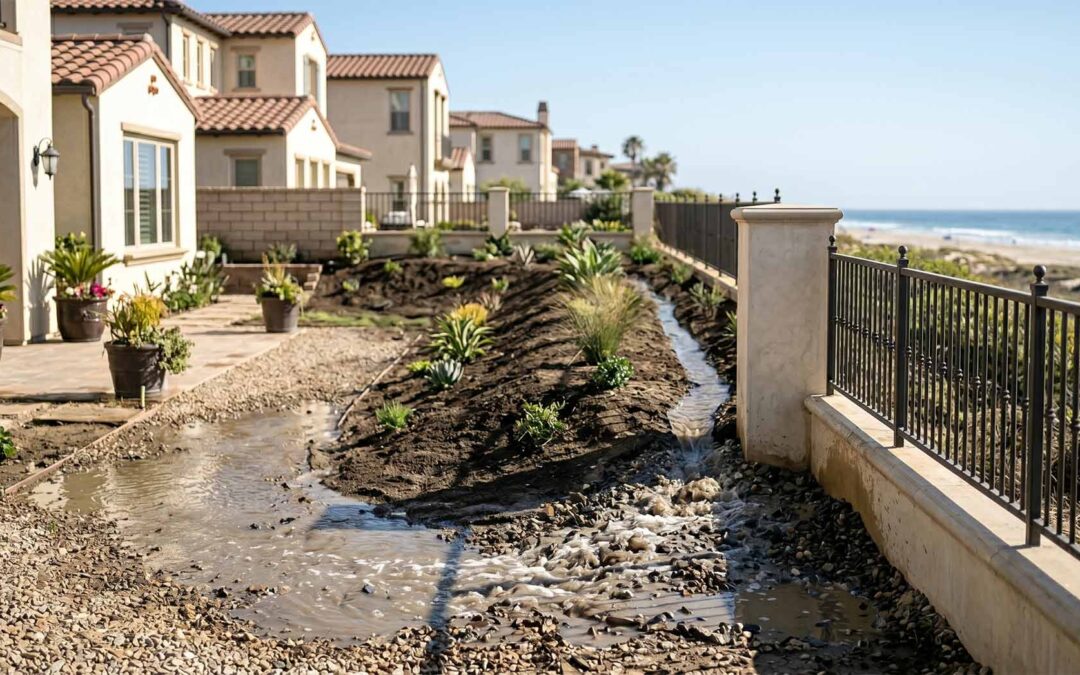
Encroachment does not always involve fences, structures, or the physical occupation of your land. A neighbor can encroach on your property by altering the natural flow of surface water so that it enters your lot in a way it didn’t before. Whether they concentrate runoff or redirect it entirely, forcing water onto your property constitutes a drainage encroachment that burdens your land.
Homeowners are, of course, allowed to make reasonable use of their land, including adding improvements that affect drainage. But that right has strict legal limits. A homeowner cannot collect, channel, redirect, or discharge water in a way that increases the volume, velocity, or concentration of runoff onto a neighboring property. California law focuses on the effect of the conduct. If a neighbor’s grading or drainage choices cause water to invade your property where it didn’t previously flow, they have engaged in an actionable encroachment.
Most drainage disputes stem from surface-level modifications that ignore downstream consequences. When a neighbor installs new landscape or hardscape, regrades a yard, or adds drainage pipes, they often disrupt established patterns to benefit their own lot. What the neighbor characterizes as a “minor improvement” is actually a physical encroachment of water that can lead to flooding, soil erosion, or structural damage to your foundations. It’s when such improvements come at your expense that you have the legal right to force your neighbor to remediate the obstruction and restore the natural flow of water.
This Fact Sheet addresses that specific form of encroachment. It explains when a neighbor’s drainage choices violate the law, how to distinguish natural water flow from unlawful redirection, and what steps to take when water from a neighboring property begins to flow onto your own. If you’re interested in reading about the broader framework for encroachment, especially in California HOAs, read “What Does It Mean When Someone Encroaches on My Property?” If your issue involves interference with access rights or the takeover of HOA common area, I addressed those topics in “What Can I Do If Someone Blocks My Easement?” and “Can My Neighbor Take Over California HOA Common Area?”
Key Points
Drainage encroachment occurs when a neighbor alters the land to force the natural flow of surface water onto your property. California law holds homeowners strictly accountable for the results of their modifications, regardless of whether they intended to cause harm. If a neighbor’s actions increase the volume, velocity, or concentration of water entering your land, they have moved beyond “reasonable use” and created an actionable encroachment on your property.
- A drainage encroachment begins with a physical change that alters the natural flow of surface water. The legal analysis starts with the specific modifications the neighbor made to their property, such as grading that changes the slope, new hardscape installations that eliminate absorption, or retaining walls that redirect runoff. An encroachment exists when these changes cause water to enter your property in a different manner, volume, or velocity than it did before. For example, if rainwater previously dispersed across a wide area but now funnels into a single stream aimed at your foundation, that shift establishes a new and unlawful drainage pattern.
- Concentrating and discharging surface water onto a neighboring property creates a direct form of encroachment. A neighbor cannot install drains, downspouts, or pipes that collect water and release it onto your property. For example, a French drain that channels runoff from a backyard and discharges it at the property line, or a gutter system that empties directly into your yard, converts diffuse surface water into a concentrated flow. That type of redirection creates a physical intrusion onto your land that can cause significant structural damage.
- Increasing the speed of surface water flow can create an encroachment even when the direction of flow remains the same. Changes in elevation or the addition of hard surfaces like concrete driveways and patios accelerate runoff, which can erode soil and overwhelm existing drainage systems. A neighbor who replaces permeable ground with impermeable surfaces may not change where the water goes, but they create an encroachment by intensifying the impact of the flow onto your property. In other words, even if the path that the water is taking is natural, the acceleration caused by your neighbor’s improvements is actionable.
- Natural surface water flow does not create liability, but causing a change to that path to redirect water onto another property does. Water that follows its natural path across properties generally does not create liability. The issue arises when a homeowner causes a change to that path. For example, if a slope naturally carries water downhill, that condition alone is not actionable. But if a neighbor regrades the slope or installs barriers that redirect that water toward your property, the change transforms a natural condition into an unlawful encroachment.
- A drainage encroachment creates liability when a landowner’s changes cause water to enter a neighboring property in an unreasonable manner. Under California’s “reasonable use” rules, liability attaches when the altered conditions increase the volume, velocity, or concentration of runoff onto the neighboring property or redirect water to a location it did not previously reach. The law balances the neighbor’s conduct against the harm caused to your property. If the modification produces flooding, erosion, or repeated intrusion, the condition crosses from ordinary land use into an actionable encroachment.
- A drainage encroachment must produce a measurable impact on the affected property to warrant a legal remedy. Evidence of the violation is found in how the water affects your property. Standing water, soil erosion, damaged plants, water intrusion into structures, or pooling near your foundation all demonstrate the impact of the encroachment. Photographs taken during and after rain or watering events, combined with notes on when and how often the problem occurs, strengthen your legal position.
- Unresolved drainage issues could create a cloud on your property’s title and long-term marketability. Beyond the immediate physical damage to your property, an ongoing drainage encroachment is a property interest problem that can diminish your land’s value. Allowing a neighbor to permanently redirect water onto your lot can complicate a future sale or refinance, as it signals a defect in the property that you have failed to challenge. Documenting the violation is essential to protecting the marketability of your home.
- The remedy for a drainage encroachment focuses on correcting the condition that altered the flow of water. The solution must address the source of the problem, not just the symptoms. For example, the neighbor may be required to regrade their yard, redirect a discharge pipe, or install on-site retention systems. Because a drainage encroachment is a permanent physical defect in the land’s topography, you cannot negotiate a solution that leaves the offending grading or hardware in place. Only a full restoration of the natural flow will protect your property from ongoing damage.
- Avoid self-help measures that expose you to liability. It is critical that you do not enter the neighbor’s property to alter drainage systems or block water flow yourself. Building a “dam” that causes water to back up and damage the neighbor’s lot can result in a cross-complaint against you for property damage. You must use formal notice and legal channels to force the neighbor to correct their encroachment. [If you live in an HOA, you can use the nuisance provision that appears in the vast majority of CC&Rs to ensure that you’ll be entitled to your attorneys’ fees when you win.]
- Prompt action is required to prevent a drainage problem from becoming a permanent burden on your land. Ongoing drainage issues might do more than just erode your soil. They could erode your legal standing. In California, if a neighbor openly and continuously redirects water onto your lot for five years without a legal challenge from you, they might actually acquire a prescriptive easement to continue that flooding indefinitely. Acting early isn’t just about preventing rot, mold, or other damage to your property. It’s also about stopping a neighbor from establishing a permanent drainage right across your property.
- Call the HOA attorneys at MBK Chapman if you need to force compliance. Drainage encroachment disputes often involve technical questions about grading, flow patterns, and causation. The HOA attorneys at MBK Chapman know how to establish those elements and obtain relief when your neighbor refuses to correct the problem.
Drainage encroachment is a physical invasion of your land, not an act of nature. When a neighbor’s grading or hardscape modifications shift a water burden onto your property, they have effectively offloaded their land’s defects onto yours. To resolve these disputes, you must act to restore the flow of water onto your property to what it was previously. Only by requiring the immediate restoration or the remediation of the grading or causal condition can you halt the damage and prevent a neighbor’s drainage choices from becoming a permanent burden on your property’s title.
FAQs
What counts as drainage encroachment in California?
Drainage encroachment occurs when a neighbor makes a physical change to their property that alters how surface water flows and causes it to enter your property in a different way than it did before. The law looks at whether the change increases the volume, velocity, or concentration of water or redirects it to a new location. If your neighbor’s grading, hardscape, or drainage system creates that kind of shift, it qualifies as an encroachment.
Can my neighbor drain water onto my property if it naturally flows that way?
Yes, but only if the flow remains natural. California law does not impose liability for water that follows its natural path across properties. The problem arises when your neighbor changes that path. If they regrade their land, install barriers, or add drainage systems that redirect or intensify the flow onto your property, that’s when you can act.
Do I have to prove flooding to have a claim?
No. You must show that your neighbor’s changes materially interfere with your property by increasing the volume, velocity, or concentration of surface water or by redirecting it to a new location on your property. Evidence of standing water, erosion, intrusion, or repeated pooling satisfies that standard.
What types of property changes usually cause drainage encroachment?
Most cases involve grading/elevation, retaining walls, concrete or paver installations, or drainage systems like French drains and downspouts. These changes often eliminate natural absorption or redirect water toward a neighboring lot. The key is not the type of improvement, but whether it alters the natural flow and pushes water onto your property in a new or more damaging way.
What evidence do I need to prove a drainage encroachment?
You need evidence that shows both the change and its impact. That includes photographs and video during rain or watering events, documentation of standing water or erosion, and records showing how often the problem occurs (and/or when). The goal is to prove that your neighbor’s modifications caused the drainage change and that the change is affecting your property in a measurable way.
What happens if I ignore a drainage problem for too long?
You risk more than property damage. If a neighbor continuously redirects water onto your property for five years without a legal challenge, they may claim a prescriptive easement to continue doing so. That can permanently burden your property. Acting early protects both your land and your legal rights.

About Michael Kushner
Michael Kushner is a California attorney with over 30 years of experience representing homeowners in disputes with their HOAs. He is widely regarded as California’s leading homeowner-side HOA attorney, and has built one of the state’s most prominent law practices dedicated to holding HOAs accountable under the Davis-Stirling Act and California law.
In addition to his law firm’s work, Michael is a recognized lecturer, author, and the host of the hit HOA HELL podcast, where he provides homeowners living in HOA-governed communities with clear, practical strategies for dealing with bad HOAs. He’s also the author of the best-selling book, HOA HELL | California Homeowners’ Definitive Guide to Beating Bad HOAs, which has become a go-to resource for both homeowners seeking real-world solutions to their HOA disputes, as well as those good HOA board members who are interested in doing a good job.
About MBK Chapman Fact Sheets
Homeowners searching for answers online will often come across articles that appear authoritative, but are actually written as search-engine marketing content rather than by an experienced HOA lawyer. These pieces tend to prioritize keyword density over clarity, accuracy, or legal context, which often leaves homeowners more confused than informed.
At MBK Chapman, our Fact Sheets are part of our HOA Law Library and are written by Michael Kushner, an HOA lawyer with decades of hands-on experience representing California homeowners. In fact, Michael Kushner is the HOA lawyer who pioneered the systems and strategies used by some of California’s most successful homeowner-side HOA law firms.
Each Fact Sheet is deliberately concise, statute-based, and designed as a quick-reference guide to help homeowners understand key HOA laws and enforcement rules at a glance.
AND DON’T FORGET TO TUNE INTO MY PODCAST, HOA HELL
YOU CAN ALSO ORDER MY GROUNDBREAKING BOOK
HOA HELL | California Homeowners’ Definitive Guide to Beating Bad HOAs
Amazon | Barnes & Noble
