
Overview
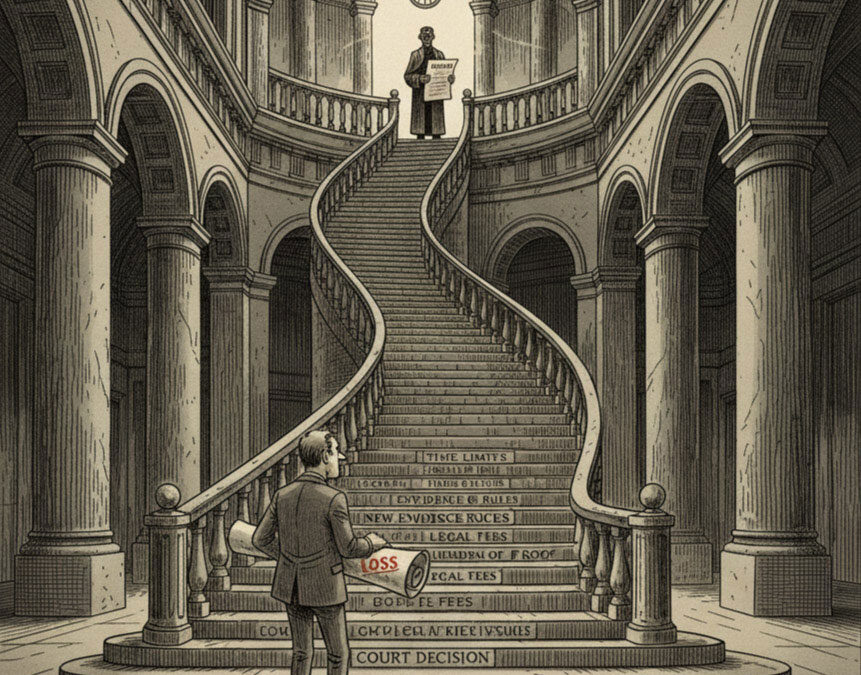
Losing an HOA lawsuit can be frustrating and expensive. But if you think that the trial court got it wrong, and if the issue is important enough to you, then you’ll be glad to hear that just because a trial court issues a final judgment against a homeowner, that decision is not necessarily the end of the road. California law allows homeowners to appeal when they’re not satisfied with a judgment, but only under specific conditions and within strict deadlines.
Appeals are not “do-overs.” The appellate court does not retry the case, hear new witnesses, or consider new evidence. Instead, it reviews the record from the trial court to decide whether the judge applied the law correctly. This Fact Sheet explains when and how appeals work in California HOA cases, the common mistakes to avoid, and why accurate information matters in a space often flooded with misleading “articles” from so-called “experts.”
Key Points
Appeals in HOA lawsuits follow the same California appellate rules that apply to any civil case. The following points summarize how they work and when they are allowed.
- Appeals challenge legal errors, not factual findings. California appellate courts do not re-examine evidence or decide which side’s witnesses were more believable. They review only whether the trial judge misapplied the law or made a procedural error that affected the outcome.
- Only final judgments can be appealed. A “final judgment” is a decision that ends the entire case in the trial court. Interim rulings, such as discovery orders or pre-trial motions, are not immediately appealable (although they may be heard by the appellate court in the form of a Writ, but only if the appellate court wants to hear the Writ).
- Appeals are governed by the California Rules of Court, not the Federal Rules of Civil Procedure. HOA lawsuits in California are state-court matters. They are appealed to the California Court of Appeal, not to any federal court. Despite what you may have read (erroneously) elsewhere, the Federal Rules of Civil Procedure apply only in federal cases, not in California civil appeals.
- The notice of appeal must be filed quickly. Homeowners generally have 60 days from service of the notice of entry of judgment (or 180 days from entry if no notice is served) to file a notice of appeal. Missing that deadline ends the right to appeal regardless of the appeal’s relative merit.
- The appellate process is mostly written. After filing the notice, the appellant prepares a record on appeal and an opening brief explaining the alleged legal errors. The opposing party files a respondent’s brief, and the appellant may reply. Oral argument is optional and limited to clarifying legal issues. No witnesses or new exhibits are allowed.
- Possible outcomes of an appeal. The Court of Appeal can: (1) affirm the judgment, leaving it intact; (2) reverse it; or (3) remand the case back to the trial court for further proceedings (that are not inconsistent with other aspects of the appellate court’s ruling). Reversals are relatively rare.
- Binding arbitration decisions are virtually non-appealable. If the HOA’s governing documents or a pre-trial agreement required binding arbitration, the resulting award can be corrected or vacated only under the narrow grounds listed in Code of Civil Procedure 1286–1286.2 (e.g., fraud, corruption, or the arbitrator exceeding powers). Beyond that, the parties are out of luck. Unlike in the court system, where the right to appeal is exactly that, a right, no such right exists in the case of binding arbitration.
The purpose of the appellate process is to correct errors of law, not to relitigate a case that simply ended badly. Knowing that distinction could save you a tremendous amount of money, time, and stress.
FAQs
What is an appeal in an HOA lawsuit?
An appeal asks a higher California court (the appellate court) to review the trial court’s decision for legal mistakes. Legal mistakes means errors of law, not fact. Appellate courts do not review facts. For example, an appellate court will not second-guess a judge or jury’s assessment of the trustworthiness of a particular witness. Appeals do not involve the introduction of new evidence or witnesses. The Court of Appeal reviews the existing record and written arguments to decide whether the trial judge applied the law correctly.
Can I appeal a decision that came from binding arbitration?
Generally, no. Binding arbitration awards are almost always final and can generally only be overturned for specific statutory reasons contained in Code of Civil Procedure 1286.2 (e.g., fraud or corruption on the part of the arbitrator, or if the arbitrator acted beyond their prescribed powers). Dissatisfaction with the outcome is not grounds for appeal.
How long do I have to file an appeal?
Typically 60 days from the date you were served with the notice of entry of judgment (or 180 days from the date the judgment was entered, whichever comes first) (California Rule of Court, rule 8.104). Timeliness is jurisdictional, which means that if you miss the deadlines, you waive your right to appeal.
Do I get to present new evidence or witnesses on appeal?
No. Appeals rely solely on the written record from the trial court. The appellate court reviews what happened below. It doesn’t re-hear testimony or take new evidence.
What happens if I win my appeal?
The appellate court may reverse the judgment, modify it, or send the case back to the trial court for further proceedings. If reversed, the prevailing party can usually recover their costs on appeal.
Do I need an attorney for an appeal?
It depends on what you mean by “need.” If by “need” you mean to ask whether you’re required to have an attorney, then the answer is no. If, however, you mean whether you should have an attorney, then the answer is an emphatic yes. Appeals are highly technical and complex, and depend on a certain level of mastery of California appellate procedure. Experienced counsel can identify viable issues, preserve deadlines, and avoid procedural dismissal. If you wish to appeal an unfavorable judgment, you can call us at MBK CHAPMAN. We’re experienced appellate attorneys.
Another HOA law firm posted an article on this topic recently, and it talked about things like “the Federal Rules of Civil Procedure,” “tax disputes,” “Medicare health plans,” and “Medicare Advantage.” What do any of those have to do with appealing decisions in HOA lawsuits?
As it so happens, I read the article to which you’re referring, and the answer is absolutely nothing. The article consisted of a shockingly nonsensical collection of loosely related words thrown together and called an “article.” But if you look at that law firm’s other “articles,” you’ll find that most are like that. Repetitive, sloppily written, SEO/keyword dumps. Many are riddled with grammatical errors, needlessly repetitive phrases, blatant misstatements of the law, and citations to irrelevant statutes.
To the substance of your question: none of those things (the Federal Rules of Civil Procedure, Medicare programs, or the IRS Independent Office of Appeals) have anything to do with appealing HOA lawsuits in California. HOA disputes are governed by the California Civil Code, Code of Civil Procedure, and the California Rules of Court. The Federal Rules cited in that other article are inapplicable, as the Federal Rules apply only in federal cases, and federal administrative agencies like Medicare or the IRS have no jurisdiction over HOA litigation. More importantly, I can’t think of a single fact pattern that would involved any of those offices.
The article’s author also inserted irrelevant references to criminal cases, which have nothing to do with civil HOA litigation, and bizarrely conflated receiving an HOA violation notice with receiving a final court judgment—two entirely different things. It also included absolutely meaningless filler phrases such as “the court’s legal principle will guide its final decision.” I don’t even know what those words, in that order, mean.
Then there’s the fact that only about 15–20% of the content even touches on California HOA appeals. Even worse, that “article” misstates fundamental law. For example, the author of that article claims that “appellate courts review both the facts and the legal aspects of a case.” They do not. Appellate courts review legal error (i.e., errors of law), not factual disputes. Suggesting that homeowners can appeal an HOA violation notice is also flatly wrong. Those are internal administrative matters, not judicial judgments.
In short, that “article” reads like someone stitched together random paragraphs from unrelated “appeal” articles to inflate length. It’s a reminder that homeowners should rely on accurate, California-specific information, not recycled filler written for search algorithms.
More importantly, when confronted with “articles” like that one, people searching for HOA attorneys should seriously consider looking elsewhere because if that’s what the law firm is proud to publish under its name, you’re probably wise to assume that the work they perform for you will be just as sloppy, unpolished, and error-riddled.

About Michael Kushner
Michael Kushner is a California attorney with over 30 years of experience representing homeowners in disputes with their HOAs. He is widely regarded as California’s leading homeowner-side HOA attorney, and has built one of the state’s most prominent law practices dedicated to holding HOAs accountable under the Davis-Stirling Act and California law.
In addition to his law firm’s work, Michael is a recognized lecturer, author, and the host of the hit HOA HELL podcast, where he provides homeowners living in HOA-governed communities with clear, practical strategies for dealing with bad HOAs. He’s also the author of the best-selling book, HOA HELL | California Homeowners’ Definitive Guide to Beating Bad HOAs, which has become a go-to resource for both homeowners seeking real-world solutions to their HOA disputes, as well as those good HOA board members who are interested in doing a good job.
About MBK Chapman Fact Sheets
Homeowners searching for answers online will often come across articles that appear authoritative, but are actually written as search-engine marketing content rather than by an experienced HOA lawyer. These pieces tend to prioritize keyword density over clarity, accuracy, or legal context, which often leaves homeowners more confused than informed.
At MBK Chapman, our Fact Sheets are part of our HOA Law Library and are written by Michael Kushner, an HOA lawyer with decades of hands-on experience representing California homeowners. In fact, Michael Kushner is the HOA lawyer who pioneered the systems and strategies used by some of California’s most successful homeowner-side HOA law firms.
Each Fact Sheet is deliberately concise, statute-based, and designed as a quick-reference guide to help homeowners understand key HOA laws and enforcement rules at a glance.
AND DON’T FORGET TO TUNE INTO MY PODCAST, HOA HELL
YOU CAN ALSO ORDER MY GROUNDBREAKING BOOK
HOA HELL | California Homeowners’ Definitive Guide to Beating Bad HOAs
Amazon | Barnes & Noble
